After enjoying the first two Anne of Green Gables books, I decided to try something harder - one of the books that I’ve been thinking of reading for the SEA Reading Challenge. And now that I’ve finished it, I can confidently say that if not for this challenged, I would not have picked up this book or finished it.
The Zenith is a confusing story. As far as I can make out, there are two plot lines. One follows the aging president of Vietnam as he slowly dies in isolation, supposedly loved and respected but really under house arrest, and his relationship with one of his subordinates (who has his own relationship issues). The other follows a family in the Woodcutter’s Hamlet, as the father remarries and brings strife (and lots of gossip to the village).
As it turns out, the patriarch of the family in the woodcutter’s hamlet is the guy who died in the opening of the book. I’m sure that they referenced it somewhere at the start, but I didn’t make the connection until much later.
Looking back, I guess there was some action in the story, but it just felt so long. Everyone seemed inclined to make a speech about politics or sex or sex and politics/marital relationships which dragged the story out. I think that if all the speeches were cut out, the book would be half it’s length and at least twice as interesting.
Although I’m not sure if that would help because the story about the president bored me. The characters were unsympathetic and not very interesting, and it felt like the message of “all ideals will be corrupted by power and politics” was hammered into every speech. In fact, the times where I considered giving up on this book happened mostly during the section about the president and his party officials.
I suppose that if this book was only about the family in the Woodcutter’s Hamlet and without speeches, I would have enjoyed it a lot more. There is, after all, some romance and lots of family drama inside. But as it is, this book felt like a thinly veiled political essay and that isn’t really what I wanted to read
Showing posts with label eastern. Show all posts
Friday, August 17, 2018
Tuesday, July 3, 2018
The SEA is Ours edited by Jaymee Goh and Joyce Chng
Found this in the library and decided to borrow it for the SEA Reading Challenge! Like the title says, this is an anthology of short stories set in Southeast Asia, largely by Southeast Asian authors (from the back it seems like at least half the authors were born and raised in Southeast Asia while the rest have Southeast Asian roots). There are twelve stories in this anthology and they are:
The collection starts with a short introduction that, to be very honest, left me with a bad impression of the book before I started reading (good thing I borrowed the book without reading the introduction). It felt so angry and I didn’t really understand why - as far as I could tell, they were angry at the tropes in steampunk (Victorian England) because of diversity. Not sure how they connect but the anger was palpable.
There are twelve stories in this anthology and they are:
1. On the Consequence of Sound: This was about flying and flying whales! Very cool and I liked how Tagalog was woven into the stories - I was asking Jo Jie Jie about the sentences. It’s a pretty haunting story about ambition and sacrifice and a strong start to the collection.
2. Chasing Volcanoes: Another story set in the Philippines and another really good one! It’s set on an airship and has two strong female characters - the captain and the rebel princess who’s trying to save a village.
3. Ordained: This seems to be a family drama but to be honest, it was too short and I couldn’t grasp the story.
4. The Last Aswang: My brother and I have been talking about aswang with Jo Jie Jie and so I was really excited for this story. Unfortunately, it was a letdown. Perhaps it was the influence of the introduction (I really don’t like activist fiction, it’s not my thing) but this felt like an “our culture is better than the colonial culture” sort of story. Which could be good if done well (the story Devil Wind from Young Warriors is a good example), but in this case, it felt like the author started with a message in mind, which totally did not appeal to me.
5. Life under Glass: This was a short story about hunting rare creatures. I kind of wish it was longer because I didn’t get a chance to connect with the main character.
6. Between Severed Souls: It took me a little while to get into this story about a Filipino Pygmalion in the midst of a civil war but when I did, I thoroughly enjoyed it. The steampunk elements fit in well and I felt like all the characters had their own motivations and hurts, which made them come to life.
7. The Unmaking of Cuadro Amoroso: This was pretty good - three genius students plan and execute their revenge after the fourth in their group dies. Again, it took me a while to understand what was going on but the ending was very satisfying.
8. Working Woman: A steampunk story set in colonial Singapore, with triad lords and half-machine Samsui women. This was definitely one of the strongest stories in the book and one of my favourites because it had plot, it had strong characters, and it was in a world that was strange yet familiar. Would definitely recommend this to people looking for a Singapore steampunk story.
9. Spider Here: Another Singaporean steampunk story but this one wasn’t as strong was Working Woman. The world was intriguing, with the idea of ‘threads’ in living creatures that can be manipulated and a protagonist in a walking chair, but I wasn’t clear about what was happening even by the end of the story.
10. The Chamber of Souls: This was Vietnamese steampunk and one of the stronger stories in the collection. It deals with a group of refugees who are accepted into what seems like paradise - until they’re under attack. Add in a robot whose main purpose is to serve tea and store souls and you’ve got a story that kept me interested until the end.
11. Petrified: Another story taking place on a steamship, this was a fairly enjoyable (but also sad) tale with automatons that can pass for human. It felt like most of the action took place off the page (told to us in a recap) but I liked the concept, start, and ending.
12. The Insects and Women Sing Together: The last story in the collection was, sadly, a weak ending. Like with Ordained and Life Under Glass, I didn’t understand what was going on, even at the end.
Overall, this was a pretty uneven collection. It’s a pity because I am always for tropes being broken in a smart manner, but some of the stories didn’t connect and/or make sense to me. There were some good stories, but I went into this collection expecting an anthology as strong as Track Faults and Other Glitches and sadly, I didn’t find it.
The collection starts with a short introduction that, to be very honest, left me with a bad impression of the book before I started reading (good thing I borrowed the book without reading the introduction). It felt so angry and I didn’t really understand why - as far as I could tell, they were angry at the tropes in steampunk (Victorian England) because of diversity. Not sure how they connect but the anger was palpable.
There are twelve stories in this anthology and they are:
1. On the Consequence of Sound: This was about flying and flying whales! Very cool and I liked how Tagalog was woven into the stories - I was asking Jo Jie Jie about the sentences. It’s a pretty haunting story about ambition and sacrifice and a strong start to the collection.
2. Chasing Volcanoes: Another story set in the Philippines and another really good one! It’s set on an airship and has two strong female characters - the captain and the rebel princess who’s trying to save a village.
3. Ordained: This seems to be a family drama but to be honest, it was too short and I couldn’t grasp the story.
4. The Last Aswang: My brother and I have been talking about aswang with Jo Jie Jie and so I was really excited for this story. Unfortunately, it was a letdown. Perhaps it was the influence of the introduction (I really don’t like activist fiction, it’s not my thing) but this felt like an “our culture is better than the colonial culture” sort of story. Which could be good if done well (the story Devil Wind from Young Warriors is a good example), but in this case, it felt like the author started with a message in mind, which totally did not appeal to me.
5. Life under Glass: This was a short story about hunting rare creatures. I kind of wish it was longer because I didn’t get a chance to connect with the main character.
6. Between Severed Souls: It took me a little while to get into this story about a Filipino Pygmalion in the midst of a civil war but when I did, I thoroughly enjoyed it. The steampunk elements fit in well and I felt like all the characters had their own motivations and hurts, which made them come to life.
7. The Unmaking of Cuadro Amoroso: This was pretty good - three genius students plan and execute their revenge after the fourth in their group dies. Again, it took me a while to understand what was going on but the ending was very satisfying.
8. Working Woman: A steampunk story set in colonial Singapore, with triad lords and half-machine Samsui women. This was definitely one of the strongest stories in the book and one of my favourites because it had plot, it had strong characters, and it was in a world that was strange yet familiar. Would definitely recommend this to people looking for a Singapore steampunk story.
9. Spider Here: Another Singaporean steampunk story but this one wasn’t as strong was Working Woman. The world was intriguing, with the idea of ‘threads’ in living creatures that can be manipulated and a protagonist in a walking chair, but I wasn’t clear about what was happening even by the end of the story.
10. The Chamber of Souls: This was Vietnamese steampunk and one of the stronger stories in the collection. It deals with a group of refugees who are accepted into what seems like paradise - until they’re under attack. Add in a robot whose main purpose is to serve tea and store souls and you’ve got a story that kept me interested until the end.
11. Petrified: Another story taking place on a steamship, this was a fairly enjoyable (but also sad) tale with automatons that can pass for human. It felt like most of the action took place off the page (told to us in a recap) but I liked the concept, start, and ending.
12. The Insects and Women Sing Together: The last story in the collection was, sadly, a weak ending. Like with Ordained and Life Under Glass, I didn’t understand what was going on, even at the end.
Overall, this was a pretty uneven collection. It’s a pity because I am always for tropes being broken in a smart manner, but some of the stories didn’t connect and/or make sense to me. There were some good stories, but I went into this collection expecting an anthology as strong as Track Faults and Other Glitches and sadly, I didn’t find it.
Labels:
eastern
,
fiction
,
SEA reading challenge
,
short story
,
steampunk
Thursday, October 26, 2017
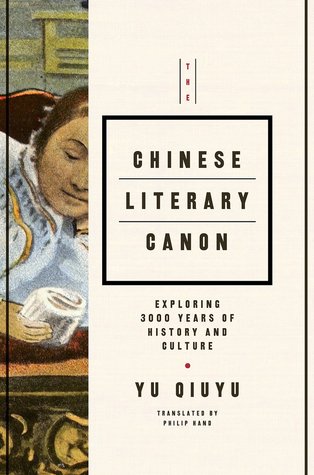
The Chinese Literary Canon by Yu Qiuyu
Every now and then, I feel guilty that I don't know more about Chinese literature (don't ask me why, I just do). But the problem is, I don't know where to start to learn about it. So when I saw this book while browsing through NLB's catalog, I thought it would be a good way to learn about Chinese literature.
To be honest, I almost gave up after the first chapter. The first chapter is the introduction and there were so many names referenced that I got thoroughly lost and thought I would never understand. But I decided to continue reading and the book got much, much better.
The Chinese Literary Canon is basically a series of essays exploring various aspects of Chinese literature in chronological order. The writing is expressive and elegant and it feels like a passionate teacher is standing in front of you, delivering a lecture (an interesting lecture, I should add). This isn't an unbiased account of history, this is one man's summation of his view of Chinese literature and the passion shines through every word.
There is so much of the book that is quotable, which is to say it rings true to me. For example, when talking about myth, the author writes:
I will not pretend that reading this has given me a grasp of the Chinese literary canon. While I feel like I understand more than I did before, large parts of the book still elude me. In the end, I read and let the words flow over me, grabbing what I could and letting go of the rest. I don't know if it's possible, but I would like to learn a bit more about Chinese literature and then reread this book, to see what a second reading would bring.
To be honest, I almost gave up after the first chapter. The first chapter is the introduction and there were so many names referenced that I got thoroughly lost and thought I would never understand. But I decided to continue reading and the book got much, much better.
The Chinese Literary Canon is basically a series of essays exploring various aspects of Chinese literature in chronological order. The writing is expressive and elegant and it feels like a passionate teacher is standing in front of you, delivering a lecture (an interesting lecture, I should add). This isn't an unbiased account of history, this is one man's summation of his view of Chinese literature and the passion shines through every word.
There is so much of the book that is quotable, which is to say it rings true to me. For example, when talking about myth, the author writes:
"Why are myths and legends so often treated with contempt by historians? For one, they do not respect the boundaries of time and space, and because they free our imagination."And when talking about Ruan Ji and his flouting of convention, the author notes that:
"This is a story that we have seen a thousand times throughout history: The prodigal son is often more true to the kernel of meaning than the most well-trained mommy' boy who follows every rule."And when talking about the Tang Dynasty, the author touches on the idea of cultural purity and notes that:
"In truth, excessive purity is like a glass plate. It may be highly polished and crystal bright; but it is still small, thin, fragile. One day, some slight pressure will crack it, and it will cut your fingers.
And in any event, isn't glass a compound? Can it really claim purity?"There was only one chapter that struck me as slightly odd. In the chapter on Chinese archaeology, the author talks about the disruption the fall of the Qing dynasty has on the progress of Chinese archaeology, but completely neglects to talk about the effect of the cultural revolution and World War II. It may be that there is nothing worth talking about, but I found the gap to be odd.
I will not pretend that reading this has given me a grasp of the Chinese literary canon. While I feel like I understand more than I did before, large parts of the book still elude me. In the end, I read and let the words flow over me, grabbing what I could and letting go of the rest. I don't know if it's possible, but I would like to learn a bit more about Chinese literature and then reread this book, to see what a second reading would bring.
Labels:
Chinese
,
eastern
,
literature
Tuesday, October 17, 2017
Tooth and Nail, Fur and Scale by Anupam Arunachalam
I clicked on this book because of the cover and I decided to borrow it because of the blurb. From the blurb, I was under the impression that this book was going to introduce creatures from Indian myths. Since I don't know much about Indian myth and legends, I was super excited to learn more.
Well, I was a little mistaken. Sure, there were quick introductions to the creatures, but this is mainly a short story anthology featuring Indian mythological creatures. Which is just as interesting as a reference book (ok maybe more).
What I really liked about all these stories is that they were set in India with Indian characters. I know it sounds obvious but for some reason, a lot of stories with Japanese mythology tend to star white people (or perhaps those just stick in my mind because I don't like them). So I appreciated that these creatures were shown in the country, culture, and tradition that they actually belonged too.
I liked all the stories but my favourites were:
Last Words, which stars the Crocotta and has courtly intrigue and betrayal in it.
Guardian of the Font, which was mostly cute and a little sad story about how mythological creatures have to adapt to modern times. (Another story, The Great Understanding, also deals with this theme and I enjoyed it a lot too)
Safe Haven, about deadly ants and had a very smart girl as the heroine.
The Writing on the Wall, about a very unique witch and how one boy learns to use her curse against her - this character probably grew up to become a lawyer.
There are a total of 15 stories in this book and you should read all of them. It's available via the NLB ereads site (or it will be once I return it) and I would recommend everyone who enjoys myths and legends to read this.
Well, I was a little mistaken. Sure, there were quick introductions to the creatures, but this is mainly a short story anthology featuring Indian mythological creatures. Which is just as interesting as a reference book (ok maybe more).
What I really liked about all these stories is that they were set in India with Indian characters. I know it sounds obvious but for some reason, a lot of stories with Japanese mythology tend to star white people (or perhaps those just stick in my mind because I don't like them). So I appreciated that these creatures were shown in the country, culture, and tradition that they actually belonged too.
I liked all the stories but my favourites were:
Last Words, which stars the Crocotta and has courtly intrigue and betrayal in it.
Guardian of the Font, which was mostly cute and a little sad story about how mythological creatures have to adapt to modern times. (Another story, The Great Understanding, also deals with this theme and I enjoyed it a lot too)
Safe Haven, about deadly ants and had a very smart girl as the heroine.
The Writing on the Wall, about a very unique witch and how one boy learns to use her curse against her - this character probably grew up to become a lawyer.
There are a total of 15 stories in this book and you should read all of them. It's available via the NLB ereads site (or it will be once I return it) and I would recommend everyone who enjoys myths and legends to read this.
Labels:
eastern
,
fiction
,
mythological
Wednesday, August 23, 2017
In Order to Live by Yeonmi Park
I saw this on @twofronteeth 's Dayre at the end of June and thought it sounded interesting so I added it to my TBR. After over a month, I finally picked it up and it is a really good (though heavy) read.
In Order to Live is a memoir of Yeonmi Park's life in North Korea and China. She was born and raised in North Korea, and for a time being, did fairly well despite her family not being part of the elites anymore.
Her father was very entrepreneurial and he managed to put food on the table. There was even a black market where they could get goods from China and DVDs of South Korean shows! But one day, he was arrested and her family suddenly struggled to survive.
The method Yeonmi and her mother took was to escape to China, which was said to have food and jobs. But even though they risked their lives to get there, China was no paradise. The women found that they would be sold to Chinese men as wives and had to live in the shadows, constantly looking over their shoulder. And yet Yeonmi managed to live on, and she eventually managed to bring her mother to South Korea, where she finally resumed her education and without intending it, ended up as the face of a movement.
This is an incredibly powerful book and I would encourage everyone to read it. North Korea is basically a boogeyman right now and Yeonmi's memoir helps to reveal what life is really like there (and let's face it, even reporters with the best intentions will not be as accurate as someone who actually grew up in North Korea). She is candid about the hardships of life and the brainwashing that goes on, but she also shows the strength that people can have even in the worst situations.
If you've ever wondered what it's like in North Korea, or why people would risk their lives to escape, or even why people haven't risen up against their Dear Leader, you have to read this book. It's not just the story of an incredible person, it's also a peek into how an entire society can be brainwashed and it gives one the hope that people can 'wake up' from the brainwashing. Trust me, you won't regret reading this.
In Order to Live is a memoir of Yeonmi Park's life in North Korea and China. She was born and raised in North Korea, and for a time being, did fairly well despite her family not being part of the elites anymore.
Her father was very entrepreneurial and he managed to put food on the table. There was even a black market where they could get goods from China and DVDs of South Korean shows! But one day, he was arrested and her family suddenly struggled to survive.
The method Yeonmi and her mother took was to escape to China, which was said to have food and jobs. But even though they risked their lives to get there, China was no paradise. The women found that they would be sold to Chinese men as wives and had to live in the shadows, constantly looking over their shoulder. And yet Yeonmi managed to live on, and she eventually managed to bring her mother to South Korea, where she finally resumed her education and without intending it, ended up as the face of a movement.
This is an incredibly powerful book and I would encourage everyone to read it. North Korea is basically a boogeyman right now and Yeonmi's memoir helps to reveal what life is really like there (and let's face it, even reporters with the best intentions will not be as accurate as someone who actually grew up in North Korea). She is candid about the hardships of life and the brainwashing that goes on, but she also shows the strength that people can have even in the worst situations.
If you've ever wondered what it's like in North Korea, or why people would risk their lives to escape, or even why people haven't risen up against their Dear Leader, you have to read this book. It's not just the story of an incredible person, it's also a peek into how an entire society can be brainwashed and it gives one the hope that people can 'wake up' from the brainwashing. Trust me, you won't regret reading this.
Labels:
autobiography/biography
,
eastern
,
non-fiction
Thursday, August 17, 2017
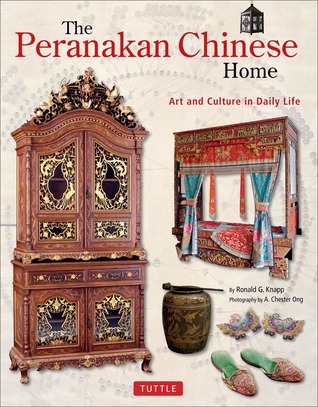
The Peranakan Chinese Home by Ronald G. Knapp
I have no idea why, but I thought this would be one of those simple introductions to an aspect of Peranakan Chinese culture, much like the books by Asiapac. But this turned out to be a more scholarly work that provided a deep inside into the houses of Peranakan Chinese.
If you haven't heard of them, Peranakans refer mainly to people who are the offspring of a local and a foreigner in South East Asia. If you've lived in Singapore a few years back, you might have seen the show "The Little Nonya" which was based on Peranakan culture. In common use (or at least how I always understood it), it most often refers to people who were the offspring of Malay and Chinese parents (often Malay mothers and Chinese fathers). The book also has a whole chapter dedicated to discussing the definition of the term "Peranakan", so it's clear that the most commonly understood definition may not be the most accurate.
And from there, the book goes on to explore in detail the Peranakan house, looking at its form, symbols, the reception hall, the courtyard, the ancestral hall, the living areas, the bedroom, and the kitchen. Every chapter is lavishly illustrated (you'll want either a print copy or an e-reader that can show coloured photographs and not just black and white text for this) which really helped me to understand what the author is talking about.
The pictures in the book draw on Peranakan Chinese homes in Indonesia, Malaysia, Singapore, and Thailand, and has both breadth and depth. It was interesting to see how these houses were similar despite the fact that they were built in different countries and influenced by different cultures.
While the tone is scholarly and a little intimidating, I think that anyone interested in learning about Peranakan culture should read this book. It's very detailed and combined with the pictures, it gave me a more in-depth understanding of Peranakan culture and what it was like.
If you haven't heard of them, Peranakans refer mainly to people who are the offspring of a local and a foreigner in South East Asia. If you've lived in Singapore a few years back, you might have seen the show "The Little Nonya" which was based on Peranakan culture. In common use (or at least how I always understood it), it most often refers to people who were the offspring of Malay and Chinese parents (often Malay mothers and Chinese fathers). The book also has a whole chapter dedicated to discussing the definition of the term "Peranakan", so it's clear that the most commonly understood definition may not be the most accurate.
And from there, the book goes on to explore in detail the Peranakan house, looking at its form, symbols, the reception hall, the courtyard, the ancestral hall, the living areas, the bedroom, and the kitchen. Every chapter is lavishly illustrated (you'll want either a print copy or an e-reader that can show coloured photographs and not just black and white text for this) which really helped me to understand what the author is talking about.
The pictures in the book draw on Peranakan Chinese homes in Indonesia, Malaysia, Singapore, and Thailand, and has both breadth and depth. It was interesting to see how these houses were similar despite the fact that they were built in different countries and influenced by different cultures.
While the tone is scholarly and a little intimidating, I think that anyone interested in learning about Peranakan culture should read this book. It's very detailed and combined with the pictures, it gave me a more in-depth understanding of Peranakan culture and what it was like.
Labels:
eastern
,
non-fiction
Wednesday, April 26, 2017
Last Night I Dreamed of Peace by Dang Thuy Tram
Finally finished another book for the SEAReadingChallenge! This book is from Vietnam and it's the first non-fiction book that I've read for the challenge. Last Night I Dreamed Of Peace is a diary written by a young (27 when she died, only slightly older than me!) Vietnamese doctor as she worked in the front lines during the Vietnam War.I think this is my favourite book of the challenge so far! Dang Thuy Tram is an introspective woman and she writes extremely movingly about what she sees and experiences. It's an extremely good reminder that there are two sides to every story, and that even on the 'wrong' side (Dang Thuy Tram is from North Vietnam), there are people who truly believe in what they're fighting for.
But the thing about the book that occasionally annoyed me (and this is no fault of the translators) is how naive Dang Thuy Tram is. Apart from the fact that she doesn't ever change her view of the communist party or the other side (she comes close in the beginning but seems to double down on her beliefs after), the number of 'pure love' relationships she has is... staggering. I'm pretty sure that some of those guys are in love with her, but she basically denies everything. And while that was fine with me in the beginning, the fact that her mindset never change got a little annoying towards the end of the book. I was expecting her to grow but she didn't.
Still, I managed to suppress these feelings for the most part, and I genuinely enjoyed reading this book. If you want to see another facet of the Vietnam war, you have to pick this up.
Labels:
eastern
,
non-fiction
,
SEA reading challenge
Wednesday, April 5, 2017
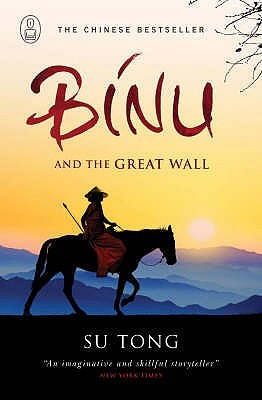
Binu and the Great Wall by Su Tong
Binu and the Great Wall is a retelling of the legend of Meng Jiangnu. If you haven't heard it, her husband was forced to work building the Great Wall of China. When she delivered him winter clothes, she found out that he died and cried so hard that the wall collapsed to reveal his bones. And it occurs to me that famous Chinese love stories don't have happy endings.
I had really high hopes for this because it's a retelling of a Chinese myth by a Chinese author and obviously I'm interested in a modern take on it. Binu and the Great Wall follows the same plot as the myth it inspires (I.e. Binu goes to deliver winter clothes), but there's not enough story in this myth and the book feels much longer than it is.
The good: I thought the world that this is set in was fascinating. Clearly there is magic, with the way Binu cries and the deer boys and the rest. There were lots of interesting elements and though there never was an explanation of the world, reading about it was the most interesting part of the book.
However, the book is let down by a poor plot and absolutely no character growth. The original tale is basically her travelling and most of the book centres on that. It's the perfect way to show an internal journey as well, but Binu stays exactly the same as she was in the start of the book. As a result, things just happen to Binu and she never really engages the reader's attention because she never really takes charge.
To be honest, I'm disappointed in this book. It's got an interesting world and it's based on a famous legend, which should resonate with all Chinese people. However, the execution of this story was poor and despite my best efforts, I found myself disappointed by the story.
I had really high hopes for this because it's a retelling of a Chinese myth by a Chinese author and obviously I'm interested in a modern take on it. Binu and the Great Wall follows the same plot as the myth it inspires (I.e. Binu goes to deliver winter clothes), but there's not enough story in this myth and the book feels much longer than it is.
The good: I thought the world that this is set in was fascinating. Clearly there is magic, with the way Binu cries and the deer boys and the rest. There were lots of interesting elements and though there never was an explanation of the world, reading about it was the most interesting part of the book.
However, the book is let down by a poor plot and absolutely no character growth. The original tale is basically her travelling and most of the book centres on that. It's the perfect way to show an internal journey as well, but Binu stays exactly the same as she was in the start of the book. As a result, things just happen to Binu and she never really engages the reader's attention because she never really takes charge.
To be honest, I'm disappointed in this book. It's got an interesting world and it's based on a famous legend, which should resonate with all Chinese people. However, the execution of this story was poor and despite my best efforts, I found myself disappointed by the story.
Labels:
Chinese
,
eastern
,
fiction
,
mythological
Tuesday, March 14, 2017
Teaser Tuesday - Binu and the Great Wall by Su Tong
It's Tuesday again! My sister is here (yay!) and the day that I start working draws nearer too (ok, I'm a bit worried about this one). I'll have an entrance ceremony for my company this week, so I'm trying to balance preparing for the test that will happen then and bringing my sister around. As you can imagine, that doesn't leave much time for books. I just started Binu and the Great Wall today. It's supposed to be a retelling of Meng Jiang, a legend based on the fact (fact? I remember hearing that as a child) that people were buried in the Great Wall of China.
My teaser:
My teaser:
"At that moment, the boys were plunged into inexplicable terror, from which emerged the certainty that they must stop the woman from shouting. Her shouts were so shrill that they swirled around the forest, just as their mothers' cries had when they were calling their sick children's spirits back from the mountains."What do you think? Would you read this?
How to participate in Teaser Tuesday:
•Grab your current read
• Open to a random page
• Share two (2) “teaser” sentences from somewhere on that page
• BE CAREFUL NOT TO INCLUDE SPOILERS! (make sure that what you share doesn’t give too much away! You don’t want to ruin the book for others!)
• Share the title & author, too, so that other TT participants can add the book to their TBR Lists if they like your teasers! Everyone loves Teaser Tuesday.
Labels:
Chinese
,
eastern
,
fiction
,
teaser tuesday
Friday, March 3, 2017
Ilustrado by Miguel Syjuco
I have finished my second book for the SEA Reading Challenge! Ilustrado is written by Miguel Syjuco, a Pinoy writer. It's got tons of good reviews from prestigious places, and I decided to read it because it sounded interesting - a writer commits suicide and his magnum opus disappears. His friend goes back to the Philippines to find out about him and what happened to the manuscript.
Sounds like an interesting mystery, right?
Well, it was extremely hard work.
The story is told through: blog posts and comments, excerpts from the dead writer's work, excerpts from a biography of the dead writer, narration from the protagonist (first and third person) and probably a few more that I've forgotten. It's a tricky form of narration and unfortunately, it doesn't quite work for me. Apart from the fact that the story was hard to find, everything sounded the same.
There was some good stuff in there - I particularly like the observations about writers living overseas and writing in a language non-native to their country yet receiving acclaim as a representative voice. The frustration (and envy) of the local writers was understandable and I wish this was explored in more detail in the book.
The seedy world of the rich and powerful was also intriguing, though it reminded me of Crazy Rich Asians. I suppose some things don't change.
I didn't quite get the connection between the [SLIGHT SPOILER ALERT] political unrest/riots at the end of the story and the story itself. It seems like there is a connection, but I can't see the point.
If I had read this in IB, I supposed I would have enjoyed the book a little more. The author has clearly put a lot of work into this: the protagonist is named after him, and the start of the book reads like non-fiction, which I think is to blur the lines between fiction and reality. But, I'm in the stage where a book has to be first and foremost entertaining, and any literary message a plus (not impossible: see Fahrenheit 451, To Kill a Mockingbird, and tons of other classics).
Finally, I wonder who this is aimed for. For Filipinos? For the literary elite of the country? Or is it for the literary elite in the West?
Sounds like an interesting mystery, right?
Well, it was extremely hard work.
The story is told through: blog posts and comments, excerpts from the dead writer's work, excerpts from a biography of the dead writer, narration from the protagonist (first and third person) and probably a few more that I've forgotten. It's a tricky form of narration and unfortunately, it doesn't quite work for me. Apart from the fact that the story was hard to find, everything sounded the same.
There was some good stuff in there - I particularly like the observations about writers living overseas and writing in a language non-native to their country yet receiving acclaim as a representative voice. The frustration (and envy) of the local writers was understandable and I wish this was explored in more detail in the book.
The seedy world of the rich and powerful was also intriguing, though it reminded me of Crazy Rich Asians. I suppose some things don't change.
I didn't quite get the connection between the [SLIGHT SPOILER ALERT] political unrest/riots at the end of the story and the story itself. It seems like there is a connection, but I can't see the point.
If I had read this in IB, I supposed I would have enjoyed the book a little more. The author has clearly put a lot of work into this: the protagonist is named after him, and the start of the book reads like non-fiction, which I think is to blur the lines between fiction and reality. But, I'm in the stage where a book has to be first and foremost entertaining, and any literary message a plus (not impossible: see Fahrenheit 451, To Kill a Mockingbird, and tons of other classics).
Finally, I wonder who this is aimed for. For Filipinos? For the literary elite of the country? Or is it for the literary elite in the West?
Labels:
eastern
,
fiction
,
SEA reading challenge
Tuesday, February 28, 2017
Teaser Tuesday - Ilustrado by Miguel Syjuco
Hi everyone! Long time no see :D I had to take a really, really long break when I moved and found out that my internet would come much later than what I was originally told. So I was without wifi for slightly more than a week, but I'm back now and happily reading away.
Right now, I'm reading Ilustrado by Miguel Syjuco, as part of my SEA Reading Challenge, where I'm challenging myself to read more books by and about people in South East Asia. If you've got a recommendation, let me know! So far, Ilustrado is a...challenging read, but I hope it will be rewarding in the end. I mean, the summary sounded good, which is why I'm pressing on.
My teaser:
What about you? What are you reading and how have you been?
Right now, I'm reading Ilustrado by Miguel Syjuco, as part of my SEA Reading Challenge, where I'm challenging myself to read more books by and about people in South East Asia. If you've got a recommendation, let me know! So far, Ilustrado is a...challenging read, but I hope it will be rewarding in the end. I mean, the summary sounded good, which is why I'm pressing on.
My teaser:
"The President's speech yesterday to members of the Combined Military Forces at Fort Bonifacio was disrupted when twenty-six hecklers were arrested and charged with "scandal" and "alarm". They were mauled by crowds as they were brought into the precinct office, though none suffered significant injuries."This is supposed to be from a blogpost. The entire book is basically excerpts from an 'unpublished' work, emails, blogposts, and the occasional conventional narrative. It should be interesting, but it's not make much sense yet (I'm still in the first third of the book, though, so I haven't given up hope yet).
What about you? What are you reading and how have you been?
How to participate in Teaser Tuesday:
•Grab your current read
• Open to a random page
• Share two (2) “teaser” sentences from somewhere on that page
• BE CAREFUL NOT TO INCLUDE SPOILERS! (make sure that what you share doesn’t give too much away! You don’t want to ruin the book for others!)
• Share the title & author, too, so that other TT participants can add the book to their TBR Lists if they like your teasers! Everyone loves Teaser Tuesday.
Labels:
eastern
,
fiction
,
teaser tuesday
Saturday, February 11, 2017
Silence: Movie Review
On January 21, Silence was released in Japan! It's directed by Martin Scorsese and has spent 26 years in the making! As a big fan of the book (to the point where my Extended Essay was a comparison analysis of Silence and The Man Within), I was at the first showing at Hakata's T-Joy theatre on the first day.
The film was amazing and I definitely recommend everyone to watch it (and read the book) once it's out in a theatre near you. So obvious, to try and get you to do that, I'm going to share my thoughts on the film.
Warning: this is going to be all rambly, possibly incoherent and very likely spoiler-ish. You've been warned.
First things first: between Silence the novel and Silence the film, the novel will always win. It has a greater complexity to it (at least for me), and it was what got me interested in Japan. That being said, the movie was fantastic. I've been waiting for this since last March when I heard that it was being filmed. So you can imagine my excitement.
Silence, if you've never heard of it, is a novel by Endo Shusaku, a Japanese who happened to be Catholic. He wrote lots of great novels, but Silence happens to be considered his masterpiece. The story is about two Jesuit priests who have arrived in Nagasaki. It's the Tokugawa era, and Christians are severely persecuted. The two priests have heard rumours that their teacher, Ferreira, has apostatized and came to find out the truth, plus minister to the faithful.
As you can imagine, this is not a happy movie. The scenes of torture are many and varied, and music is largely absent. The atmosphere of the book was carried over pretty well, and I love the movie for that.
So anyway, one of the priests is Rodrigues and it is his story that we follow. He's played by Andrew Garfield, but I managed not to see Spider-Man after five minutes. Rodrigues meets Kichijiro (Yosuke Kubozuka), a complex guy who repeatedly apostatizes and then returns. And if you're interested, Kichijiro was one of the main characters I analysed for my EE. Sorry, forgot to say that I loved this so much I dissected it for my EE. (When I found this was going to be a movie, I emailed my EE teacher immediately)
And I think the book does a better job of exploring this moral dilemma. In the film, it is more obvious (to me, anyway), that these men are making the selfish choice when they commit apostasy. I should note that when I was talking about this film to my friend, she thought that the moral dilemma was very well-conveyed, so it may just be me, because I've been thinking about it ever since I read the book. So anyway, my thoughts:
Despite the protests of love and of the inability for the Japanese to truly understand Christianity (something I don't agree with), it feels to me that these men apostatized for the sake of their minds rather than for others. The scene where Ferreira first meets Rodrigues, and the look of unease when he is called "at peace", shows that this was done for their sakes, not for others.
These are men who have understood the glory and reward of martyrdom but not its suffering. They have remembered the words "suffer unto me" but not the words "I did not come to bring peace, but a sword". In short, they have only a one-sided understanding of Christianity. But that is something a lot of us have, especially with the rise of things like the Prosperity Gospel.
And like Kichijiro says, persecution is trying. In times of ease, it's easy to be a good Christian, but when it's your life on the line, can you do the same?
I do believe Kichijiro when he says that in another time, he would have lived and died a good Christian. In fact, I think the fact that he repeatedly tries to overcome his weak nature shows great courage - something that Rodrigues and Ferreira don't really show.
Plus, even though I was just all "this wasn't as complex as the book", I do realise that there are limitations to what the visual medium can do, even with voiceovers, and I think this is as complex as it could have been.
I heard that Silence is going to be released in Singapore, so please spend some time watching it. It won't be a comfortable film - and I mean for everyone, even Christians - but it is thought-provoking and beautifully shot. I haven't spent much time on that, but really, the film was gorgeous.
And to end, another Endo quote, though it isn't from Silence:
| Also, I discovered Snow! |
Warning: this is going to be all rambly, possibly incoherent and very likely spoiler-ish. You've been warned.
First things first: between Silence the novel and Silence the film, the novel will always win. It has a greater complexity to it (at least for me), and it was what got me interested in Japan. That being said, the movie was fantastic. I've been waiting for this since last March when I heard that it was being filmed. So you can imagine my excitement.
Silence, if you've never heard of it, is a novel by Endo Shusaku, a Japanese who happened to be Catholic. He wrote lots of great novels, but Silence happens to be considered his masterpiece. The story is about two Jesuit priests who have arrived in Nagasaki. It's the Tokugawa era, and Christians are severely persecuted. The two priests have heard rumours that their teacher, Ferreira, has apostatized and came to find out the truth, plus minister to the faithful.
As you can imagine, this is not a happy movie. The scenes of torture are many and varied, and music is largely absent. The atmosphere of the book was carried over pretty well, and I love the movie for that.
So anyway, one of the priests is Rodrigues and it is his story that we follow. He's played by Andrew Garfield, but I managed not to see Spider-Man after five minutes. Rodrigues meets Kichijiro (Yosuke Kubozuka), a complex guy who repeatedly apostatizes and then returns. And if you're interested, Kichijiro was one of the main characters I analysed for my EE. Sorry, forgot to say that I loved this so much I dissected it for my EE. (When I found this was going to be a movie, I emailed my EE teacher immediately)
Christ did not die for the good and beautiful. It is easy enough to die for the good and beautiful; the hard thing is to die for the miserable and corrupt.I'm not doing a very good job of it, but the story explores the themes of faith and love - whether one can apostatise and still be a Christian, and whether it is better to apostatise to save a few or to remain firm and to bring about more martyrs.
And I think the book does a better job of exploring this moral dilemma. In the film, it is more obvious (to me, anyway), that these men are making the selfish choice when they commit apostasy. I should note that when I was talking about this film to my friend, she thought that the moral dilemma was very well-conveyed, so it may just be me, because I've been thinking about it ever since I read the book. So anyway, my thoughts:
Despite the protests of love and of the inability for the Japanese to truly understand Christianity (something I don't agree with), it feels to me that these men apostatized for the sake of their minds rather than for others. The scene where Ferreira first meets Rodrigues, and the look of unease when he is called "at peace", shows that this was done for their sakes, not for others.
These are men who have understood the glory and reward of martyrdom but not its suffering. They have remembered the words "suffer unto me" but not the words "I did not come to bring peace, but a sword". In short, they have only a one-sided understanding of Christianity. But that is something a lot of us have, especially with the rise of things like the Prosperity Gospel.
And like Kichijiro says, persecution is trying. In times of ease, it's easy to be a good Christian, but when it's your life on the line, can you do the same?
I do believe Kichijiro when he says that in another time, he would have lived and died a good Christian. In fact, I think the fact that he repeatedly tries to overcome his weak nature shows great courage - something that Rodrigues and Ferreira don't really show.
"[B]ut our Lord was not silent. Even if he had been silent, my life until this day would have spoken of Him."The ending definitely has more complexity than the middle portion, and I enjoyed the fact that the state of Rodrigue's faith was left unanswered, and invites the reader to draw her own conclusions.
Plus, even though I was just all "this wasn't as complex as the book", I do realise that there are limitations to what the visual medium can do, even with voiceovers, and I think this is as complex as it could have been.
I heard that Silence is going to be released in Singapore, so please spend some time watching it. It won't be a comfortable film - and I mean for everyone, even Christians - but it is thought-provoking and beautifully shot. I haven't spent much time on that, but really, the film was gorgeous.
And to end, another Endo quote, though it isn't from Silence:
True religion should be able to respond to the dark melodies, the faulty and hideous sounds that echo from the heart of men. (From Scandal)Now, I feel like re-reading Silence, Scandal and the other works of Shusaku Endo (and the works that I haven't read before).
Monday, February 6, 2017
Alone by GCM
I wasn't quite sure what I expected from Alone. It's about Yuuta, a boy from Ishikawa who moves to Kyoto for high school. It starts off promisingly, with him making a new friend, but then he gets hits by a car driven by a man named Kurokami.And what is with the strange girl that he sees everywhere?
It was pretty hard to do a summary of this book (as seen by the terrible attempt above) because this book is centered on Yuuta and his state of mind. The plot itself is pretty simple: Yuuta is in a hospital for most of the book. To describe more would be to give the story away.
What I liked about this book was its atmosphere. The sense that something is wrong is very heavy, and the oddness of the things that Yuuta goes through is contrasted with the mundane hospital life where he does nothing but sleep and meet with few visitors. Nothing is what it seems, and I was left wondering how unreliable a narrator Yuuta was.
I can't say that I fully understand the ending of the book, but I have a rough idea. Plus, it was creepy and fit in perfectly with the atmosphere that the entire story had. To be honest, I'm hoping for a sequel which explores this version of Japan a little bit more because I have so many questions that are left unanswered.
Thursday, February 2, 2017
The Soy Sauce Towkay by Alfred Yeo
My mom passed me this book quite some time ago, but I didn't get around to reading it till now. It's a biography of Yeo Thian In, and by extension Yeo Hiap Seng, the company that he founded.The Soy Sauce Towkay focuses on Yeo Thian In (the "towkay" in question) and his Christian faith. And the fact that my Church is mentioned probably explains why my mom knew about this book. And if you're not Singaporean or Malaysian, "towkay" means "boss" in English.
The book is divided into four parts: the background, as in what happened before the company was founded, the founding of the company and how it grew (I didn't know that Yeos started out with Soy Sauce! I only know it for the drink), the Yeo family, and more background, this time on Christianity in China, Chinese business practices, etc. The appendix is a discussion on what makes a business Christian.
And I think in the second part, on the business, they have a chapter about how soy sauce is made, so there's more background there.
I don't know if it's because the book is fairly short, but Yeo Thian In remained a distant historical figure throughout. Unlike some biographies which can resemble novels in style, this read more like a history book.
In addition, I wish that the book went into more detail. For example, it was mentioned that the Yeo family didn't join the Hokkien Association because of religious beliefs, but I would have liked a lot more detail on how that might make doing business more difficult (or not, but it seems like a disadvantage).
That being said, I'm still glad that I read the book, because it's a part of Singapore history that I didn't know, and that I think it's worth knowing. We tend to focus on the same few individuals (like Tan Tock Seng) in our history classes and museums, so it's nice to read about someone else.
Labels:
autobiography/biography
,
Christianity
,
eastern
,
historical
,
non-fiction
,
Singapore
Monday, January 30, 2017
Where Seagulls Fly by Mitta
I have to admit that I am extremely biased about this book. I read the book before it was published, and gave loads of comments, so yeah, not exactly the most impartial reader here.Where Seagulls Fly is a romance set in South Korea. When Su Bin, a doctor-in-training, reluctantly agrees to be acknowledged as her father's heir (and her father is way, way rich), she has no idea what she just entered. Su Bin was raised as a normal person and entering the world of the Chaebols means entering a completely different world. The only person she knows, apart from her father, is Lee Min Jun, the handsome guy that she saved before all this occurred.
Lee Min Jun's, Su Bin's father's right-hand man, just got his heart broken when he caught his fiancee cheating. Suddenly pressed for money (for a family emergency), he agrees to enter into a marriage with Su Bin, in order to try and give her family an heir. Unknown to him, however, Su Bin has been in love with him ever since she saved his life.
What this story has in spades is heart. From the first time I saw it in its raw, unpolished state, I found myself caring about these two characters and wishing that they would hurry up and fall in love, so that they could have their happily ever after. Both Su Bin and Lee Min Jun are fantastic characters, and I was very emotionally invested in their journey (and romance isn't even a genre that I read very often!)
My favourite character, though, is Yeo Bin Joon, one of the Chaebol natives who turns out to be Su Bin's knight in shining armour (even though her heart belongs to another). I really enjoyed all the scenes that he was in, and I hope that he gets his own happily ever after soon.
While the writing still stumbles occasionally (and really, it's very occasionally), the story is absorbing. If you're a sucker for romances and happy endings, you'll like this. And if you're a fan of KDramas, then you definitely have to give this a shot.
Disclaimer: I know the author and got this book while it was a freebie, but my review was voluntarily done.
Thursday, January 26, 2017
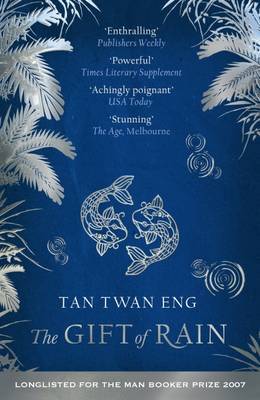
The Gift of Rain by Tan Twan Eng
Finished my first book for the #SEAreadingchallenge . The Gift of Rain is a WWII novel set in Penang, by Malaysian author Tan Twan Eng.
The Gift of Rain follows Phillip Hutton, a Eurasian boy who doesn't feel like he belong. One day, he meets a Japanese named Hayato Endo and begins studying the art of Aikijutsu (Aikido) as well as Japanese culture. However, when WWII comes, Phillip has to make a difficult choice about which choice to support.
I had really high hopes for this, but ended up talking a long time to warm up to the book. In fact, I wanted to stop reading a few times, but decided to continue for the challenge. I have a few complaints about the book, such as:
First, Penang never really comes alive. There is some description, largely in the latter half, but I never felt like I was in Malaysia, unlike when I was reading The Ghost Bride. In fact, I felt the presence of China more strongly than Malaysia, despite the fact that it only has one chapter dedicated to it.
Second, I never felt Phillips exclusion. True, he complained a lot about feeling like he didn't belong, but all I saw was him holding himself apart, rather than society rejecting him.
Finally, the use of non-English words felt very grating. Despite the fact that the book is loosely framed as a reminiscence of the past to a Japanese lady, every time a Japanese word appears for the first time, a translation always follows. If you're telling a story to a Japanese person, I highly doubt you need to translate the Japanese words. Perhaps the author should have chosen a different listener. But really, the translations were unnecessary, because the words were either going to be used enough times that a reader could infer their meaning, or could be omitted entirely.
Luckily, the book got better in the second half, when the Japanese occupied Penang. I thought the moral question that the book brought out was interesting - is it better to work with the enemy and try to save lives, or is it better to resist and risk the killing of innocents? The addition of this dilemma made the second half a lot more enjoyable and way more gripping than the first half. So while the first half felt very slow, the second half sped by.
Overall, this is a decent WWII novel, though I wouldn't read it to get a feel of Malaysia (it feels like it could take place anywhere in Asia). It's got a slow start, but if you're willing to persevere, the second half is much stronger and raises some interesting questions.
The Gift of Rain follows Phillip Hutton, a Eurasian boy who doesn't feel like he belong. One day, he meets a Japanese named Hayato Endo and begins studying the art of Aikijutsu (Aikido) as well as Japanese culture. However, when WWII comes, Phillip has to make a difficult choice about which choice to support.
I had really high hopes for this, but ended up talking a long time to warm up to the book. In fact, I wanted to stop reading a few times, but decided to continue for the challenge. I have a few complaints about the book, such as:
First, Penang never really comes alive. There is some description, largely in the latter half, but I never felt like I was in Malaysia, unlike when I was reading The Ghost Bride. In fact, I felt the presence of China more strongly than Malaysia, despite the fact that it only has one chapter dedicated to it.
Second, I never felt Phillips exclusion. True, he complained a lot about feeling like he didn't belong, but all I saw was him holding himself apart, rather than society rejecting him.
Finally, the use of non-English words felt very grating. Despite the fact that the book is loosely framed as a reminiscence of the past to a Japanese lady, every time a Japanese word appears for the first time, a translation always follows. If you're telling a story to a Japanese person, I highly doubt you need to translate the Japanese words. Perhaps the author should have chosen a different listener. But really, the translations were unnecessary, because the words were either going to be used enough times that a reader could infer their meaning, or could be omitted entirely.
Luckily, the book got better in the second half, when the Japanese occupied Penang. I thought the moral question that the book brought out was interesting - is it better to work with the enemy and try to save lives, or is it better to resist and risk the killing of innocents? The addition of this dilemma made the second half a lot more enjoyable and way more gripping than the first half. So while the first half felt very slow, the second half sped by.
Overall, this is a decent WWII novel, though I wouldn't read it to get a feel of Malaysia (it feels like it could take place anywhere in Asia). It's got a slow start, but if you're willing to persevere, the second half is much stronger and raises some interesting questions.
Labels:
eastern
,
fiction
,
historical
,
Malaysia
,
SEA reading challenge
Friday, December 16, 2016
Sister of My Heart by Chitra Banerjee Divakaruni
I found this book via Wendy @ Literary Feline, when she talked about books she planned to give as gifts. The book sounded amazing and the library has a copy, so why not? I've read Before We Visit the Goddess, which is by the same author, and loved it so I had very high hopes. And luckily this did not disappoint!
Sister of My Heart follows Sudha and Anju, two cousins who are more like sisters. They have an incredibly tight bond, but one day, Sudha discovers something about her past that calls everything she knows about their relationship into doubt. And even though she is madly in love with someone, she agrees to her arranged marriage because it will make Anju happy.
While Anju loves the man her mother has picked for her, she discovers on her wedding day that he has fallen in love with Sudha (who has done absolutely nothing except be beautiful). But she is moving to America with him, and so sort of manages an escape.
And then the rest of the book happens, but I don't want to spoil it for you so let's live it as that.
What I really loved about this book is the language. The language is absolutely beautiful, and so extremely lyrical. It brings you into the mind of Sudha and Anju, and I found that I really sympathised and was rooting for both of them to be able to find their own happiness.
Where the book falters is when it comes to the male characters. With the exception of Singhji, the chauffeur, the male characters never really come to live. I didn't really mind, but it seems like it would be important in the second book.
And yes, there is a second book. I'm sort of hesitant to read it because it promises heartbreak. I might just borrow it (if it's available) and just read the ending or something.
Sister of My Heart follows Sudha and Anju, two cousins who are more like sisters. They have an incredibly tight bond, but one day, Sudha discovers something about her past that calls everything she knows about their relationship into doubt. And even though she is madly in love with someone, she agrees to her arranged marriage because it will make Anju happy.
While Anju loves the man her mother has picked for her, she discovers on her wedding day that he has fallen in love with Sudha (who has done absolutely nothing except be beautiful). But she is moving to America with him, and so sort of manages an escape.
And then the rest of the book happens, but I don't want to spoil it for you so let's live it as that.
What I really loved about this book is the language. The language is absolutely beautiful, and so extremely lyrical. It brings you into the mind of Sudha and Anju, and I found that I really sympathised and was rooting for both of them to be able to find their own happiness.
Where the book falters is when it comes to the male characters. With the exception of Singhji, the chauffeur, the male characters never really come to live. I didn't really mind, but it seems like it would be important in the second book.
And yes, there is a second book. I'm sort of hesitant to read it because it promises heartbreak. I might just borrow it (if it's available) and just read the ending or something.
Thursday, December 15, 2016
The Wall of Storms by Ken Liu
Even though it was extremely addictive (super hard to put down when reading), I'm in two minds as to whether I want to continue the series or not.
The Wall of Storms is the sequel to The Grace of Kings, which I absolutely loved when I read it. But, I also read a volume of Romance of the Three Kingdoms between the two so when I first started this, I was very confused as to what happened in The Grace of Kings because it drew pretty heavily on Chinese history.
But luckily most of the main characters here are new, so I got used to it after a few chapters. The "main characters" from The Grace of Kings are: Kuni Garu and his wives (Jia and Risana), Gin, and Luan. The new characters are: Kuni's kids (Thera, Phyro, Timu and Fara) and Zomi.
To be honest, out of the four kids, only Thera made a strong and positive impression. Fara seemed to be more of a prop, Phyro was unmemorable and I wanted to punch Timu at the end of the book.
But it's a large cast of characters and I suppose I can't expect to love and remember all of them. Oh, and even though I didn't mention their names, plenty of characters from the previous book do appear, they just don't play as big a role.
The Wall of Storms can roughly be divided into two halves: How an Empire keeps its peace and The Foreigners Invade. I liked the first half better, but that's because despite having their history, I couldn't stand the invaders (Lyucu people).
And while I liked how the plot moved for most of the book, there was a series of chapters (that was essentially all flashbacks) during the invasion that I skimmed. I suppose important information might have been there and I might have missed some (hence my inability to sympathise with the invaders), but I wanted to read about how the fighting would turn out, not about the past. I wish those chapters could have been moved somewhere else.
Oh yes, the 'Greek chorus' using the Gods of Dara felt about the same as before. I liked it, especially when they meddled, and I thought their changes based on how the invading people thought about them pretty interesting.
And now for why I'm in two minds about continuing the series. While the writing was gripping, Jia is making me seriously reconsider reading on. I much preferred her to Risana, Kuni's other wife (although I don't think I mentioned it in my first review - just that I liked her) and the path that she is taking is just breaking my heart. I'm quite afraid that her end will not be what I hope for her, which is why I'm considering stopping here.
In a way, I guess I should have listened to myself in my first review (that I checked to refresh my memory about the book) and not have read on, because the ending of the first book was much more hopeful than this one. Plus, even though this isn't really a cliffhanger ending, it's so obviously leading to a third book so it doesn't feel as 'complete' as the first was.
The Wall of Storms is the sequel to The Grace of Kings, which I absolutely loved when I read it. But, I also read a volume of Romance of the Three Kingdoms between the two so when I first started this, I was very confused as to what happened in The Grace of Kings because it drew pretty heavily on Chinese history.
But luckily most of the main characters here are new, so I got used to it after a few chapters. The "main characters" from The Grace of Kings are: Kuni Garu and his wives (Jia and Risana), Gin, and Luan. The new characters are: Kuni's kids (Thera, Phyro, Timu and Fara) and Zomi.
To be honest, out of the four kids, only Thera made a strong and positive impression. Fara seemed to be more of a prop, Phyro was unmemorable and I wanted to punch Timu at the end of the book.
But it's a large cast of characters and I suppose I can't expect to love and remember all of them. Oh, and even though I didn't mention their names, plenty of characters from the previous book do appear, they just don't play as big a role.
The Wall of Storms can roughly be divided into two halves: How an Empire keeps its peace and The Foreigners Invade. I liked the first half better, but that's because despite having their history, I couldn't stand the invaders (Lyucu people).
And while I liked how the plot moved for most of the book, there was a series of chapters (that was essentially all flashbacks) during the invasion that I skimmed. I suppose important information might have been there and I might have missed some (hence my inability to sympathise with the invaders), but I wanted to read about how the fighting would turn out, not about the past. I wish those chapters could have been moved somewhere else.
Oh yes, the 'Greek chorus' using the Gods of Dara felt about the same as before. I liked it, especially when they meddled, and I thought their changes based on how the invading people thought about them pretty interesting.
And now for why I'm in two minds about continuing the series. While the writing was gripping, Jia is making me seriously reconsider reading on. I much preferred her to Risana, Kuni's other wife (although I don't think I mentioned it in my first review - just that I liked her) and the path that she is taking is just breaking my heart. I'm quite afraid that her end will not be what I hope for her, which is why I'm considering stopping here.
In a way, I guess I should have listened to myself in my first review (that I checked to refresh my memory about the book) and not have read on, because the ending of the first book was much more hopeful than this one. Plus, even though this isn't really a cliffhanger ending, it's so obviously leading to a third book so it doesn't feel as 'complete' as the first was.
Thursday, December 8, 2016
The Book of Tea by Kakuzo Okakura
The Book of Tea is what its title says. It's a discussion of the Japanese perspective on tea. It has 7 chapters:
- The Cup of Humanity
- The Schools of Tea
- Taoism and Zennism
- The Tea-room
- Art Appreciation
- Flowers
- Tea-masters.
There's also a mini-biography of the author, which helps explain why he wrote the book.
The author's love of tea comes across very clearly in this book - as does his disdain for the West (although his life seemed to tell a different story). I really enjoyed the whole book and learnt a lot from it. Plus, I really love the language in it, like this passage:
Translation is always a treason, and as a Ming author observes, can at its best be only the reverse side of a brocade - all the threads are there, but not the subtlety of colour or design.
And by the way, this was originally written in English. So you can be sure that you're getting the original, not a translation without subtlety or colour.
If you like tea, you should take a look at this. I borrowed it from the NLB e-reads app, so if you have an account, you can get it straight away (if you don't, you can make one if you're an NLB member).
Labels:
eastern
,
historical
,
japan
,
non-fiction
Tuesday, November 29, 2016
Teaser Tuesday - Sister of My Heart by Chitra Banerjee Divakaruni
This week, I briefly contemplated not doing a Teaser Tuesday. I finished a book on the train, and I was like "should I write a review? Should I do a teaser from a book I already finished?" and was in two minds about the whole thing. Then I saw Wendy's post at Literary Feline and she recommended quite a few amazing sounding books that I've never read (I'm continually reminded that as much as I think I've read, it's still not that much).
I went to the library's ebook app to search for it, and I found two of them! So I borrowed one immediately and favourited the other. And tada, I have something to share. My teaser is from the first two lines of Sister of My Heart by Chitra Banerjee Divakaruni:
"They say in the old tales that the first night after a child is born, the Bidhata Purush comes down to earth himself to decide what its fortune is to be. That is why they bathe babies in sandalwood water and wrap them in soft red malmal, color of luck."
The author's name looked familiar, so I looked her up on Goodreads and I found out that she wrote Before We Visit the Goddess, which I loved. So I have really high hopes for this book!
What about you? What are you reading this week?
Teaser Tuesdays is a weekly bookish meme, hosted by Jenn of Books and a Beat. Anyone can play along! Just do the following:
- Grab your current read
- Open to a random page
- Share two (2) “teaser” sentences from somewhere on that page
- BE CAREFUL NOT TO INCLUDE SPOILERS! (make sure that what you share doesn’t give too much away! You don’t want to ruin the book for others!)
- Share the title & author, too, so that other TT participants can add the book to their TBR Lists if they like your teasers!
Labels:
eastern
,
fiction
,
teaser tuesday
Subscribe to:
Comments
(
Atom
)