Showing posts with label Chinese. Show all posts

Thursday, March 15, 2018

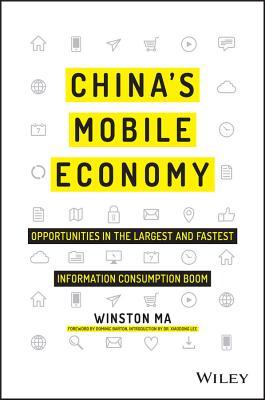
China's Mobile Economy by Winston Ma

Heard about this book from someone on Dayre and it sounded interesting so I decided to borrow it!

China’s Mobile Economy is about the shape of China’s Internet Economy (which is very much shaped by the smartphone). Through ten chapters, the book explores:

- Stakeholders in this mobile economy
- Xiaomi
- Digital retailing
- Entertainment
- The O2O (online to offline) model in the movie business
- The effect of the internet on finance
- Trends, opportunities and challenges of internet and tech companies in China

Within each chapter are columns that explain more about certain cultural terms or norms that may not be immediately obvious to a foreigner.

You don’t have to be an expert on China to read this because the first chapter is on the mobile economy. It will, however, help if you know a little about things like “omnichannels” (which are basically multi-channels but with complete integration).

As you can imagine, this book covers a lot. It’s definitely something to be read a couple of times, because I think it would be very difficult to fully understand everything that this book is talking about on the first read.

Two things mentioned that I thought were interesting were:

- China’s Internet literature: it’s not something I hear a lot, but it seems like the barriers to self-publishing are pretty low and the appetite for serialised, mobile-friendly stories are high. The business model for sites like Shanda Literature is something that Wattpad could learn from (although whether Wattpad’s userbase is open to paying for subscriptions is another matter)

But the fact that online authors exist in great enough number that ranks can be made is very exciting!

- The way the finance industry is being affected. The book specifically mentions WeBank and that it innovates by providing microloans to the public, conducts all operations online, and creditworthiness is analysed by big data.

Personally, I wished for a bit more discussion on the third part because the big data part is very Black Mirror-ish (if you don’t believe me, Wired has a couple of good articles on the issue, including “In China, a three digit score could dictate your place in society”, which has a few not-so-positive first-hand accounts).

Overall, the book is very positive and a good introduction to how China is changing and has been changed by the mobile economy. It doesn’t cover the manufacturing side of things (although it’s arguable related since the infrastructure will play a pretty important role in the future) but I suppose the book would have been far too long if it didn’t have a focus! It’s a bit academic in tone but definitely worth reading if you want to find out what’s going on!

Monday, February 5, 2018

Alibaba's World by Porter Erisman

This was one of the books that I got at the Popular fair last year. I was interested in this because I don’t know much about the Chinese Internet despite black zemi being all about the internet.

Alibaba’s World was written by Porter Erisman, who worked at Alibaba from 2000 to 2008, when it was growing from startup to the juggernaut that it is today. The book focuses mainly on the competition with eBay China and the acquisition of Yahoo! China. At the end, there’s a brief overview of the company and 40 lessons for the reader.

The book is mainly about Alibaba’s history, which was focused mainly on China (they even pulled out their Silicon Valley Office pretty early on), so I think the tagline “how a remarkable Chinese company is changing the face of global business” isn’t very accurate. You won’t really learn the how, although you’ll definitely be able to trace the growth of the company.

What I thought was interesting about my reaction to the book is that I didn’t get the “this company is AMAZING” response that I got when I read biographies of Google (incidentally, Jack Ma met the founders of Google. The meeting did not go well and if you believe this account, it’s Google’s fault). This is despite the fact that the book is highly complimentary towards Jack Ma. While I think that Alibaba’s achievements are amazing, I wasn’t convinced that they’re doing good.

I think part of the reason is because the book doesn’t go much into business ethics (and their stance to counterfeit goods was... standard) and part of the reason is that they don’t seem interested in challenging China’s censorship laws, which I have a pre-existing bias against. Don’t get me wrong, I’m not all in the “all speech should be allowed camp”, but I think that China is way too excessive.

Perhaps this is from the Google meeting, where Jack Ma appeared to be uninterested in getting better search results, unlike the Google People’s (even if they were portrayed as unfriendly).

But I digress.

If you’re interested in learning more about Alibaba, I think this is a good read. It’s not a comprehensive look at the company, but it’s a good, easy to read introduction. And seeing Alibaba’s growing dominance, it may be a good idea to learn more about it.

Thursday, October 26, 2017

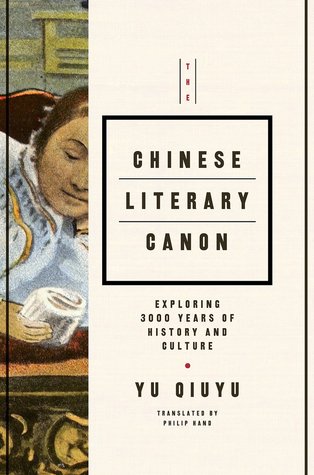
The Chinese Literary Canon by Yu Qiuyu

Every now and then, I feel guilty that I don't know more about Chinese literature (don't ask me why, I just do). But the problem is, I don't know where to start to learn about it. So when I saw this book while browsing through NLB's catalog, I thought it would be a good way to learn about Chinese literature.

To be honest, I almost gave up after the first chapter. The first chapter is the introduction and there were so many names referenced that I got thoroughly lost and thought I would never understand. But I decided to continue reading and the book got much, much better.

The Chinese Literary Canon is basically a series of essays exploring various aspects of Chinese literature in chronological order. The writing is expressive and elegant and it feels like a passionate teacher is standing in front of you, delivering a lecture (an interesting lecture, I should add). This isn't an unbiased account of history, this is one man's summation of his view of Chinese literature and the passion shines through every word.

There is so much of the book that is quotable, which is to say it rings true to me. For example, when talking about myth, the author writes:
"Why are myths and legends so often treated with contempt by historians? For one, they do not respect the boundaries of time and space, and because they free our imagination."
And when talking about Ruan Ji and his flouting of convention, the author notes that:
"This is a story that we have seen a thousand times throughout history: The prodigal son is often more true to the kernel of meaning than the most well-trained mommy' boy who follows every rule."
And when talking about the Tang Dynasty, the author touches on the idea of cultural purity and notes that:
"In truth, excessive purity is like a glass plate. It may be highly polished and crystal bright; but it is still small, thin, fragile. One day, some slight pressure will crack it, and it will cut your fingers. 
And in any event, isn't glass a compound? Can it really claim purity?"
There was only one chapter that struck me as slightly odd. In the chapter on Chinese archaeology, the author talks about the disruption the fall of the Qing dynasty has on the progress of Chinese archaeology, but completely neglects to talk about the effect of the cultural revolution and World War II. It may be that there is nothing worth talking about, but I found the gap to be odd.

I will not pretend that reading this has given me a grasp of the Chinese literary canon. While I feel like I understand more than I did before, large parts of the book still elude me. In the end, I read and let the words flow over me, grabbing what I could and letting go of the rest. I don't know if it's possible, but I would like to learn a bit more about Chinese literature and then reread this book, to see what a second reading would bring.

Wednesday, July 26, 2017

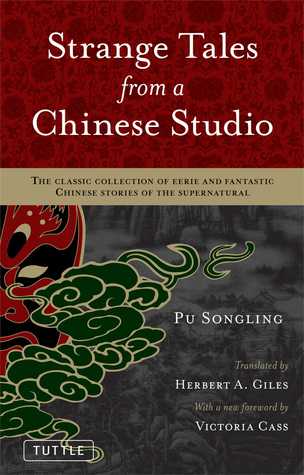
Strange Tales from a Chinese Studio by Pu Songling

This book was recommended to me from the Overdrive app/NLB ebook site, which is the main reason why my TBR is growing uncontrollably the past few days. Given that I've read very little Chinese fairytales/folklore compared to Western and even Japanese tales, I really wanted to read this book.

Strange Tales from a Chinese Studio consists of 164 tales from the 17th Century (I think? Author lived during that time) that involve supernatural creatures/occurrences and 4 appendixes.

The appendixes are about:

1. The Yuli Chao Zhuan (a term that seems to appear only in this book but looks to be about the 'chamber of horrors' in Taoist temples

2. Cultural notes on ancestral worship, bi-location, dreams and much more

3. The translator, Herbert Allen Giles

4. Suggested readings.

There are also pretty comprehensive and interesting footnotes, though sadly the book isn't formatted to allow for easy toggling back and forth (pity, especially since this is an ebook).

As for the tales themselves, quite a few of them were very short and I didn't really get them. I did, however, really enjoy the longer tales, especially those about foxes (maybe because I have been writing about foxes?). Stories that I particularly enjoyed include:

The Painted Skin: about a man who 'rescues' a beautiful girl only to find that she's hiding a very dark secret

Miss Yingning; or, The Laughing Girl: a surprisingly happy story

The Virtuous Daughter-in-Law: where a nagging mother-in-law learns to appreciate her daughter in law in a very painful lesson

Danan in Search of his Father: where a family ended up being "reunited" in a way that completely changed the dynamics for the better.

And more that I forgot to bookmark. And I have no idea if I should be providing full summaries with spoilers or doing these attempts at summaries that don't give away the ending :p

While I generally enjoyed the book, it does have its flaws. It was first published in 1908 by a British national which means that the writing is a little stiff and at times uses very Western expressions like:

"You better call in Yunqi, and tell the fair Eloisa that her Aberlard is awaiting her"

Which feels very out of place given that these are Chinese stories set in China.

Still, if you're looking for Chinese folklore to read, it's worth reading this at least once. Most (if not all) of the tales were new to me and I enjoyed reading through the book.

P.s. There is one thing that I don't get. I'm not sure if it's a translation thing but in these stories, people remarry and concubines are bought and sold pretty easily and I'm wondering if this is so. It seems like the concubinage thing might be so but the remarrying thing seems odd.

Anyone familiar with ancient Chinese customs and can let me know more about this/recommend some reading material about it? I did try Googling but I couldn't find much about it.

Wednesday, April 5, 2017

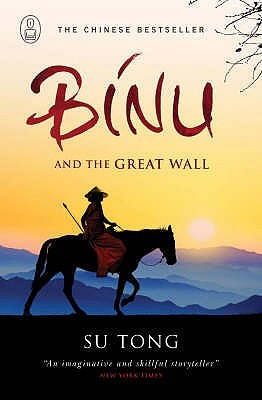
Binu and the Great Wall by Su Tong

Binu and the Great Wall is a retelling of the legend of Meng Jiangnu. If you haven't heard it, her husband was forced to work building the Great Wall of China. When she delivered him winter clothes, she found out that he died and cried so hard that the wall collapsed to reveal his bones. And it occurs to me that famous Chinese love stories don't have happy endings.

I had really high hopes for this because it's a retelling of a Chinese myth by a Chinese author and obviously I'm interested in a modern take on it. Binu and the Great Wall follows the same plot as the myth it inspires (I.e. Binu goes to deliver winter clothes), but there's not enough story in this myth and the book feels much longer than it is.

The good: I thought the world that this is set in was fascinating. Clearly there is magic, with the way Binu cries and the deer boys and the rest. There were lots of interesting elements and though there never was an explanation of the world, reading about it was the most interesting part of the book.

However, the book is let down by a poor plot and absolutely no character growth. The original tale is basically her travelling and most of the book centres on that. It's the perfect way to show an internal journey as well, but Binu stays exactly the same as she was in the start of the book. As a result, things just happen to Binu and she never really engages the reader's attention because she never really takes charge.

To be honest, I'm disappointed in this book. It's got an interesting world and it's based on a famous legend, which should resonate with all Chinese people. However, the execution of this story was poor and despite my best efforts, I found myself disappointed by the story.

Tuesday, March 14, 2017

Teaser Tuesday - Binu and the Great Wall by Su Tong

It's Tuesday again! My sister is here (yay!) and the day that I start working draws nearer too (ok, I'm a bit worried about this one). I'll have an entrance ceremony for my company this week, so I'm trying to balance preparing for the test that will happen then and bringing my sister around. As you can imagine, that doesn't leave much time for books. I just started Binu and the Great Wall today. It's supposed to be a retelling of Meng Jiang, a legend based on the fact (fact? I remember hearing that as a child) that people were buried in the Great Wall of China.

My teaser:
"At that moment, the boys were plunged into inexplicable terror, from which emerged the certainty that they must stop the woman from shouting. Her shouts were so shrill that they swirled around the forest, just as their mothers' cries had when they were calling their sick children's spirits back from the mountains."
What do you think? Would you read this?
How to participate in Teaser Tuesday: 
•Grab your current read 
• Open to a random page 
• Share two (2) “teaser” sentences from somewhere on that page 
• BE CAREFUL NOT TO INCLUDE SPOILERS! (make sure that what you share doesn’t give too much away! You don’t want to ruin the book for others!) 
• Share the title & author, too, so that other TT participants can add the book to their TBR Lists if they like your teasers! Everyone loves Teaser Tuesday.

Monday, November 14, 2016

Invisible Planets Translated and Edited by Ken Liu

If you read fantasy/steampunk, you may have heard of The Grace of Kings. If you read sci-fi, you may know The Three Body Problem. Ken Liu is related to both these works - he is the author of the former and the translator of the latter. So when I heard that he has translated and edited a collection of Chinese Sci-Fi, I knew I had to read it.

The anthology had stories from Chen Qiufan, Xia Jia, Ma Boyong, Hao Jingfang (who contributed the story that gives the collection its name), Tang Fei, Cheng Jingbo and the man of the hour, Liu Cixin. The authors, while all writing Sci-Fi, all have write in the different subgenres, which makes this a pleasure to read.

I'm not going to review each story individually, but I will say that if you're read The Three Body Problem, Liu Cixin's The Circle will feel familiar to you.

My favourite story has got to be A Hundred Ghosts Parade Tonight, which is about robots, ghosts and even talks about tourism! Actually, I think Xia Jia (the author of this story) is my favourite author of them all because I enjoyed all three stories that were contributed.

Liu Cixin's stuff was good too, though that may be because I already have a very good impression of him. But in general, all the authors wrote enjoyable stories (though I didn't completely understand a few of them).

At the end of the collection, there are three essays: "The world of all possible universes and the best of all possible earths: Three Body and Chinese Science Fiction", "The Torn Generation: Chinese Science Fiction in a Culture of Transition" and "What makes Chinese Science Fiction Chinese?" All three are pretty interesting and definitely worth reading too.

The only part of the book I didn't really agree with was the request not to view the works through Western lens. While I think it's an interesting exercise if the reader wants to, Reader-Response Criticism is a valid way of reading texts. And in its most extreme form (if I'm remembering correctly), the author's intentions don't even factor into the interpretation. I'm all for reading stories the way you want to read them, so asking people to avoid a particular way of reading isn't really something I can get behind. Basically, if you want to read and digest it naturally, go ahead. If you want to try and read without preconceived notions, then go ahead and do that.

Plus, if you have a story about censorship that was censored to pass the Chinese censors, I think it's not a wild/extremely unorthodox thing to read it as being about the censorship by the Chinese government.

If you're looking to widen your reading horizon but still want to stick to the English language, definitely get this collection. It's a good look (though as Ken Liu admits, not comprehensive) at Chinese Sci-Fi.

Disclaimer: I got a free copy of this book from the publisher via NetGalley in exchange for a free and honest review.

Monday, August 29, 2016

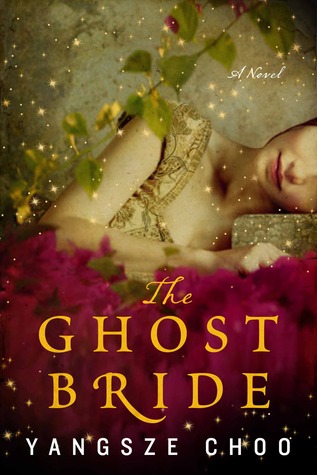
The Ghost Bride by Yangsze Choo

In Chinese culture, it's believed that the seventh lunar month (the seventh month in the Chinese calendar) is when the gates of hell open and the dead can come back to the world. It's a month where the smell of incense is thick (and the haze makes it worse). If you're not a fan of all this smoke and ashes, you may wish for the Japanese Obon, which is similar but only lasts for about a week. At any rate, it's the seventh month now, and I decided to read The Ghost Bride.

Anyway, The Ghost Bride is a fantasy novel set in Malacca, back when it was still a British colony. Li Lan is the beautiful protagonist, and the story starts when her father asks her if she'd like to be the bride in a ghost marriage.

Her family's quite poor, but the groom's side is rich, so if she marries him, she'll live in comfort. But the prospective groom visits her in her dreams (bad decision on her part) and he is so repulsive of course she won't want to marry him. Instead, she prefers his cousin, who was originally her intended.

And because the story is complicated, this isn't even the main plot.

The bulk of the book features Li Lan after she accidentally left her body and meets Er Lang. He enlists her help in finding out information from her prospective ghost groom, and we get to see what the spirit world is like.

While it's quite complicated to follow, I didn't have any problems with the plot, probably because I have years of Chinese dramas behind me. I thought it was pretty well-paced, and I never grew bored with the story.

I really liked the descriptiveness, although it went a bit overboard sometimes. Although I could believe the idea that Li Lan didn't really know about the spirits because of her father being a strict Confucianist, I didn't get why she had to explain every single little bit of life, including translating the word 'baju' into English. I can only assume it's for the ang moh's, or perhaps the author is illustrating the hold our ex-colonial masters still have on us.

Oh, and even though relationships (and romance) is one of the pillars of this book, I wasn't annoyed by it at all, which is a first for me. I mean, there are three guys that Li Lan gets involved in and they are:

- the Ghost Groom: Odious so whatever
- Tian Bai (Ghost Groom's cousin): Li Lan gets a crush on him because who wouldn't when their intended is so repulsive
- Er Lang: the mysterious dude that helps Li Lan. They bicker a lot, but I genuinely like how their relationship develops.

So to me, it's not a love rectangle because two of the three guys aren't even serious candidates. Which really helps because I am not a fan of love triangles or shapes of any kind.

If you're looking for a lyrical, absorbing fantasy book set close to home, you should definitely pick this up.

Monday, July 11, 2016

Murder in Ancient China: Two Judge Dee Mysteries, Translated by Robert Van Gulik

I haven't read Judge Dee before, so I was quite happy to find two of his stories released as an ebook. And since they're short, I thought I'd just review each individual story:

The Murder on the Lotus Pond

First line for The Murder on the Lotus Pond:

"From the small pavilion in the centre of the lotus pond he could survey the entire garden, bathed in moonlight. "

I should say before I start that I don't have any experience with Chinese mysteries. Apart from the TVB dramas "A Pillowcase of Mystery" and "Xi Yuan Lu", I have no idea what ancient China was like and how they solved crimes back then.

The first story was definitely interesting, and more like a Western mystery than I expected. It's got a twist, a almost super-sleuth, a beautiful young woman, etc. I guess some things really do transcend culture.

I thought Mrs. Meng was an interesting character - even though she's not the main character (not even close to it), she's essentially the hooker with a heart of gold character, and I would have liked to see more of her.

Murder on New Year's Eve

First line of Murder on New Year's Eve:

"When Judge Dee had put away the last file and locked the drawer of his desk he suddenly shivered."

Just finished the second story, and it's really very charming. I won't give the ending away, but I had a smile on my face at the end of it.

Oh, and the start, where they mention his three wives really reminded me of Xi Yuan Lu - specifically the ending of the first season, where Song Ci ends up with his two wives. And that's all I wanted to say - that I was reminded of it.

This story starts with what looks like a murder, and the lonely Judge Dee goes and investigates right away. And then... One thing leads to another hahaha. Really can't say without giving it away.

By the way, you really shouldn't read the starting note for this, because it does give the twist away. Or at least, that's what I thought when I read it after the story (didn't read it before).

Oh, and I realise that I'm really not used to how they transliterated the Chinese here haha. It's quite different from the hanyu pinyin that I'm used too.

That said, I would totally read more of Judge Dee. These stories are short and satisfying, and I would like to see if by reading more, certain characters would be more fleshed out.

Friday, June 24, 2016

Romance of the Three Kingdoms by Luo Guanzhong

I'm actually a bit ashamed to say that I've never read The Romance of the Three Kingdoms until now. All I know about the story are the excerpts from Chinese class/Chinese tuition, and stuff from dramas. So clearly this is something that has to be remedied. However, my Chinese isn't the best, so I opted to read a translation.

The story is too complicated to describe. Basically, a bunch of people scheme and fight and betray one another in order to gain power. Of course, there are a few characters who, through either sheer luck or ruthlessness, manage to remain in the story. For me, the two that come to mind are Cao Cao and Liu Bei plus his sworn brothers.

Oh, and for some reason, I've always had this Cao Cao = bad and Liu Bei = good association in my mind.

This is mostly true (Cao Cao does some really horrific things, while Liu Bei... Not so much), but the characters are more nuanced than that. Occasionally, Cao Cao acts like a decent human being. Of course, this normally occurs after his 'enemy' has been put to death and only when it suits him.

Liu Bei reminds me of the Mulan song, where you need to bend like bamboo in the wind. He really does bend here and there. But he's a good guy at heart.

Which is more than most of the other characters. I really think that he and his sworn brothers are the most loyal characters there (and have the most 'righteous' personalities). Everyone else... likes to listen to what suits them. But I guess that's human nature.

Oh, and the most pitiful character is definitely the emperor and his family. They're basically puppets of the prime minister, which reminds me a lot of the emperor and the Shogun in Japan (though this comes first, I think)

I'd totally read on. But before I pick up the second volume, I have quite a few other books on my TBR list. And I guess when I've finished this, I should go on to the Red Chambers (can't remember full title) and other classics.