Showing posts with label japan. Show all posts

Monday, July 23, 2018

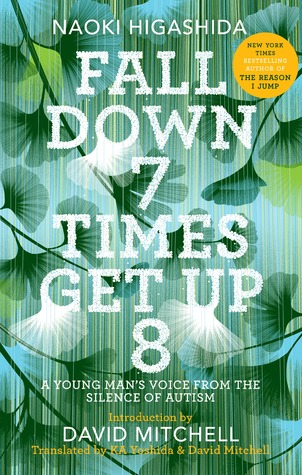
Fall Down 7 Times Get Up 8 by Naoki Higashida

Someone from Church lent me this and it is so good! Written by the same author of The Reason I Jump (which I haven’t read but really want to now), this book contains the thoughts of a young man who happens to be severely autistic.

Naoki Higashida writes using an alphabet grid, without anyone else’s hand touching his, so you can be sure that the words in this book really did come out of his mind. And when you look at the subjects he muses about, his poetry, and his short story, it’s clear that he has an extra-ordinary mind.

In this books, he talks about his struggles to learn and communicate, as well as encourage all neurotypical people not to give up on people with autism, because they do want to live their best life and they can pick up our emotions. If this wasn’t a library book, I would have highlighted so many quotes, such as:
"On the surface, a sheltered life spent on your favourite activities might look like paradise but I believe that unless you come into contact with some of the hardships other people endure, your own personal development will be impaired."
And I probably would have bookmarked all his poetry. I’m normally not a poetry type of person, but I find that his poems inspire and uplift, even when they look on the slightly more unpleasant side of life. Two that I particularly liked are Rumours and Words - look out for them if you're reading the book!

I would totally recommend this book! It’s a moving and uplifting insight into a person that we might not even think we can communicate with. The beauty of his words show that there is deep potential within everyone, and that we should not be so quick to write off people as unable to contribute to society.

Definitely read this if you have the chance!

Wednesday, February 28, 2018

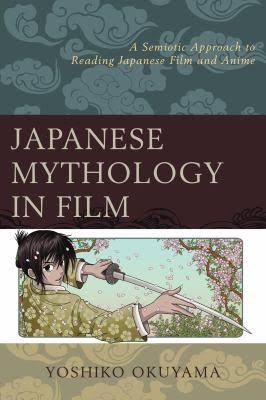
Japanese Mythology in Film by Yoshiko Okuyama

I had to borrow this book as soon as I saw it because I took a class on Miyazaki Hayao’s films. That’s a very tenuous connection but I’m clinging on to it all the same.

Japanese Mythology in Film is an introduction to the study of Japanese culture through movies (both live action and anime). The author argues that semiotics can be used to uncover signs of Japanese mythology which in turn can be used to develop cultural or visual literacy.

First, a few definitions:

Semiotics is “the study of a system of signs to determine how symbolic meanings are created and transmitted through use of words, concepts, images, and so forth.” In other words, studying the meaningful words and pictures in the movie (at least in my understanding).

Mythology in this book is defined as “the stories and allegories of deities and humans, the afterlife, and natural phenomena and supernatural forces as well as to other myths and legends of the mainstream and folk religions of Japan.” So basically religious Japanese culture.

After explaining what semiotics is in detail and why it’s a valid way of analysing film, as well as the presence of mythology in film, the book goes on to analyse the following topics:

- Taoism and Shintoism in Onmyoji and Onmyoji II

- Folklore motifs in Spirited Away and Princess Mononoke (Obviously this was my favourite chapter)

- Buddhist and Folklore motifs in Dorito and Departures

- Eclectic myths in Mushi-Shi and Cyber mythology of Ghost in the Shell 2: Innocence

I’m only familiar with Miyazaki’s movies and I’ve watched a few episodes of Mushi-shi, but the book does a great job of summarising the movies so that I can understand the analysis (and it made me want to watch everything mentioned).

If I start to go into detail about what I learnt, I’d just end up summarising the whole book. Perhaps it’s because of the breadth of the work, but I felt that this book taught me more about Japanese mythology and culture than the Miyazaki module.

Because this book is aimed at undergraduates, the tone is academic. However, it is definitely not inaccessible and I would recommend this to anyone interested in Japan, myths, and/or cinema.

Tuesday, November 21, 2017

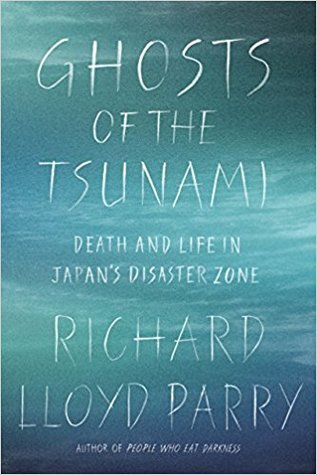
Ghosts of the Tsunami by Richard Llyod Parry

This is another NetGalley book, one that I wished for and was granted to me. I'm thankful that I got to read this because it's a heartbreaking account of the effect of the March 11th tsunami. Instead of trying to show all the destruction, Ghosts of the Tsunami focuses on Okawa Elementary School, where a series of heartbreakingly wrong decisions led to the deaths of 74 out 78 students and 10 out of 11 teachers.

Desperate for some answers and frustrated by the actions of the school and the principal, a group of parents took the brave step of bringing things to court. But this is not a legal drama. The book takes an intimate look at the lives of all those involved by talking to survivors and relatives of victims to build an account of what happened and what happened after, including the court case.

There are many heartbreaking moments in this book, such as a grandfather unable to recognise the body of his granddaughter, whom he lifted out of the mid, because of the state she was in.

Or the words of this mother:
"We used to think that we were bringing up our children," said Sayomi Shinto. "But then we discovered that it was we, the parents, who were brought up by them. We thought that the children were the weakest among us, and that we protected them. But they were the keystone. All the other pieces depended on them. When they were taken away, we realised this for the first time. We thought that we were looking after them. But it was the children who supported us."
And by making sure the book isn't too narrowly focused on the court case, instead following the lives of the parents and one of the surviving children, Richard Lloyd Parry managed to convey how the community of Tohoku reacted. For example, the way the community divided into two regarding what to do with the school - preserve it or not - reflected how they chose to deal with grief; whether they wanted to face it and talk about it or to hide it away.

There was only one moment in the book that made me double take. Someone was talking about the size of the tsunami and the words "twenty feet" was quoted. I suppose that this is to make things easier for Americans to understand, despite the fact that all but three countries in the world use the metric system, but I didn't like it. If you're quoting someone, I would prefer that the translation be as accurate as possible, and yes, meters to feet is a small change but if I doubt the small things, then I might end up doubting the important things too.

Overall, though, this was a fantastic book and one of the most powerful things that I've read this year. If you're going to read one book on the 3/11 Tsunami, this is it. By the way, if you want a sneak pic, the Guardian has a good excerpt that you should read.

Disclaimer: I got a free copy of this book from the publisher via NetGalley in exchange for a free and honest review.

Saturday, October 14, 2017

Some Photos from Okinawa

As you may know, I've been on a holiday in Okinawa. While I'm still going through the photos that I took using my camera, I thought I'd share a few photos that I grabbed with my phone (yes, I definitely took too many photos):


Manzamo Cape


Taking a break at a cafe - The photo looks odd because the food was originally very dark and this was my best attempt to lighten it.


My sis and I at the beach.


Photo of said beach - I am in love with the beaches at Okinawa! The water is so clear!


One of the whale sharks at Churaumi aquarium - The aquarium was really cool and it's definitely a must-visit if you're ever in Okinawa! It is a little crowded though.


This photo was taken at Shuri Castle - also another must-visit spot. Do try the tea set (310 yen for sanpin tea + 4 types of sweets!)


At the entrance of Gyokusendo caves. It's part of a larger attraction called Okinawa World so if you ever want to explore caves, experience Okinawan culture and see some snakes, this is the place to go (we did not go see the snakes because I am not a fan).


My sister and I in Okinawan kimonos! We got this taken at Okinawa world as well!

I'll be blogging about the trip in detail at my other blog once the photos are ready, so feel free to check it out.

I also got quite a bit of reading done on the trip, so the reviews will be appearing here soon!

Friday, June 30, 2017

Foreign Studies by Shusaku Endo

Foreign Studies is actually a collection of two short stories and one novel, but all of them deal with the topic of studying abroad (specifically, in France). And since it's Endo, I picked it up as soon as I saw it.

The first story is 'A Summer in Roan' and is about a Japanese student in the village of Roan. Though everyone is kind, he feels like he doesn't belong and the longer he stays, the more he feels like a coward for remaining polite and in the village.

The second story, 'Araki Thomas', has a more factual tone and talks about one of the Japanese students who went abroad in the 17th century and came back to a closed country and persecution to Christians. This is the same period that Silence takes place in, but the protagonist is a Japanese rather than a foreigner. The factual tone makes me wonder if it's a mini-biography but I haven't done any research so I can't tell.

The third and longest story (probably can be classified as a novel) is 'And You, Too'. It follows the path of Tanaka, who came to Paris to study Sade. It's more complicated than the other two, since there is a Japanese community in Paris, so Tanaka must negotiate both a foreign culture and a culture that is home-but-not-quite and which will influence his standing when he returns home.

All three stories are rather bleak and they convey a sense of discontent and distance. In the introduction by Endo (which really should be read only after you've finished the stories), he mentions that this book arose out of his struggle in trying to reconcile two seemingly different cultures.

What is interesting is how his views have changed. His younger self thought that there was no way that Japanese people could understand French culture and vice versa, but twenty years later, he became "convinced that meaningful communication between East and West is possible."

I feel that the sense of alienation that Endo describes in this story is universal to anyone who has lived overseas. We are in a totally different country after all. But, I think his characters have chosen to look at the differences with bitterness, and that leads them to a state of mental anguish. Personally, I think that to see insights, to see slights and 'microagressions' and to read malicious meanings into perfectly kind actions is the road to an unhappy life.

I would recommend this book to anyone, especially those who have lived overseas for any period of time.

Friday, May 19, 2017

Penance by Kanae Minato

I found this book on Netgalley and couldn't resist requesting it. It is a good read, but I can't quite decide which genre it belongs to.

Penance is ostensibly a mystery. Five children are playing at school when one of them ends up dead after a mysterious man takes her away. The four of them swear that they can't remember what the man looks like and Emily, the dead girl's mother, curses them to either help solve the murder or do a penance.

That said, the book isn't so much about who killed Emily but what happened to Sae, Akiko, Mae, and Yuko as the deadline for the statute of limitations draw closer. Each of them is affected by the murder in a different way, but they are all driven to tragic ends. There is a clue from each of the girls, but the denouement is more about Emily's mother than the murderer.

I guess that if I had to sum up the book, it would be that it's more about the emotions that drive people to murder and the ripple effect that it causes.

Each girl gets her own story, and it's not until the later half that things start to come together. But I was really captivated from the start, because of how the relationships were written. They're sad and oddly fascinating.

For example (please ignore this if you don't want spoilers, though I will try to avoid the biggest one): Sae feels that the murderer chose Emily as his victim because she had already started menstruating and was thus a woman. The stress from this causes her not to menstruate at all. Despite this, she manages to get married, only to find out that her husband proposed only because she looks like the doll he was fascinated with and he's thrilled to have a real life doll now.

This book is dark and twisted and it's absolutely captivating. It's not a very long read but it manages to pack a punch. I wasn't able to put it down, which explains why I have a book review 2 days after the previous one. If you're in the mood for something dark and definitely not-cheery, you need to read this.

Disclaimer: I got a free copy of this book from the publisher via NetGalley in exchange for a free and honest review.

Saturday, February 11, 2017

Silence: Movie Review

On January 21, Silence was released in Japan! It's directed by Martin Scorsese and has spent 26 years in the making! As a big fan of the book (to the point where my Extended Essay was a comparison analysis of Silence and The Man Within), I was at the first showing at Hakata's T-Joy theatre on the first day.

Also, I discovered Snow! 
The film was amazing and I definitely recommend everyone to watch it (and read the book) once it's out in a theatre near you. So obvious, to try and get you to do that, I'm going to share my thoughts on the film.

Warning: this is going to be all rambly, possibly incoherent and very likely spoiler-ish. You've been warned.

First things first: between Silence the novel and Silence the film, the novel will always win. It has a greater complexity to it (at least for me), and it was what got me interested in Japan. That being said, the movie was fantastic. I've been waiting for this since last March when I heard that it was being filmed. So you can imagine my excitement.

Silence, if you've never heard of it, is a novel by Endo Shusaku, a Japanese who happened to be Catholic. He wrote lots of great novels, but Silence happens to be considered his masterpiece. The story is about two Jesuit priests who have arrived in Nagasaki. It's the Tokugawa era, and Christians are severely persecuted. The two priests have heard rumours that their teacher, Ferreira, has apostatized and came to find out the truth, plus minister to the faithful.

As you can imagine, this is not a happy movie. The scenes of torture are many and varied, and music is largely absent. The atmosphere of the book was carried over pretty well, and I love the movie for that.

So anyway, one of the priests is Rodrigues and it is his story that we follow. He's played by Andrew Garfield, but I managed not to see Spider-Man after five minutes. Rodrigues meets Kichijiro (Yosuke Kubozuka), a complex guy who repeatedly apostatizes and then returns. And if you're interested, Kichijiro was one of the main characters I analysed for my EE. Sorry, forgot to say that I loved this so much I dissected it for my EE. (When I found this was going to be a movie, I emailed my EE teacher immediately)
Christ did not die for the good and beautiful. It is easy enough to die for the good and beautiful; the hard thing is to die for the miserable and corrupt.
I'm not doing a very good job of it, but the story explores the themes of faith and love - whether one can apostatise and still be a Christian, and whether it is better to apostatise to save a few or to remain firm and to bring about more martyrs.

And I think the book does a better job of exploring this moral dilemma. In the film, it is more obvious (to me, anyway), that these men are making the selfish choice when they commit apostasy. I should note that when I was talking about this film to my friend, she thought that the moral dilemma was very well-conveyed, so it may just be me, because I've been thinking about it ever since I read the book. So anyway, my thoughts:

Despite the protests of love and of the inability for the Japanese to truly understand Christianity (something I don't agree with), it feels to me that these men apostatized for the sake of their minds rather than for others. The scene where Ferreira first meets Rodrigues, and the look of unease when he is called "at peace", shows that this was done for their sakes, not for others.

These are men who have understood the glory and reward of martyrdom but not its suffering. They have remembered the words "suffer unto me" but not the words "I did not come to bring peace, but a sword". In short, they have only a one-sided understanding of Christianity. But that is something a lot of us have, especially with the rise of things like the Prosperity Gospel.

And like Kichijiro says, persecution is trying. In times of ease, it's easy to be a good Christian, but when it's your life on the line, can you do the same?

I do believe Kichijiro when he says that in another time, he would have lived and died a good Christian. In fact, I think the fact that he repeatedly tries to overcome his weak nature shows great courage - something that Rodrigues and Ferreira don't really show.
"[B]ut our Lord was not silent. Even if he had been silent, my life until this day would have spoken of Him."
The ending definitely has more complexity than the middle portion, and I enjoyed the fact that the state of Rodrigue's faith was left unanswered, and invites the reader to draw her own conclusions.

Plus, even though I was just all "this wasn't as complex as the book", I do realise that there are limitations to what the visual medium can do, even with voiceovers, and I think this is as complex as it could have been.

I heard that Silence is going to be released in Singapore, so please spend some time watching it. It won't be a comfortable film - and I mean for everyone, even Christians - but it is thought-provoking and beautifully shot. I haven't spent much time on that, but really, the film was gorgeous.


And to end, another Endo quote, though it isn't from Silence:
True religion should be able to respond to the dark melodies, the faulty and hideous sounds that echo from the heart of men. (From Scandal)
Now, I feel like re-reading Silence, Scandal and the other works of Shusaku Endo (and the works that I haven't read before).

Monday, February 6, 2017

Alone by GCM

I wasn't quite sure what I expected from Alone. It's about Yuuta, a boy from Ishikawa who moves to Kyoto for high school. It starts off promisingly, with him making a new friend, but then he gets hits by a car driven by a man named Kurokami.

And what is with the strange girl that he sees everywhere?

It was pretty hard to do a summary of this book (as seen by the terrible attempt above) because this book is centered on Yuuta and his state of mind. The plot itself is pretty simple: Yuuta is in a hospital for most of the book. To describe more would be to give the story away.

What I liked about this book was its atmosphere. The sense that something is wrong is very heavy, and the oddness of the things that Yuuta goes through is contrasted with the mundane hospital life where he does nothing but sleep and meet with few visitors. Nothing is what it seems, and I was left wondering how unreliable a narrator Yuuta was.

I can't say that I fully understand the ending of the book, but I have a rough idea. Plus, it was creepy and fit in perfectly with the atmosphere that the entire story had. To be honest, I'm hoping for a sequel which explores this version of Japan a little bit more because I have so many questions that are left unanswered.

Thursday, December 8, 2016

The Book of Tea by Kakuzo Okakura

This week has been rather hectic, so here's another short review. I read The Book of Tea and it's only 74 'pages' on my iPad, so a really quick read.

The Book of Tea is what its title says. It's a discussion of the Japanese perspective on tea. It has 7 chapters:

- The Cup of Humanity
- The Schools of Tea
- Taoism and Zennism
- The Tea-room
- Art Appreciation
- Flowers
- Tea-masters.

There's also a mini-biography of the author, which helps explain why he wrote the book.

The author's love of tea comes across very clearly in this book - as does his disdain for the West (although his life seemed to tell a different story). I really enjoyed the whole book and learnt a lot from it. Plus, I really love the language in it, like this passage:

Translation is always a treason, and as a Ming author observes, can at its best be only the reverse side of a brocade - all the threads are there, but not the subtlety of colour or design.

And by the way, this was originally written in English. So you can be sure that you're getting the original, not a translation without subtlety or colour.

If you like tea, you should take a look at this. I borrowed it from the NLB e-reads app, so if you have an account, you can get it straight away (if you don't, you can make one if you're an NLB member).

Monday, October 17, 2016

Oishinbo: Japanese Cuisine by Tetsu Kariya

Found this in the NLB and immediately got it because I haven't read Oishinbo in English before! The only time I read it, it was in Japanese, and at a manga cafe when I was staying the night, so I didn't make it very far.

Anyway, Oishinbo is a really famous manga in Japan, and it's all about food! Sadly, it's now on hiatus (probably permanent) because the author made a misstep when talking about food from Fukushima.

The plot of Oishinbo is roughly like this: Tozai News wants to create an "ultimate menu" and Yamaoka Shiro and Kurita Yuko (the new girl) are in charge. Yamaoka is fairly lazy, but quite a genius with regards to food. He also has a huge feud with his uber famous father, which results in his dad going to work on the rival "Supreme menu" for the Teito times. Oh, and along the way Yamaoka and Kurita fall in love, get married and have a kid.

But it's mostly about the food. Really.

But to be honest, the plot doesn't really matter because the English translation is an 'a la carte' which means that they ignored the main plot and just translated a bunch of chapters around a theme. In this case, Washoku (Japanese cuisine).

While I enjoyed the plot (I read a few of the chapters in order, so I knew the basics - there is a summary though), the main star is clearly the food. This can be a textbook for Japanese cuisine, though the Japanese manga contains 111 volumes! (Incidentally, that makes it the 8th longest manga ever released)

This particular volume talks about dashi, basic knife skills, the right to be a chef, the pinnacle of technique (cooking sashimi), the soul of hospitality, the ultimate etiquette (chopsticks), the tea master and the strawberry, a real feast (the spirit of gochisou), the principles of Japanese cuisine and tea.

If you're a fan of Japanese food, you'll definitely want to read this. Though it may be a good idea to read this with Japanese food within reach, because this is going to make you hungry.

Thursday, October 13, 2016

The Doctor's Wife by Sawako Ariyoshi

This book is really a short, exquisite piece! The title pretty much tells you who it's about (Kae is the doctor's wife the title refers to), but there are two main characters. One is her mother-in-law, Otsugi, whom she initially admires and has a close relationship too, and the other one is her husband, Seishu.

So basically Kae has admired Otsugi since she was a little girl, and was thrilled when she was invited to be her daughter-in-law. The two had a close relationship until Seishu came back from Kyoto (she got married without her husband there... Weird, I know) and it turns out that Otsugi has some kind of Freudian issue where she has to be the number 1 woman in her son's life. So they end up competing for his affection by pretending to be model women.

The tone of the book is very restrained. While I know how Kae and Otsugi feel, I never really dive headfirst into their emotions. Even though that would normally be a bad thing, I think it works well for this book, where daughter-in-laws (and women in general) were expected to be restrained and demure.

And because this book basically covers Kae's life in fifteen short chapters (it's 174 pages total), there's a lot of things that get glossed over. Only the important stuff is covered.

Of course, this also means that despite the huge numbers of characters in the book (Otsugi gave birth to 7 kids), the only ones that felt real were Kae, Otsugi, Seishu, and to a lesser extent, two of his sisters.

If you're looking to go back in time with a short, quiet piece, you should pick up this book. I'm definitely interested in reading more of the author's works, and hopefully the libraries in Japan have more.

Tuesday, September 13, 2016

The Samurai Garden by Gail Tsukiyama

Hey everyone! I just came back to Japan today (it was an overnight flight), and I'll be going on a class trip tomorrow, so I think I'll be absent till Friday (or maybe Thursday, depending on my state of exhaustion). Anyway, I didn't really know what to expect from this book (apart from the fact that it is Asian fiction), so I basically went in without any preconceived notions.

The Samurai Garden is set during WWII and a sickly young Chinese man named Stephen is sent to a small village in Japan to recuperate. In his family's vacation home is the silent caretaker and no one else. Soon, though, Stephen meets the once-beautiful Sachi, the young Keiko (whom he falls in love with), and others. The story basically meanders through time, with not much plot apart from a journey of self-discovery. It could easily be boring, but I found myself captivated.

Though this is set against the war, the war is not the overarching plot. Sure, it's a constant presence and prompts certain events, but this is not a war novel. In fact, I think his family causes more emotional turmoil.

His family is pretty interesting too - Chinese, but with business connections in Japan. And though there is a lot of drama, as with the war, it never seems to fully take centre stage. The centre stage is reserved for Sachi and Matsu, the caretaker. They are the ones that teach Stephen the most, and I think that apart from Stephen, they are the two most important characters.

There were only two things that brought up questions:

One was Stephen's Japanese. At the start, it seems like he doesn't know much Japanese, but he does have some pretty deep conversations with a bunch of people, so how fluent is he really? The random Japanese words, while a nice touch, don't help the reader to figure this out.

The second was his relationship with Keiko. I know this is a journal entry and it skips around in time, but I never felt convinced of his romance with her. His relationships with Sachi, Matsu and his dad were better.

Overall, though, this is a beautiful piece of writing. The 'flaws' that I pointed out didn't really bother me while I was reading, only after. If you ever want to lose yourself in a different world, you should consider picking up this book.

Friday, July 22, 2016

Summer, Fireworks and My Corpse by Otsuichi

My second Otsuichi book, the first being Black Fairy Tale. While I like Black Fairy Tale better, since you know, fairy tales and its connection to stories, Summer, Fireworks and My Corpse was an equally weird and creepy short novel.

IIn Summer, Fireworks and My Corpse, the protagonist Satsuki (incidentally, it's another way of saying "May", which may or may not have a deeper meaning) is killed by her best friend Yayoi. Did I mention that the girls are only... I think nine? They're seriously young kids. Anyway, kids being kids, Yayoi freaks out, and her older brother (only two years older) decides that the solution is to hide Satsuki's corpse. What follows are the kids moving a dead body around, and lots of close calls.

The end of the tale though, I totally did not expect, and seriously creepy stuff. I do wonder what would happen to Ken, Yayoi's brother if the story continued.

The second tale, Yuko, was much shorter but no less weird. The story follows Kiyone, a maid at a big house who begins to suspect that her master's wife, Yuko, isn't really alive. To be honest, my suspicions and Kiyone's matched up, but at the end, I was left very confused as to who was telling the truth and who was deluded about everything. It really can be read both ways.

Both stories combined still make for a short read, and I finished it in under an hour. I recommend it if you're looking for something different and creepy to read.

Disclaimer: I got a free copy of this book from the publisher via NetGalley in exchange for a free and honest review.

Thursday, July 14, 2016

Black Fairy Tale by Otsuichi

I heard about this book from a friend and her review convinced me to request it from Netgalley. I finished it and woah, it is so dark, but so good.

Despite what the summary says, this book is not "also" about Nami, it's "mainly" about Nami, the girl who has lost her memories, and hence her former personality (and am I the only one to think of Nagi from KHR? Yes? Ok).

Anyway, Nagi receives an eyeball (which is connected to the Raven story and quite against current medical science, if I'm not wrong), and suddenly begins to receive memories from its previous owner. It seems like something terrible has happened, and unhappy at home, Nagi decides to go and set things right for the former owner of the eyeball.

To be honest, I did not expect this to be quite so dark. I have no idea why, though. It's not like the original fairy tales were any happier :p

And I'm really happy to say that I did not see the ending coming. I actually believed Nagi and her reasoning, so the sudden twist came as a surprise to me too.

I really enjoyed this story. I like the dual-perspective narration, and the fact that it interweaves a fairytale as well (although I totally don't understand the author's note at the back). If you're looking for a dark read that is a little different, you should check this book out.

Disclaimer: I received a free copy of this book from the publisher via NetGalley in exchange for a free and honest review.

Monday, June 27, 2016

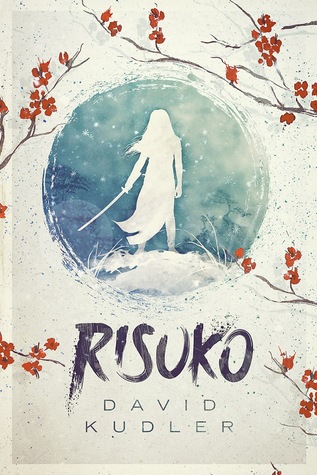
Risuko by David Kudler

Risuko is the tale of Murasaki Kano, nicknamed Risuko (squirrel) for her ability to climb anything. One day, she finds that her mother sold her to Lady Chiyome, to become a "kunoichi". What a kunoichi is would be the point of the whole book, along with a subplot about a traitor in their midst.

Unfortunately (or fortunately?), I already knew what the Kunoichi were, and I guess that anyone interested in Japanese history would know who they were too. So the whole mystery was sort of a non-mystery for me. I did, however, enjoy the descriptions of the lessons that Risuko and the two other novices - Emi and Toumi go through.

I also liked most of the characters - especially Masugu and Mieko. It was so obvious what their bickering was about, even if Risuko didn't see it. I found it cute.

So, some complaints:

One, the chef's way of speaking. The chef is from Korea, and he speaks with what I imagine is a Texan accent. That was really odd, but then again, I think in the English dub of Detective Conan, Heiji's Kansai accent was changed to a Southern drawl too, so it's not entirely without precedent. It's still weird though. (And yay for me not needing subtitles or dubs anymore)

Second, I didn't get along well with the prologue. It felt more like a blurb to me. But it's short, so I'd just recommend everyone skip it.

Last, there was a slight inconsistency in the way lady Chiyome was addressed. Sometime, she was Lady Chiyome, at other times, she was Chiyome sama. If there was a pattern, I couldn't figure it out. There was also some unneeded repetitions, like "mukashi mukashi, long ago" (mukashi; 昔 means long ago so...) which I thought was odd.

But I did read an advance copy, so hopefully all that's been ironed out.

Despite the complaints (which are fairly minor), I enjoyed this story. The lessons that Risuko and the other two were interesting, and the subplot developed in a way that I didn't really expect, but made sense.

Disclaimer: I got a free copy of this book from the publisher via NetGalley in exchange for a free and honest review.

Thursday, June 16, 2016

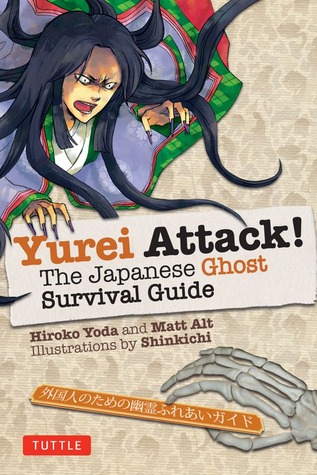
Yurei Attack by Hiroko Yoda and Matt Alt

I found this book quite by accident, but because I've read Ninja Attack, a different book by the same author, and enjoyed it, I decided to borrow this and read.

Luckily, it totally lived up to my expectations.

Yurei Attack is basically an introduction to the various kinds of Yurei (ghosts) haunting Japan. Of course, it's not exhaustive, but most of the main Yurei are featured (I think).

The Yurei in this book are divided into three categories: "Sexy and Scary" (aka famous lady ghosts), "Furious Phantoms" and "Sad Spectres". There's also a section on haunted areas in Japan and games related to the Yurei. Altogether, 36 Yurei/Yurei-related things are introduced. The last section is on the Japanese version of hell, a glossary, Yurei toys and an extensive bibliography.

Oh, and a list of resources they recommend.

I thought the book was very interesting, and I liked that each topic came with an illustration. So it was very easy to read and very colourful. It is not, however, and in-depth look into the Yurei - when I finished this, I wanted something meatier to sink my teeth into.

But first, I think I'll check out the other book in this series - Yokai Attack. I mean, the book did constantly refer to it after all.

Thursday, May 19, 2016

Sushi & Beyond by Michael Booth

After I finished reading this book, I was so, so hungry for good (expensive) Japanese food. And ramen. And soba. And takoyaki. And sushi. And to go see that shoyu factory. In fact, I could probably use this book as a foodie guide book through Japan.

Sushi & Beyond is basically the story of one foodie (and his family's) journey through Japan, eating along the way.

I must admit, I'm actually quite jealous about how much money the author has to have, to be able to fly his family all the way there, travel through Japan (from Hokkaido to Okinawa) and eat so much good food. It's definitely not something that I can afford at the moment.

Oh, and he actually managed to meet Takuya Kimura, but didn't know who he was. I wish I was as lucky as him! I'm going to disagree with the "famous only in Japan" claim because I'm fairly certain SMAP is popular all throughout Asia.

The book may have been published in 2009 (and so, written in perhaps 2007 or 2008?), but apart from the price of Ramen, which can go over 1000 yen now, and perhaps some other things, the rest of the content feels evergreen.

Oh, and judging by the number of times this book was mentions, the author was very clearly more than a little inspired by Japanese Cooking: A Simple Art by Shizuoka Tsuji. In fact, most of his before-trip knowledge came from there.

While I don't agree with all his pronouncements on food - I remember liking some dish he didn't like, but I can't remember what it is or if I dreamt it, it was really enjoyable to read about them. He definitely packed more culinary experiences in his one trip than I have so far.

Oh, and I'm really happy that he likes Fukuoka! To quote the book:

Of all the places we visited in Japan, this was the one we could most see ourselves returning to live in. Small enough to be manageable, but large enough to be interesting, Fukuoka also has a special atmosphere - relaxed, welcoming, fun loving and unpretentious. Throw in a great climate, excellent shops, museums and music venues and a buzzing nightlife district and you have everything you could ever wish for in a city.

Maybe the Fukuoka tourist board should use this quote. I actually think it's very very accurate, and it explains why a lot of students from Fukuoka don't actually want to leave the place when they're looking for a job.

Overall, I would totally recommend this book if you're looking for a light read on Japanese cuisine. Just don't read it on an empty stomach.

Wednesday, December 23, 2015

Invaluable.com Dream Literary Collection

It's close to Christmas (only two days away!) so I thought it'd be fun to do something different. The folks at Invaluable.com, an auction site, contacted me about making a dream literary collection and I thought it'd be fun. Since it's almost Christmas (I'm not going to stop saying that, it took me long enough to get into the Christmas Spirit this year), it sort of ended up as a Christmas wish list of books.

By the way, I should state upfront that I'm not getting paid for this in any form. I'm participating because I want to. Making wishes never hurt.

Anyway, I started out browsing the rare books on invaluable.com and taking note of perfectly good books that I've been wanting.

Like a First Trade Edition of The Tale of Peter Rabbit, because my inner child said so.


And I don't know how many of you were reading this when I was still in IB, but I did write an EE (Extended Essay) comparing Shusaku Endo's Silence and Graham Greene's The Man Within. Sadly, I didn't see these two books, but I did see a first edition of The End of the Affair.


I'm always up for some Graham Greene.

And for the inner child (again), I saw a special edition of Elsie Dinsmore, which I remember reading in the primary school library (I can't remember if I was actually still a primary student at that time, because I spent a lot of time there, even during Secondary School).


This comes with another story called "Rab and his Friends". Never heard of it, but I'm always open to reading more books.

And then, things got... slightly strange. After clicking through pages of medical and legal texts (hi medical and lawyers doing research!), I found that there were Japanese and Chinese books here! You can imagine my eyes sparkling right now, if you want.

The first one I saw was this lot of four Chinese picture books


It looks unassuming, but when I clicked on a preview image...


PRETTY.

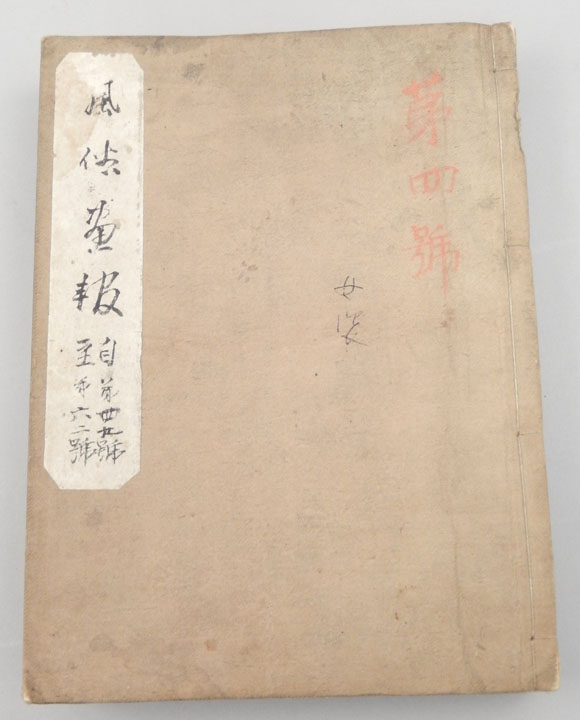
And then I saw a Japanese cloth-bound book


And you know, I'm not good at old Japanese. I know enough of standard Japanese to take all my classes in it, but old Japanese stumps me. So I clicked on the book not expecting to understand anything. And then I realised it was full of pictures.


This is when I got excited and went to search for other Japan-related books (I searched for Chinese stuff too, but nothing else caught my eye). And that's how I found the Accordion Book.


According to the description, the whole thing is made of one long piece of paper, and has a bunch of paintings, calligraphy (poetry? short stories? I have no idea) inside.


Looks like a combination of both to me. Makes me want to go learn the old Japanese, but my brain probably won't be able to handle it.

The last book I found is a ukiyo-e (woodblock) collection from the artist Utagawa Hiroshige, called "53 Stations of Tokkaido". I've always liked ukiyo-e, even if I suspect I'm not appreciating it properly, ever since I saw a ukiyo-e exhibition.


I guess I just love the lines and the colours.

This was actually pretty fun. I like looking at pictures of books, and if I had money, I'd probably be bidding on the Chinese picture book and the 53 Stations of Tokkaido, because they are beautiful. And maybe the Accordion one too.

Once again, all the listings can be found at Invaluable.com . Thanks for inviting me to do this, it was really fun :D

Friday, October 9, 2015

The Accidental Office Lady by Laura Kriska

I've seen this book a few times (in Kinokuniya), but never bothered to pick it up. But, since it's available through overdrive, I decided that, why not, since I'm already looking for a job.

Really, I don't know why I do this to my self. First, I take that class which basically made working in Japan sound terrible for ladies (no career path, really tough time when you're a mom, etc). And now, I read a book that reinforces that idea. Good thing the book was written a fairly long time ago though, so I can hope that things have drastically improved since then.

The Accidental Office Lady is the story of Laura, the first Western lady to ever work at the Honda head office. According to her, she has deep ties to Japan, being born there, and having gone for an exchange at Waseda. But of course, this is what, 1980s Japan? And things don't go as smoothly as expected. Among other things, Laura has to wear a uniform, is bossed around by the queen bee of the secretaries, and has general problems fitting in to the culture.

One thing I didn't get about Laura was how fluent in Japanese she was. In the prologue, she talks about how her "first words were Japanese", on some days, "spoke Japanese exclusively", and generally gives off the impression that she's very, very fluent in Japanese. But as the book goes on, she talks about having to have people explain things in English and Japanese, which confused me. Isn't she supposed to be fluent? How is there a language barrier? I'm guessing that she's like me, ok with conversation, but unfamiliar with business/office Japanese. This was a huge motivator to actually go practice keigo.

One thing I did understand, in fact it's one thing I worry about, are the cultural differences. By the time I graduate, I'd have spent 5 years in Japan, but assuming I can get a job, I don't know if I will be able to navigate things smoothly. Reading about Laura's experience makes me fervently wish that things have gotten better, or I have no idea how I'll last for long periods of time.

Basically, this book is like a worst-case scenario for me. Assuming I can get a job (big assumption there), I'll be going in ready to adapt to the situation as and when it needs be. You know, to change the things you can, but accept the things you can't. But you know, if things turn out to be more egalitarian, I would be thrilled.

Monday, September 7, 2015

Samurai and Ninja by Antony Cummins

This is another one of those "saw in the library and had to borrow it" sort of books. And after reading it, well, I want my own copy.

Unlike the previous ninja-related book I read, The Kouga Ninja Scrolls,  Samurai and Ninja is neither a novel, nor does it take an idealistic/unrealistic view of ninja/samurai. Instead, the book tries to strip away the misconceptions that most of us hold about these two groups of warriors, and tries to give us an accurate picture of what they are.

The book is broken into four parts. The first part basically just tries to get rid of all those mistaken impressions we've gotten from movies and books (like the Kouga Ninja Scrolls, I suppose). The second and third parts, which actually make up the bulk of the book, focus on the samurai and ninja respectively. The last part is about how the author is trying to resurrect the samurai and ninja school Natori-ryu.

It sounds weird, but what convinced me that the author knows his stuff is was how he kept trying to avoid generalisations. Apart from the fact that samurai and ninja changed as time went on, he also took great pains to emphasise that not all samurai and ninja were the same. Some were richer than others, some were hired in plain sight, and some were hired in secret, etc.

Since I'm not very familiar with the samurai and ninja world, a lot of this was new to me. I found the skills of the ninja interesting, and the translations of the Japanese texts were fascinating (and also, I still can't read them. I guess it's a sign to study ancient Japanese?). But the most surprising thing I learnt was that the samurai were headhunters. And that heads could be used to divine the future. The section of head-hunting was pretty detailed, like how they cut of the head, what they did with it, the five types of heads, etc. I was reading it on the train, so hopefully no one thought I was planning to revive that particular aspect of the samurai.

Basically, this book is very accessible, and I think a really good introduction into the world of samurai and ninja. If I ever write a story featuring them, you can bet that I'll buy this book as reference. Or maybe I'll just buy it because it's interesting.

This review is also published to my other blog: With Love from Japan, Eustacia