Monday, February 9, 2015

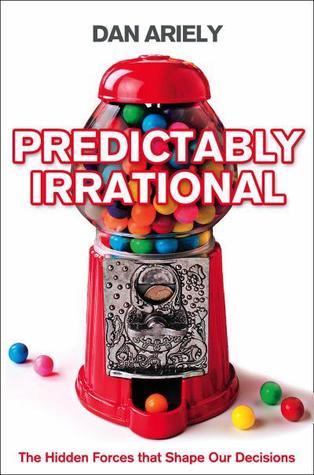
Predictably Irrational by Dan Ariely

I picked this book up at Changi Airport and I'm so glad I did. This is fast turning into one of the most useful, entertaining and informative books that I've read (while in Japan)!

One of the assumptions on which economics is built is that people are perfectly rational and seek to maximise their own benefit. However, through a series of experiments (many of them you might have heard before), Dan Ariely shows that this isn't true. Our past, our beliefs all conspire to influence our decisions. Like it or not, we make a lot of decisions with our emotions.

You might recognise this as a description of behavioural economics. I'm not too familiar with the subject (my introduction to microeconomics teacher didn't manage to get to that part), but I really prefer this form of economics to Classical/Keynesian economics. Sorry fans of the Phillips curve (the Phillips curve is cool. But not as cool as this).

I don't think I can tell you "my favourite chapter" of this book, like I normally do, but I can tell you what I used in my essays so far. So far, I've used "the cost of social norms" and "the fallacy of supply and demand". Now that I've arbitrarily picked out two chapters, I can go into a little bit more detail so you can see if the contents of the book is something that interests you.

"The cost of social norms" can be summed up in one question: When you have dinner at a friend's house, why is it ok to bring a gift of chocolates (or wine), but not ok to pull out 50 dollars to pay for the bill (assuming you didn't agree before hand to split the costs)? The answer lies in the fact that there is something called "social norms" and something called "market norms". Social norms look at relationships - it's give and take. Market norms look at getting what you paid for. That's why, you're much more likely to flag down waiter because your food is slow in coming, but less likely to go into the kitchen to pester your friend about why dinner isn't ready yet (at least for the first hour or so. And even then, there's a good chance that if you're like me, you'll go in to say "Hey, can I help?")

"The fallacy of supply and demand" talks about something called price anchors. Basically, although the theory of supply and demand assumes that we choose our optimal price independently, the truth is, we're affected by substitute products and our past experience. A case used in the book (that I used in an essay) was about Starbucks. Starbucks is expensive, but why are people still buying the coffee? The book theorizes that it's because Starbucks manages to be different enough that we don't compare it to other coffee shops, it becomes a category of its own. This is done through things as small as the names of coffee sizes. You might not thing you're influenced, but try comparing a "small" coffee to a "short". For some reason, your brain is more inclined to see those as two separate categories.

I like this book because it's incredibly easy to understand, and because there are a lot of examples. You could probably summarise each chapter into one paragraph (like I did), but if you want to walk away with many cool examples you can use in conversation or in essays, you should just read the book. The author doesn't use many technical terms, in fact, it feels like the author is just talking to you, which makes the book completely un-intimidating.

In short, I can't recommend this book highly enough. I found it a pleasure to read and I learnt a lot from it.

Friday, February 6, 2015

First Frost by Sarah Addison Allen

I can't remember where or when I first read Garden Spells, but I remember that I really liked it. So when I saw that First Frost was available for review on NetGalley, I immediately requested it. Thankfully, and I mean thankfully because I had a slightly bad reading streak, this book lived up to expectations.

First Frost is set quite some time after after Garden Spells, with Bay all grown up and one of the main characters in her own right. This time, it's the week leading up to First Frost, and the Waverly women are anxious. Claire's candy business is booming, but no one knows her secret - she's stopped using ingredients from the garden. Sydney wants a child really, really badly, but no luck. Bay found the boy she belongs with, but he doesn't like her. This is tough enough for them, but then, a mysterious man comes to town, and he's after Claire.

The magic, for me, was in the little things. Claire's gift is cooking, Sydney's is in hairdressing, and Bay is in figuring out where things belong. Those may seem like tiny gifts, but they have huge effects on the people around them. A dish cooked in a bad mood can make others cry. Hair cut with spite brings bad luck. And so on. I really liked the magic in here.

While the focus is very much on the Waverly women, there's a healthy cast of supporting characters. For some reason, the one that stuck in my head was Violet, who's a lazy worker and a fairly terrible mother who basically wants to get out of the town. Needless to say, I didn't like her, although I appreciated the role she played in the book. There was also Anne, who exists only for the subplot of the mysterious man. Yup, the unknown entity gets his own backstory, and another character gets her own character growth too.

To be honest, I was quite surprised to see that this is the second book in the Waverly family series. For some reason, reading this book felt like coming back to a really long series. I do hope that there's a third book coming soon.

Disclaimer: I received a free copy of this book from the publisher via Goodreads in exchange for a free and honest review.

Tuesday, February 3, 2015

Teaser Tuesday - A Mickey Mouse Reader edited by Garry Apgar

Woohoo, another Tuesday. One exam down, another uh, three or four more to go? I know I have two this week, but I only end next Tuesday. Hmm....

Anyway, my teaser is from A Mickey Mouse Reader, which sounds sooooo lighthearted. It's basically a scrapbook of articles about Mickey Mouse.

My teaser:

"But those who profit by cash have less to thank Mickey Mouse for than those who profit by the escape he provided. For the peoples of the earth, Mickey is a miracle."

That little guy is the best :D

What's your Teaser Tuesday?

Monday, February 2, 2015

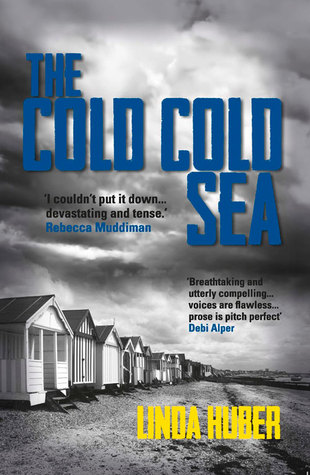
The Cold, Cold Sea by Linda Huber

Every now and then, I decide to eat lunch out because I want time to read. If I stayed home, I'd feel compelled to study, especially during the exam season. The Cold, Cold Sea was one of those books that made me leave the house and eat lunch somewhere else, just so I could finish what I started on the train.

The Cold, Cold Sea starts with a little girl being caught by waves. Then it switches to Maggie, who's daughter Olivia has gone missing at the beach. We see the beginning of the aftermath, and then we cut to Jennifer and her daughter Hailey. I had thought the book was going to toggle between Maggie and Jennifer's chapters, but most of the book is actually between Jennifer and Katie, Hailey's new teacher.

Well, Jennifer is certainly not normal. I actually guessed what was going on from the start, because there is no way that she's a normal mom. I was actually prepared to read a story of Maggie vs Jennifer, but after a strong first impression, Maggie sort of faded away, and we missed most of the aftermath. For example, Maggie's husband was really mad at her at first, but the next time we see her, he's gotten over the anger. That's a huge, huge gap.

Instead, most of the story is about Katie trying to convince herself that everything is normal, but unable to do so. The thing that kept me reading would be the thought "when is everyone going to realise what's going on?" In fact, now that I think about it, no one character actually actively interferes. The story just sorta happens, until an act of random coincidence brings it to a close.

This book excels in its portrayal of an ever-increasingly unstable personality. Jennifer is one of those villains that'll make you push the book on people and go "isn't she terrible? Read the book and tell me how terrible she is!" Her characterisation was actually fantastic, and the main reason why the work captivated me.

I guess this book is really about how people can, for whatever reasons they have, just stand passively by as a crime is being committed. Katie isn't this apathetic character - she does care about Hailey. But she doesn't really want to poke her head in, and she accepts the easy/convenient explanation straight away. How many of us do that too?

Disclaimer: I received this book from the publisher via Netgalley in exchange for a free and honest review.