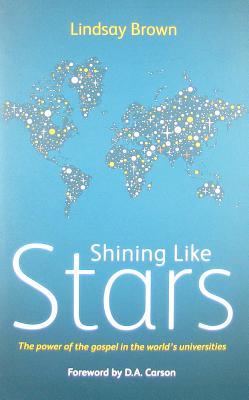
My sister brought this book home and recommended I read it and it is so good! Shining Like Stars is about the International Fellowship of Evangelical Students (IFES) and what they do.
I’ve got to admit, I’m not familiar with the IFES. And from what I read, they’re a non-denominational movement dedicated to training and raising up Christian student leaders and missionaries. The book talks about why they do this and shares lots of stories about their students.
Reading this makes me feel a bit guilty that I didn’t do much Church things during my university days. I always thought that because there were so few Christians in my uni (and in Japan in general) that there wasn’t much I could do. But the students here put me to shame because they’ve achieved amazing things in harder situations with much less. I’ve learnt that:
- Evangelism starts with personal friendships. You can do big events, but if you have not yet laid the groundwork by showing the love of Christ, it’s not going to work.
- All of us must be able to give a defence of our faith at any time (echoing Matthew 22:37). Reason does not replace faith but it provides the basis for our faith - and if we cannot explain why we believe, there is no reason for others to listen to us.
- Students (everyone) can do great things through Christ. It was amazing to read the testimonies of how God used these students to spread the Word while helping their community and standing against things like corruption and other social ills.
- Christians should be concerned with social issues, but we must remember that they are not the end goal.
This was a really fantastic book. I would recommend it to everyone - students and non-students alike, because although it’s centered on IFES and the work it does, the principles for Christianity and evangelism hold true for everyone.
Showing posts with label Christianity. Show all posts
Wednesday, June 20, 2018
Wednesday, May 16, 2018
Devoted by Jennifer Mathieu
As soon as I heard about Devoted, I knew I had to read it and that I would either love it or hate it - turns out I loved it (and it's a very intense book).
Devoted revolves around Rachel, a girl “devoted to God.” She’s a member of Calvary Christian Church, which is obviously part of the Quiverfull movement (and if you know me, you know I can’t stand them). She tries to be a Godly girl, but the rules chafe at her, and one day, she makes contact with one of the girls that ran away. And suddenly, the world looks a lot wider.
First, I should mention that although I’m a Christian, I cannot stand the groups that pervert the name of God. I don’t even think they should be allowed to call themselves Christian, and the Quiverfull movement, with its legalistic and sexist theology, is one of them.
Which is why my heart broke when I read about Rachel. Rachel is curious and loves books and I hate how all the legalism almost breaks her soul. Christianity is freeing, not a jail and the ‘Church’ she went to made me rage. I absolutely rooted for her to get away and for her to re-establish her relationship with God.
Another thing I loved about this book was its portrayal of Christianity, which I found very fair. The author doesn’t paint all Christians as people who go to Calvary Christian, and even though some who left that ‘Church’ turned away from God, that wasn’t the only way that you could leave. Most of the time, religion in YA books is shown as either totally good or totally bad, so I appreciated this level of nuance, which mimics real life.
If you’re into moving books with nuance and characters that will steal your heart, you need to read this. I found this to be a deeply moving book and while parts of it broke my heart, I am glad that I had the chance to read it.
Devoted revolves around Rachel, a girl “devoted to God.” She’s a member of Calvary Christian Church, which is obviously part of the Quiverfull movement (and if you know me, you know I can’t stand them). She tries to be a Godly girl, but the rules chafe at her, and one day, she makes contact with one of the girls that ran away. And suddenly, the world looks a lot wider.
First, I should mention that although I’m a Christian, I cannot stand the groups that pervert the name of God. I don’t even think they should be allowed to call themselves Christian, and the Quiverfull movement, with its legalistic and sexist theology, is one of them.
Which is why my heart broke when I read about Rachel. Rachel is curious and loves books and I hate how all the legalism almost breaks her soul. Christianity is freeing, not a jail and the ‘Church’ she went to made me rage. I absolutely rooted for her to get away and for her to re-establish her relationship with God.
Another thing I loved about this book was its portrayal of Christianity, which I found very fair. The author doesn’t paint all Christians as people who go to Calvary Christian, and even though some who left that ‘Church’ turned away from God, that wasn’t the only way that you could leave. Most of the time, religion in YA books is shown as either totally good or totally bad, so I appreciated this level of nuance, which mimics real life.
If you’re into moving books with nuance and characters that will steal your heart, you need to read this. I found this to be a deeply moving book and while parts of it broke my heart, I am glad that I had the chance to read it.
Labels:
Christianity
,
fiction
,
western
Thursday, April 26, 2018
Plain Secrets by Joe Mackall
A few years ago, I had this Amish fiction binge and I’ve remained curious about them ever since. When I heard that there was a book that wrote about them accurate and compassionately, I knew that I had to read it.
Plain Secrets is a fairly short book (only twelve chapters!) about Joe and his friendships with his Amish neighbours, the Shetlers. His neighbours are respected in their community and show no hint of dissatisfaction, but one of their nephews, Jonas, has left the Amish. By talking to Jonas and being a good neighbour and friend to the Shetlers, Joe shows us why people would stay Amish, and why people would leave.
I thought that this approach made the book very even-handed. Even though Joe cares dearly for his friends and values them, he also feels frustration at some of the things they do, such as continuing to drive in buggies (which are really no match for cars). I especially felt his frustration when he told me that many Amish don’t vaccinate their kids, which was also something that surprised me.
And occasionally, Joe also talks about the differences within the Amish. The way he adds the info always felt appropriate and I learnt a lot. I knew there was a difference between a Mennonite and the Amish, but I didn’t realise that there were so many differences between the Amish too. The degree to which they separate themselves from our world depends on the order that they belong to.
If you’re interested in reading about a group of people who live completely different lives from us, I think you’ll like this book. It’s not some shocking, scandalous expose, but it taught me more about the Amish. I’ll end my review with the last sentence of the book, which I really liked:
Plain Secrets is a fairly short book (only twelve chapters!) about Joe and his friendships with his Amish neighbours, the Shetlers. His neighbours are respected in their community and show no hint of dissatisfaction, but one of their nephews, Jonas, has left the Amish. By talking to Jonas and being a good neighbour and friend to the Shetlers, Joe shows us why people would stay Amish, and why people would leave.
I thought that this approach made the book very even-handed. Even though Joe cares dearly for his friends and values them, he also feels frustration at some of the things they do, such as continuing to drive in buggies (which are really no match for cars). I especially felt his frustration when he told me that many Amish don’t vaccinate their kids, which was also something that surprised me.
And occasionally, Joe also talks about the differences within the Amish. The way he adds the info always felt appropriate and I learnt a lot. I knew there was a difference between a Mennonite and the Amish, but I didn’t realise that there were so many differences between the Amish too. The degree to which they separate themselves from our world depends on the order that they belong to.
If you’re interested in reading about a group of people who live completely different lives from us, I think you’ll like this book. It’s not some shocking, scandalous expose, but it taught me more about the Amish. I’ll end my review with the last sentence of the book, which I really liked:
"And the beauty and truth of it is this: That to these plain people, in these times and in all others, the values that reign supreme are community, acceptance, and faith, which can, with prayer and a little luck, lead to peace."
Labels:
Christianity
,
non-fiction
,
western
Friday, March 30, 2018
Judas and the Gospel of Jesus by N.T. Wright
Have a blessed Easter weekend everyone!
My uncle managed to help me borrow this book so I finally got to read it! I heard it was a good explanation of Gnosticism vs Christianity and it didn’t disappoint.
Judas and the Gospel of Jesus focuses on the Gospel of Judas (which you can read online just by googling - it’s only 7 pages long). It’s supposed to turn Christianity upside down because in this story, Judas is the hero because Jesus told Judas to go betray him.
But before you throw out your Bible in despair, here’s what you need to know about Gnosticism. It’s very different from Christianity, as you can see by looking at the following characteristics:
- Gnosticism has what the book called a “deep and dark dualism.” It believes that this world we live in is full of wickedness and evil and if it wasn’t for an evil god that created it, wouldn’t exist at all.
- Apart from the evil god, there is a pure and wide and tue god who is different from the creator god.
- Therefore, the aim of the human is to escape from this material world and into a purer, higher spiritual existence
- And you get this ‘salvation’ from a special secret knowledge (gnosis) from a ‘revealer’
As you can see, this is not even similar to what Christianity teaches.
So while this later writing (and it is definitely written after Matthew, Mark, Luke, and John) provides an interesting view of how some people back then thought, it’s not really Christian at all. Even though it’s called the gospel of Judas, it’s not really a Gospel the way Christians use the word.
Side note: some scholars have suggested that the Jesus in this gnostic Gospel is more humorous because he laughs but actually the laughter in the Gospel of Judas is mocking laughter rather than humour
The book also places the gospel of Judas and Gnosticism in the correct historical context. The Christians weren’t persecuting a valid alternative of Christianity in order to gain power. In fact, it’s the Christians who were dying for their faith while “the Gnostics were the cultural conservatives, sticking with the kind of religion that everyone already knew” and basically doing their best to avoid martyrdom. That means that the Church was merely defending their faith and following Jesus.
The last chapter of the book looks at how strains of gnostic thought has invaded society and how this has made everyone so eager for some new claim to ‘truth’. It’s a pretty sobering chapter because he shows that even Christians are subject to conspiracy theories.
If you’re interested in finding out what Gnosticism is, you definitely have to read this. It’s a pretty short book but it packs a lot of information. The language is also very clear and you definitely don’t have to be a Bible scholar to follow the arguments.
My uncle managed to help me borrow this book so I finally got to read it! I heard it was a good explanation of Gnosticism vs Christianity and it didn’t disappoint.
Judas and the Gospel of Jesus focuses on the Gospel of Judas (which you can read online just by googling - it’s only 7 pages long). It’s supposed to turn Christianity upside down because in this story, Judas is the hero because Jesus told Judas to go betray him.
But before you throw out your Bible in despair, here’s what you need to know about Gnosticism. It’s very different from Christianity, as you can see by looking at the following characteristics:
- Gnosticism has what the book called a “deep and dark dualism.” It believes that this world we live in is full of wickedness and evil and if it wasn’t for an evil god that created it, wouldn’t exist at all.
- Apart from the evil god, there is a pure and wide and tue god who is different from the creator god.
- Therefore, the aim of the human is to escape from this material world and into a purer, higher spiritual existence
- And you get this ‘salvation’ from a special secret knowledge (gnosis) from a ‘revealer’
As you can see, this is not even similar to what Christianity teaches.
So while this later writing (and it is definitely written after Matthew, Mark, Luke, and John) provides an interesting view of how some people back then thought, it’s not really Christian at all. Even though it’s called the gospel of Judas, it’s not really a Gospel the way Christians use the word.
Side note: some scholars have suggested that the Jesus in this gnostic Gospel is more humorous because he laughs but actually the laughter in the Gospel of Judas is mocking laughter rather than humour
The book also places the gospel of Judas and Gnosticism in the correct historical context. The Christians weren’t persecuting a valid alternative of Christianity in order to gain power. In fact, it’s the Christians who were dying for their faith while “the Gnostics were the cultural conservatives, sticking with the kind of religion that everyone already knew” and basically doing their best to avoid martyrdom. That means that the Church was merely defending their faith and following Jesus.
The last chapter of the book looks at how strains of gnostic thought has invaded society and how this has made everyone so eager for some new claim to ‘truth’. It’s a pretty sobering chapter because he shows that even Christians are subject to conspiracy theories.
If you’re interested in finding out what Gnosticism is, you definitely have to read this. It’s a pretty short book but it packs a lot of information. The language is also very clear and you definitely don’t have to be a Bible scholar to follow the arguments.
Labels:
Christianity
,
non-fiction
Monday, January 29, 2018
High King of Heaven edited by John MacArthur
I've got to admit, the title for this book is fantastic (or conversely, annoying) because I had Be Thou My Vision playing in my head every time I opened this book. Talk about a catchy title!
High King of Heaven is basically a book on Christ. There are 23 chapters by 23 pastors and theologians, including John MacArthur. The book is organised into four parts: the person of Christ, the work of Christ, the word of Christ, and the witness of Christ, with each chapter focusing on a specific topic, such as Christ in the Old Testament, the atonement, Christ’s relationship with God the Father, etc.
According to another reviewer (Doug on Goodreads), these essays are from the sermons preached at the 2017 Shepherd’s Conference. Since I didn’t listen to the sermons, all the essays were new to me. And with 23 essays, there’s a lot of material in here. There are some good parts, like a clear explanation of the Arian heresy, and the chapter on how Jesus read the Old Testament using a literal-grammatical-historical hermeneutic.
Then there are some things don’t ring true. There’s a statement that there’s “no extra-biblical evidence that Caesar Augustus ever called for an empire-wide census” and that “there is uncertainty that Quirinius was a Roman governor in Syria as early as 6 to 2BC”, and the Joseph didn’t need to return argument as though these are facts when there are also arguments to the contrary. I feel that at the very least, they should present both sides.
There’s also a statement that “in the early Church, there was no political activism. Rather, there was preaching and prayer.” I suppose this depends on what you define as political activism, but religion was a very integral part of being a Roman citizen, which means that the early Church was making a political stand just by believing in Christ. So I don’t really agree with wording that makes it seem like early Christianity was 100% apolitical.
Most importantly, this book writes from the Calvinist viewpoint, which isn’t disclosed (it might be in the introduction but that wasn’t in my review copy). This was most obvious in the chapter of definite atonement, which completely leaves out general atonement. Unsurprisingly, this was the most unconvincing chapter to an Arminian like me.
Given the narrow theological perspective here, I wouldn’t recommend this book as the book on Christology or even an introductory book to Christology, even if you are a Calvinist because I believe it’s important for us believers to know about Christianity as a whole because people do ask about these differences. It is, however, a pretty decent book on the subject and contains some good points, so I would recommend reading it along with other books.
Disclaimer: I received a free copy of this book from the publisher via NetGalley in exchange for a free and honest review.
High King of Heaven is basically a book on Christ. There are 23 chapters by 23 pastors and theologians, including John MacArthur. The book is organised into four parts: the person of Christ, the work of Christ, the word of Christ, and the witness of Christ, with each chapter focusing on a specific topic, such as Christ in the Old Testament, the atonement, Christ’s relationship with God the Father, etc.
According to another reviewer (Doug on Goodreads), these essays are from the sermons preached at the 2017 Shepherd’s Conference. Since I didn’t listen to the sermons, all the essays were new to me. And with 23 essays, there’s a lot of material in here. There are some good parts, like a clear explanation of the Arian heresy, and the chapter on how Jesus read the Old Testament using a literal-grammatical-historical hermeneutic.
Then there are some things don’t ring true. There’s a statement that there’s “no extra-biblical evidence that Caesar Augustus ever called for an empire-wide census” and that “there is uncertainty that Quirinius was a Roman governor in Syria as early as 6 to 2BC”, and the Joseph didn’t need to return argument as though these are facts when there are also arguments to the contrary. I feel that at the very least, they should present both sides.
There’s also a statement that “in the early Church, there was no political activism. Rather, there was preaching and prayer.” I suppose this depends on what you define as political activism, but religion was a very integral part of being a Roman citizen, which means that the early Church was making a political stand just by believing in Christ. So I don’t really agree with wording that makes it seem like early Christianity was 100% apolitical.
Most importantly, this book writes from the Calvinist viewpoint, which isn’t disclosed (it might be in the introduction but that wasn’t in my review copy). This was most obvious in the chapter of definite atonement, which completely leaves out general atonement. Unsurprisingly, this was the most unconvincing chapter to an Arminian like me.
Given the narrow theological perspective here, I wouldn’t recommend this book as the book on Christology or even an introductory book to Christology, even if you are a Calvinist because I believe it’s important for us believers to know about Christianity as a whole because people do ask about these differences. It is, however, a pretty decent book on the subject and contains some good points, so I would recommend reading it along with other books.
Disclaimer: I received a free copy of this book from the publisher via NetGalley in exchange for a free and honest review.
Labels:
ARC
,
Christianity
,
non-fiction
Thursday, December 28, 2017
The House on Foster Hill by Jamie Jo Wright
I'm basically a mystery-person, which is why I requested The House on Foster Hill. Houses with a dark history? Definitely gonna read that. It turns out that this is a Christian mystery, so it's not as scary as I assumed it would be, but it was still pretty interesting.
After the suspicious death of her husband, Kaine decided to renovate a house because that was his dream that she never got to do. The house she chose is related to her great-grandmother. But when she moves in, she finds that her stalking issue has increased.
For the second plot, which takes place in the past, Ivy becomes obsessed with solving the murderer of Gabriella. Who was she and what happened to her baby? And can she work with Joel, the man she thought she loved (until the Tragic Event). The dual plot lines of Kaine and Ivy mirror each other as the danger and tension increases. Along the way, both women have to confront their loss of faith.
Personally, Kaine and I got off to a rocky start when she said that “she never liked Dickens. He took four pages to explain one setting when he only needed a paragraph.” Well, I actually hold the works of Dickens in higher esteem so...
And there was one odd head-hop moment just past the 25% mark.
But the characters grew on me after these hiccups and the pacing increased in a way that I was rushing through the last quarter of the book to find out who the culprits were.
I thought the Christianity in the book was rather heavy-handed (or at least, I noticed it, and I don’t normally do unless it’s Christian-Christian fiction). I’m completely okay with that since this is my faith, but if you don’t like that sort of thing, you may want to avoid the book.
Overall, I thought this was a decent mystery. The dual plotlines came together nicely and I was invested in the characters by the end of the book.
Disclaimer: I received a free copy of this book from the publisher via NetGalley in exchange for a free and honest review.
After the suspicious death of her husband, Kaine decided to renovate a house because that was his dream that she never got to do. The house she chose is related to her great-grandmother. But when she moves in, she finds that her stalking issue has increased.
For the second plot, which takes place in the past, Ivy becomes obsessed with solving the murderer of Gabriella. Who was she and what happened to her baby? And can she work with Joel, the man she thought she loved (until the Tragic Event). The dual plot lines of Kaine and Ivy mirror each other as the danger and tension increases. Along the way, both women have to confront their loss of faith.
Personally, Kaine and I got off to a rocky start when she said that “she never liked Dickens. He took four pages to explain one setting when he only needed a paragraph.” Well, I actually hold the works of Dickens in higher esteem so...
And there was one odd head-hop moment just past the 25% mark.
But the characters grew on me after these hiccups and the pacing increased in a way that I was rushing through the last quarter of the book to find out who the culprits were.
I thought the Christianity in the book was rather heavy-handed (or at least, I noticed it, and I don’t normally do unless it’s Christian-Christian fiction). I’m completely okay with that since this is my faith, but if you don’t like that sort of thing, you may want to avoid the book.
Overall, I thought this was a decent mystery. The dual plotlines came together nicely and I was invested in the characters by the end of the book.
Disclaimer: I received a free copy of this book from the publisher via NetGalley in exchange for a free and honest review.
Labels:
Christianity
,
mystery
,
NetGalley
Wednesday, November 15, 2017
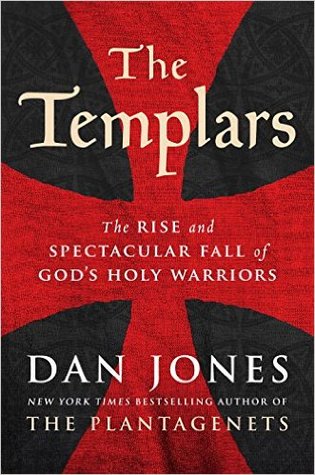
The Templars by Dan Jones
I requested this from NetGalley because it sounded interesting and I don't know anything about the Templars. If you don't know about them either, they're this Christian order that was formed to protect pilgrims to Jerusalem and ended up playing a big role in the crusades. Also, most modern portrayals of them (especially the 'Templars are still alive' thing) are inaccurate.
As a history of the organisation, this book takes a broad view, focusing not on the everyday life of a Templar but on the key events and people that made up the Templars or fought against the Templars. Since there are several countries involved this could have become very confusing but the author manages to make it one coherent narrative.
I found it pretty interesting to read about them and how they fought against the equally strong (and at times even stronger) Muslim countries. Thankfully, the author stays away from a discussion of both Islamic and Christian theology and/or which was right, instead focusing on who does what (and why), which I think helped make it an objective narrative.
Another thing I also liked that even though this is a book about a Christian organisation, Muslim sources are quoted as frequently as Christian ones (ok I didn't do a formal count but it definitely felt that way to me). Quoting both sides helped me get a fuller picture and to understand how the Templars saw themselves and how others saw them.
One thing I thought fascinating about the Templars was that their portrayal depended largely on the motives of the writer, something that holds true today. Usama ibn Minqidh portrays them as open-minded and specifically mentions that they let him use one of their Churches for his daily prayers. But another man, Imad al-Din, calls them "the worst of the infidels." The difference occurs because the former wants to talk about honour and chivalry while the later wants to praise Saladin.
I think anyone interested in history would enjoy this book. It's definitely a heavy read, but it is fascinating and after reading it, I wonder why anyone would bother making up stories about the Templars. The actual history has so much to draw on.
Disclaimer: I received a free copy of this book from the publisher via NetGalley in exchange for a free and honest review.
As a history of the organisation, this book takes a broad view, focusing not on the everyday life of a Templar but on the key events and people that made up the Templars or fought against the Templars. Since there are several countries involved this could have become very confusing but the author manages to make it one coherent narrative.
I found it pretty interesting to read about them and how they fought against the equally strong (and at times even stronger) Muslim countries. Thankfully, the author stays away from a discussion of both Islamic and Christian theology and/or which was right, instead focusing on who does what (and why), which I think helped make it an objective narrative.
Another thing I also liked that even though this is a book about a Christian organisation, Muslim sources are quoted as frequently as Christian ones (ok I didn't do a formal count but it definitely felt that way to me). Quoting both sides helped me get a fuller picture and to understand how the Templars saw themselves and how others saw them.
One thing I thought fascinating about the Templars was that their portrayal depended largely on the motives of the writer, something that holds true today. Usama ibn Minqidh portrays them as open-minded and specifically mentions that they let him use one of their Churches for his daily prayers. But another man, Imad al-Din, calls them "the worst of the infidels." The difference occurs because the former wants to talk about honour and chivalry while the later wants to praise Saladin.
I think anyone interested in history would enjoy this book. It's definitely a heavy read, but it is fascinating and after reading it, I wonder why anyone would bother making up stories about the Templars. The actual history has so much to draw on.
Disclaimer: I received a free copy of this book from the publisher via NetGalley in exchange for a free and honest review.
Labels:
Christianity
,
historical
,
NetGalley
,
non-fiction
,
western
Thursday, September 21, 2017
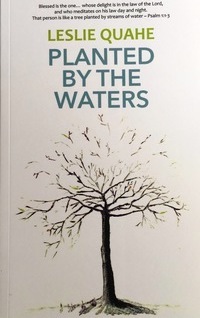
Planted by the Waters by Leslie Quahe
This book was given to me by one of my friends! It's a collection of stories from Leslie Quah's life. The title is a reference to Psalms 1:1-3, which says:
"Blessed is the man who walks not in the counsel of the wicked, nor stands in the way of sinners, nor sits in the seat of scoffers; but his delight is in the law of the Lord, and on his law he meditates Day and night. He is like a tree planted by streams of water that yields it's fruit in its season, and its leaf does not wither. In all that he does, he prospers."
But to be honest the title reminds me more of the song:
"I'm gonna be like a tree, planted by the waters, trusting in the Father to keep me strong"
Which is based on the Psalm so all's good, I guess?
Like I mentioned at the start, this is a collection of Leslie Quah's experience and how the Lord has always been taking care of him. Each story is short, so you can use it as a quick method of reminding yourself about the goodness of the Lord.
The only thing I wish was different was in how the stories were connected. I think the stories are told in chronological order, but they are not connected so it's like *boom* Harley Davidson, *boom* pro golfer, and I'm like "when did you learn to ride a motorbike or play golf?"
Apart from that minor quibble, I thought this was a really good book! It's an encouraging read and Leslie's faith is something that we all can learn from.
"Blessed is the man who walks not in the counsel of the wicked, nor stands in the way of sinners, nor sits in the seat of scoffers; but his delight is in the law of the Lord, and on his law he meditates Day and night. He is like a tree planted by streams of water that yields it's fruit in its season, and its leaf does not wither. In all that he does, he prospers."
But to be honest the title reminds me more of the song:
"I'm gonna be like a tree, planted by the waters, trusting in the Father to keep me strong"
Which is based on the Psalm so all's good, I guess?
Like I mentioned at the start, this is a collection of Leslie Quah's experience and how the Lord has always been taking care of him. Each story is short, so you can use it as a quick method of reminding yourself about the goodness of the Lord.
The only thing I wish was different was in how the stories were connected. I think the stories are told in chronological order, but they are not connected so it's like *boom* Harley Davidson, *boom* pro golfer, and I'm like "when did you learn to ride a motorbike or play golf?"
Apart from that minor quibble, I thought this was a really good book! It's an encouraging read and Leslie's faith is something that we all can learn from.
Labels:
Christianity
,
non-fiction
,
Singapore
Friday, August 11, 2017
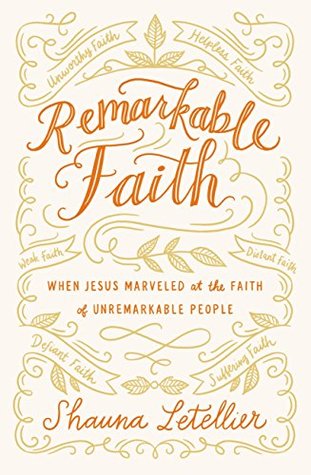
Remarkable Faith by Shauna Letellier
I was intrigued by this book when I saw it on NetGalley because I have tried to do my own retellings of Bible stories. After reading this, I see that I still have a long way to go.
Remarkable Faith contains eight retellings of various people who encountered Christ in the New Testament. The eight are:
- the father of the demon possessed boy (Mark 9:17-27)
- the paralysed man who was let down through the roof (Mark 2: 1-12)
- the Roman centurion (Luke 7:1-10)
- the hemorrhaging woman (Mark 5:21-34)
- the Samaritan Leper (Luke 17:11-19)
- the mother of the demon possessed girl (Matthew 15:21-28)
- blind Bartinaeus (Luke 18:35-42)
- the woman who washed Jesus' feet with her tears and anointed them with perfume (Luke 7:36-50)
Each retelling starts with the Biblical account, then the author's take, followed by a short reflection and a prayer. I found that these work very well as devotions and I read one or two of them a day. This is definitely a book you want to savour in small chunks rather than read in one go.
Remarkable Faith offers a fresh way of looking at these familiar stories that we may take for granted. The emphasis is on the grace of God, and it was something that I needed to hear right now.
Disclaimer: I got a free copy of this book from the publisher via NetGalley in exchange for a free and honest review.
Remarkable Faith contains eight retellings of various people who encountered Christ in the New Testament. The eight are:
- the father of the demon possessed boy (Mark 9:17-27)
- the paralysed man who was let down through the roof (Mark 2: 1-12)
- the Roman centurion (Luke 7:1-10)
- the hemorrhaging woman (Mark 5:21-34)
- the Samaritan Leper (Luke 17:11-19)
- the mother of the demon possessed girl (Matthew 15:21-28)
- blind Bartinaeus (Luke 18:35-42)
- the woman who washed Jesus' feet with her tears and anointed them with perfume (Luke 7:36-50)
Each retelling starts with the Biblical account, then the author's take, followed by a short reflection and a prayer. I found that these work very well as devotions and I read one or two of them a day. This is definitely a book you want to savour in small chunks rather than read in one go.
Remarkable Faith offers a fresh way of looking at these familiar stories that we may take for granted. The emphasis is on the grace of God, and it was something that I needed to hear right now.
Disclaimer: I got a free copy of this book from the publisher via NetGalley in exchange for a free and honest review.
Labels:
Christianity
,
NetGalley
,
retelling
Friday, March 10, 2017
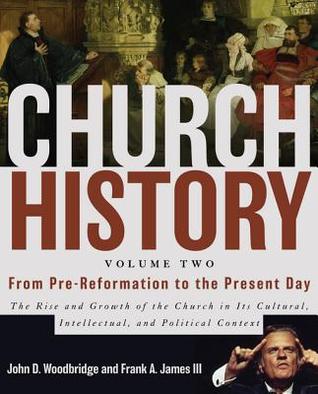
Church History: Volume Two by John Woodbridge and Frank A. James III
This volume is a continuation of volume one (review here) but by two different authors. This means that the writing style is somewhat different (personally, I preferred the first volume), but the way they present the history is largely similar. This volume is from pre-reformation (1300s) to the present day.
Like in the previous volume, I appreciated the mini-explanations of the theology involved and the biographies of key figures. I also liked the fact that the book also looks at the political, societal and economic of the time (especially political), since Christianity was very closely tied to politics.
Bits of information that surprised me include:
- Martin Luther's marriage to Katie. It started out as a loveless marriage, but Luther fell in love with his wife and the fact that such a key figure in the reformation had such an unusual marriage shaped attitudes towards marriage in society.
- I didn't know that predestination "was not the wellspring of Calvin's theology", because that is what I remember most clearly (and struggle with, for that matter).
But while the book is easy to read, it does try to cram about 700+ years of history into 800 ish pages, which means some extreme simplifications are made. For example, the book says that "Catherine [Catherine the Great] did little to improve the plight of serfs during her reign".
Since I just finished a biography about her, I found this simplification a little insulting because she had a plan to free the serfs, but eventually abandoned it for practical reasons. The book also made no mention of her Nakaz, which I thought was a pity since she did consult many people about it and their reactions would have been helpful to explaining attitudes in Russia.
More importantly, I thought that this volume was too focused on Europe, specifically the British Isles and France, and later on America. Russia was given several sections, but not whole chapters, while Asia, Africa and the Middle East were largely left out (they did appear in the last one third, but I thought their presence was far too little). The persecution in Japan was almost entirely left out, and a lot of the history in India and China greatly summarised.
It is a pity, because there is a history, and in the case of Africa, the book even admits that "it [Christianity] has a continuous history on the continent of Africa of nearly two thousand years." So even if there weren't many theological debates going on, I think the development of Christianity in those regions should have been given more space.
Thankfully, things did get more globalised towards the end, and I found the discussion on the new centres of global Christianity and the modern theological trajectories to be fascinating (especially the contextual theologies, since I haven't heard of most of them). It's an area that I'd like to read more about so hopefully I can find more recommendations some day.
If you've read volume one, you'll want to read volume two. The style of the book is largely the same, and it's a good way to get an overview of the history of the Church (even if it is very European-centric). And to end, a quote I liked:
Like in the previous volume, I appreciated the mini-explanations of the theology involved and the biographies of key figures. I also liked the fact that the book also looks at the political, societal and economic of the time (especially political), since Christianity was very closely tied to politics.
Bits of information that surprised me include:
- Martin Luther's marriage to Katie. It started out as a loveless marriage, but Luther fell in love with his wife and the fact that such a key figure in the reformation had such an unusual marriage shaped attitudes towards marriage in society.
- I didn't know that predestination "was not the wellspring of Calvin's theology", because that is what I remember most clearly (and struggle with, for that matter).
But while the book is easy to read, it does try to cram about 700+ years of history into 800 ish pages, which means some extreme simplifications are made. For example, the book says that "Catherine [Catherine the Great] did little to improve the plight of serfs during her reign".
Since I just finished a biography about her, I found this simplification a little insulting because she had a plan to free the serfs, but eventually abandoned it for practical reasons. The book also made no mention of her Nakaz, which I thought was a pity since she did consult many people about it and their reactions would have been helpful to explaining attitudes in Russia.
More importantly, I thought that this volume was too focused on Europe, specifically the British Isles and France, and later on America. Russia was given several sections, but not whole chapters, while Asia, Africa and the Middle East were largely left out (they did appear in the last one third, but I thought their presence was far too little). The persecution in Japan was almost entirely left out, and a lot of the history in India and China greatly summarised.
It is a pity, because there is a history, and in the case of Africa, the book even admits that "it [Christianity] has a continuous history on the continent of Africa of nearly two thousand years." So even if there weren't many theological debates going on, I think the development of Christianity in those regions should have been given more space.
Thankfully, things did get more globalised towards the end, and I found the discussion on the new centres of global Christianity and the modern theological trajectories to be fascinating (especially the contextual theologies, since I haven't heard of most of them). It's an area that I'd like to read more about so hopefully I can find more recommendations some day.
If you've read volume one, you'll want to read volume two. The style of the book is largely the same, and it's a good way to get an overview of the history of the Church (even if it is very European-centric). And to end, a quote I liked:
"The ultimate value of history lies not in its predictive ability or even its capacity for elucidation, but in its aptitude to teach humility."Disclaimer: I got a free copy of this book from the publisher via NetGalley in exchange for a free and honest review.
Labels:
Christianity
,
historical
,
NetGalley
Wednesday, March 8, 2017
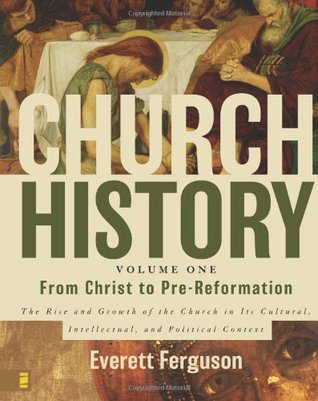
Church History: Volume One by Everett Ferguson
Church History, Volume One is like what it says, about the history of the Church from the first century to the thirteenth century. I'm not even going to attempt to summarise contents, but the book basically looks at events, trends, and notable people in Church history. Each chapter also comes with a list of recommended resources, so you could (ideally) use this book as a starting point and then delve into certain issues or events.
I found this book easy to read and follow, even for someone like me, who has no formal education in Church history (apart from what I learnt in Sunday School). In fact, I was listening to one of my cousin's lectures of the Holy Spirit (she records her teachers and shares them with those interested) and I realised that it was easier to understand what the lecturer was saying, in part because I had already encountered the concepts and events mentioned in this book.
But though the book does explain the basics of certain theological issues (like the nature of Christ), because a certain level of understanding is needed to comprehend why the disputes were a big deal, I still found myself wishing for a theology textbook that I could use as a reference. So while the theology explanations are definitely adequate, they are not sufficient. Still, this is a history book so I shouldn't be quibbling.
And since Silence is still on my mind, or rather, it has been on my mind more than normal, I found myself particularly struck by the explanation of Christian persecution in Ancient Rome. In those times, religious functions were also used as expressions of political loyalty. And since Christians would not offer such sacrifices, they were seen as a threat to the Roman state. I thought that this was remarkably similar to the persecution depicted in Silence, which explains why it was controversial.
Oh, and while I'm on this topic, I also wanted to share that there was some discussion on whether Christians be persecuted on the basis of "the name" (aka being known as Christians) or for the crimes attached to the name. Christian apologists wanted it to be the latter, since they knew they were innocent, but guess which side won out?
I think that people interested in learning more about Church history should consider picking up this book. It's accessible, and I was able to follow what the author says without additional lectures - though I'm sure that lectures and discussions would have made it even better.
Disclaimer: I got a free copy of this book from the publisher via NetGalley in exchange for a free and honest review.
I found this book easy to read and follow, even for someone like me, who has no formal education in Church history (apart from what I learnt in Sunday School). In fact, I was listening to one of my cousin's lectures of the Holy Spirit (she records her teachers and shares them with those interested) and I realised that it was easier to understand what the lecturer was saying, in part because I had already encountered the concepts and events mentioned in this book.
But though the book does explain the basics of certain theological issues (like the nature of Christ), because a certain level of understanding is needed to comprehend why the disputes were a big deal, I still found myself wishing for a theology textbook that I could use as a reference. So while the theology explanations are definitely adequate, they are not sufficient. Still, this is a history book so I shouldn't be quibbling.
And since Silence is still on my mind, or rather, it has been on my mind more than normal, I found myself particularly struck by the explanation of Christian persecution in Ancient Rome. In those times, religious functions were also used as expressions of political loyalty. And since Christians would not offer such sacrifices, they were seen as a threat to the Roman state. I thought that this was remarkably similar to the persecution depicted in Silence, which explains why it was controversial.
Oh, and while I'm on this topic, I also wanted to share that there was some discussion on whether Christians be persecuted on the basis of "the name" (aka being known as Christians) or for the crimes attached to the name. Christian apologists wanted it to be the latter, since they knew they were innocent, but guess which side won out?
I think that people interested in learning more about Church history should consider picking up this book. It's accessible, and I was able to follow what the author says without additional lectures - though I'm sure that lectures and discussions would have made it even better.
Disclaimer: I got a free copy of this book from the publisher via NetGalley in exchange for a free and honest review.
Labels:
Christianity
,
historical
,
NetGalley
,
non-fiction
Monday, February 27, 2017
Fleeing ISIS, Finding Jesus by Charles Morris & Craig Borlase
I took some time to read this book and it is so powerful! Fleeing ISIS, Finding Jesus follows Charles as he travels around the Middle East to meet with the persecuted Christians. Most of the book consists of their testimonies and reading them reminded me of how terrible things are there, and how God is working in them and through them.
Some of the believers were from a long line of Christians and lost everything when ISIS took over. It was painful to read of how many of them trusted their Muslim neighbours to take care of their houses and possessions, only to find out that their neighbours had taken their things as theirs. But it was uplifting to see that despite all this, they still forgive and love them.
Some of the believers were Muslims who came to Christ and experienced terrible persecution. But for them, no price is too high for the peace they receive and their words and actions reflect the love of Christ as well.
These people truly are heroes and there is a lot that I have to learn from them.
And this is a little bit of a sidetrack, but a bit of what someone said reminded me of the hidden Christians in Silence:
This book isn't a comfortable read - my heart kept breaking when I read about the suffering that those in the Middle East are going through. But it is a book that we have to read, because we need to open our eyes, and we need to keep working for the persecuted and those that are suffering right now.
Disclaimer: I received a free copy of this book from the publisher via NetGalley in exchange for a free and honest review.
Some of the believers were from a long line of Christians and lost everything when ISIS took over. It was painful to read of how many of them trusted their Muslim neighbours to take care of their houses and possessions, only to find out that their neighbours had taken their things as theirs. But it was uplifting to see that despite all this, they still forgive and love them.
Some of the believers were Muslims who came to Christ and experienced terrible persecution. But for them, no price is too high for the peace they receive and their words and actions reflect the love of Christ as well.
These people truly are heroes and there is a lot that I have to learn from them.
And this is a little bit of a sidetrack, but a bit of what someone said reminded me of the hidden Christians in Silence:
"I look at the West and wonder if Satan uses our affluence to limit the growth of the Church. [...] So we give God a Sunday morning but love the other six days of the week for ourselves. Where real persecution happens, you're not afforded that. You have to call on God multiple times a day."From the testimonies of these brothers and sisters in Christ, we see that God is always present, even in the toughest circumstances. So God wasn't silent like Rodriguez assumed. He was always with the Christians of Japan like He is with the Christians in the Middle East.
This book isn't a comfortable read - my heart kept breaking when I read about the suffering that those in the Middle East are going through. But it is a book that we have to read, because we need to open our eyes, and we need to keep working for the persecuted and those that are suffering right now.
Disclaimer: I received a free copy of this book from the publisher via NetGalley in exchange for a free and honest review.
Labels:
Christianity
,
NetGalley
,
non-fiction
Thursday, February 2, 2017
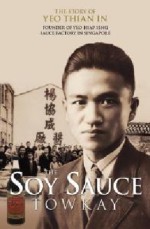
The Soy Sauce Towkay by Alfred Yeo
My mom passed me this book quite some time ago, but I didn't get around to reading it till now. It's a biography of Yeo Thian In, and by extension Yeo Hiap Seng, the company that he founded.The Soy Sauce Towkay focuses on Yeo Thian In (the "towkay" in question) and his Christian faith. And the fact that my Church is mentioned probably explains why my mom knew about this book. And if you're not Singaporean or Malaysian, "towkay" means "boss" in English.
The book is divided into four parts: the background, as in what happened before the company was founded, the founding of the company and how it grew (I didn't know that Yeos started out with Soy Sauce! I only know it for the drink), the Yeo family, and more background, this time on Christianity in China, Chinese business practices, etc. The appendix is a discussion on what makes a business Christian.
And I think in the second part, on the business, they have a chapter about how soy sauce is made, so there's more background there.
I don't know if it's because the book is fairly short, but Yeo Thian In remained a distant historical figure throughout. Unlike some biographies which can resemble novels in style, this read more like a history book.
In addition, I wish that the book went into more detail. For example, it was mentioned that the Yeo family didn't join the Hokkien Association because of religious beliefs, but I would have liked a lot more detail on how that might make doing business more difficult (or not, but it seems like a disadvantage).
That being said, I'm still glad that I read the book, because it's a part of Singapore history that I didn't know, and that I think it's worth knowing. We tend to focus on the same few individuals (like Tan Tock Seng) in our history classes and museums, so it's nice to read about someone else.
Labels:
autobiography/biography
,
Christianity
,
eastern
,
historical
,
non-fiction
,
Singapore
Friday, January 6, 2017
The Good of Giving Up by Aaron Damiani
Even though we're not yet in the Lenten season (it starts 1st March for 2017), I thought it would be a good idea to read this. The Good of Giving Up is a book on what Lent is, why one should practice it, how to practice it, as well as how you can lead others in Lent.
The author is Anglican, but the precepts are applicable to all denominations, even if the applications may differ from Church to Church. Since I'm Methodist, I do know what Lent is. My Church celebrates Ash Wednesday, Palm Sunday, Maundy Thursday, Good Friday and Easter Sunday. We also encourage each other to do a partial fast, but I don't recall having an in-depth lesson on the meaning of Lent and it's relation to the Church.
If I were to summarise part 1, the explanation of Lent and why we should practice it, it would go like this: Lent is a way for us to prepare ourselves for the feasting and rejoicing of Easter: as the book puts it:
The last part, part 3, is for pastors, parents and Church leaders, and deals with how one can lead others through Lent.
I am really thankful that I read this book. I've never really practiced Lent (apart from celebrating the different days), and I realise that this is leading me further away from God. The purpose of Lent isn't to be good only for that 40 days (as the book says, we can make every Friday a 'little Lent' and every Sunday a 'little Easter'), but to help us reorientate ourselves towards God, which carries over to the next year.
I suppose it's good that I read this way before the Lenten season. It will give me time to digest all the information here and prepare myself to practice Lent next year.
Disclaimer: I got a free copy of this book from the publisher via NetGalley in exchange for a free and honest review.
The author is Anglican, but the precepts are applicable to all denominations, even if the applications may differ from Church to Church. Since I'm Methodist, I do know what Lent is. My Church celebrates Ash Wednesday, Palm Sunday, Maundy Thursday, Good Friday and Easter Sunday. We also encourage each other to do a partial fast, but I don't recall having an in-depth lesson on the meaning of Lent and it's relation to the Church.
If I were to summarise part 1, the explanation of Lent and why we should practice it, it would go like this: Lent is a way for us to prepare ourselves for the feasting and rejoicing of Easter: as the book puts it:
We are so full on the junk food of our culture that we cannot metabolise the feast on our Easter plates.When we learn to focus our attention on our Heavenly Father and not on the issues of this world, the meaning of Easter becomes stronger. The author paraphrases Lord of the Rings when he says that on Easter:
[E]verything sad was coming untrue. Death itself had been turned on itself. Satan and his demons had run into the mousetrap of the cross, forfeiting their treats. And our Hero was making good on all His promises, sending His Spirit to renew the face of the earth, giving gifts as He ascended to His rightful throne.Part 2 is on how we can practice Lent. Lent is practiced through fasting, prayer and generosity (also almsgiving). The fast can be a partial or a whole fast, and there is concrete advice for the prayer and almsgiving sessions as well.
The last part, part 3, is for pastors, parents and Church leaders, and deals with how one can lead others through Lent.
I am really thankful that I read this book. I've never really practiced Lent (apart from celebrating the different days), and I realise that this is leading me further away from God. The purpose of Lent isn't to be good only for that 40 days (as the book says, we can make every Friday a 'little Lent' and every Sunday a 'little Easter'), but to help us reorientate ourselves towards God, which carries over to the next year.
I suppose it's good that I read this way before the Lenten season. It will give me time to digest all the information here and prepare myself to practice Lent next year.
Disclaimer: I got a free copy of this book from the publisher via NetGalley in exchange for a free and honest review.
Labels:
Christianity
,
NetGalley
,
non-fiction
Monday, December 5, 2016
Seeking Allah, Finding Jesus by Nabeel Qureshi
All of us have biases. We use it to look at the world and interpret the different things. That's the reason why two people can look at exactly the same thing and have two differing interpretations. And because these biases are so crucial in how we see the world, it's hard to hold them up and examine them. And it's even harder to reject them - especially when rejecting them means rejecting your entire support system as well.
And yet, that is what Nabeel Qureshi has done. Seeking Allah, Finding Jesus is his extremely moving testimony of how he was raised in a loving Muslim home, and how after investigating both Christianity and Islam, he ended up converting to Christianity. (Also, I just want to say - I was super surprised and happy to see that he did TOK (Theory of Knowledge). If it's the same TOK that I did, then he's a fellow IB alumni!)
This book is part testimony, part introduction to a comparison between Islam and Christianity. Of course, it's not as complete as No God but One (the later book that takes a much more in-depth view of the similarities and differences between the two religions), but it's a very good introduction to the whole thing.
There's not much more I can say. I have no regrets about buying this book, and I thought it was a very engaging, encouraging and enlightening book. Definitely a must-read, especially in the multi-religious world that we live in.
And yet, that is what Nabeel Qureshi has done. Seeking Allah, Finding Jesus is his extremely moving testimony of how he was raised in a loving Muslim home, and how after investigating both Christianity and Islam, he ended up converting to Christianity. (Also, I just want to say - I was super surprised and happy to see that he did TOK (Theory of Knowledge). If it's the same TOK that I did, then he's a fellow IB alumni!)
This book is part testimony, part introduction to a comparison between Islam and Christianity. Of course, it's not as complete as No God but One (the later book that takes a much more in-depth view of the similarities and differences between the two religions), but it's a very good introduction to the whole thing.
There's not much more I can say. I have no regrets about buying this book, and I thought it was a very engaging, encouraging and enlightening book. Definitely a must-read, especially in the multi-religious world that we live in.
Labels:
Christianity
,
non-fiction
Thursday, September 29, 2016
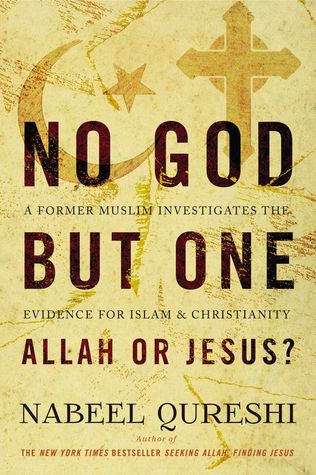
No God but One: Allah or Jesus by Nabeel Qureshi
To be honest, it was not the title of the book that caught my attention, but the prologue. The tale of Fatima, who was discovered to be a Christian by her brother and given the ultimatum "Repent! Otherwise, you have blasphemed!" (Blasphemy = death in this case) caught my heart and got me to request the book.
What made Fatima convert?
I confess that though I know the basics of Islam (mainly through school and newspaper articles whenever there's a conversion case going on), I don't really know what it's about. If you asked me to talk about Islam and Christianity, I would not be able to say anything.
Now, though, I feel much more equipped.
No God but One is written by Nabeel Qureshi, a former Muslim turned Christian who is more than qualified to write this book, having been raised in one religion and turning to the other only after thorough investigation (in fact, he's with Ravi Zacharias' ministry now). The book looks first at the differences between Islam and Christianity - specifically, the Sharia vs the Gospel, the Tawhid vs the Trinity, Muhammad vs Jesus, the Quran vs the Bible and Jihad vs the Crusades.
That alone would have been a lot to digest, but the author goes on to consider the question "Can we know whether Islam or Christianity is true?" The author takes the central questions of each religion and presents two cases for it: one for and one against. And then, as an objectively as he can (acknowledging that people in their religion will have the tendency to accept one set of facts readily and the other less so), he tries to evaluate it.
I found this book to be incredibly enlightening. This conversation (the part 2 evaluation) was actually started while the author was trying to convert a Christian friend to Islam, so his struggles with accepting what he didn't want to accept came across clearly.
Not only will I be re-reading this book in the future, I also want to look for the other books that the author has read. Hopefully, I have enough money to do so.
Disclaimer: I got a free copy of this book from the publisher via NetGalley in exchange for a free and honest review.
What made Fatima convert?
I confess that though I know the basics of Islam (mainly through school and newspaper articles whenever there's a conversion case going on), I don't really know what it's about. If you asked me to talk about Islam and Christianity, I would not be able to say anything.
Now, though, I feel much more equipped.
No God but One is written by Nabeel Qureshi, a former Muslim turned Christian who is more than qualified to write this book, having been raised in one religion and turning to the other only after thorough investigation (in fact, he's with Ravi Zacharias' ministry now). The book looks first at the differences between Islam and Christianity - specifically, the Sharia vs the Gospel, the Tawhid vs the Trinity, Muhammad vs Jesus, the Quran vs the Bible and Jihad vs the Crusades.
That alone would have been a lot to digest, but the author goes on to consider the question "Can we know whether Islam or Christianity is true?" The author takes the central questions of each religion and presents two cases for it: one for and one against. And then, as an objectively as he can (acknowledging that people in their religion will have the tendency to accept one set of facts readily and the other less so), he tries to evaluate it.
I found this book to be incredibly enlightening. This conversation (the part 2 evaluation) was actually started while the author was trying to convert a Christian friend to Islam, so his struggles with accepting what he didn't want to accept came across clearly.
Not only will I be re-reading this book in the future, I also want to look for the other books that the author has read. Hopefully, I have enough money to do so.
Disclaimer: I got a free copy of this book from the publisher via NetGalley in exchange for a free and honest review.
Labels:
Christianity
,
NetGalley
,
non-fiction
Thursday, July 21, 2016
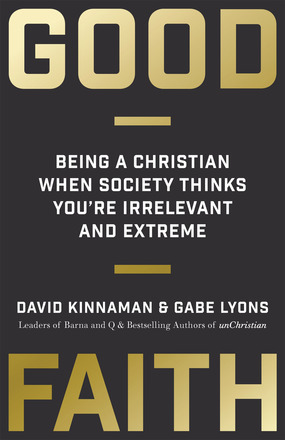
Good Faith by David Kinnaman & Gabe Lyons
With a subtitle like "being a Christian when society thinks you're irrelevant and extreme", how can I not read it?
I suspect that I did, however, approach the book differently from most of the audience. For one thing, I'm not American, so I never grew up with the "Christian nation" idea. For another, Singapore is proudly multiracial and multireligious, so living with people who don't share my views is something something that I do consider natural. But, the tensions between the religious and non-religious have been rising lately, so I figured that this book might have something useful. Oh, and this means that I didn't really look at the stats in the book either, so no comment there.
Rather than tell you what to do, Good Faith provides a blueprint ("Love - Believe - Live") and explores how we can use it to engage with the people around us while standing firm for Christ. There is some theology in it, but not as much as I was expecting.
Oh, and by the way, this book also introduced me to Darling magazine, which I really do like. Apart from the no-photoshop thing, the content (covering things from the price of people pleasing to what's in someone's bag and healthy replacement for junk foods) also appeals to me. So there's always that.
But, I did find a lot in this book illuminating, especially the different approaches that they raised. In particular, I really like the discussion on tolerance:
The other thing I liked was their point on how you don't have to have an other half to live a fulfilled life. They were very clear that as Christians, we are to build a family of brothers and sisters in Christ, and that our one purpose is not to get married and have kids. A lot of my friends are getting engaged or in long term relationships, so it's always good to have encouragement that there is nothing wrong with being single, because there are many other meaningful relationships that you can have. I am not defined by my relationship status, and no one should be either.
All in all, I'm pretty happy that I bought and read this book.
I suspect that I did, however, approach the book differently from most of the audience. For one thing, I'm not American, so I never grew up with the "Christian nation" idea. For another, Singapore is proudly multiracial and multireligious, so living with people who don't share my views is something something that I do consider natural. But, the tensions between the religious and non-religious have been rising lately, so I figured that this book might have something useful. Oh, and this means that I didn't really look at the stats in the book either, so no comment there.
Rather than tell you what to do, Good Faith provides a blueprint ("Love - Believe - Live") and explores how we can use it to engage with the people around us while standing firm for Christ. There is some theology in it, but not as much as I was expecting.
Oh, and by the way, this book also introduced me to Darling magazine, which I really do like. Apart from the no-photoshop thing, the content (covering things from the price of people pleasing to what's in someone's bag and healthy replacement for junk foods) also appeals to me. So there's always that.
But, I did find a lot in this book illuminating, especially the different approaches that they raised. In particular, I really like the discussion on tolerance:
"True tolerance is an ability to acknowledge and permit other people's views. To put up with opinions with which you don't agree. To live with ideas and people you find appalling. True tolerance - some call it "principled pluralism" - is a fundamental feature of a truly free society.
But a new definition of tolerance, let's call it "fake tolerance", has emerged over the last decade. It goes something like this: "We will tolerate you as long as your opinion falls within the range of what we deem acceptable." Diverge from society's groupthink on any number of issue, and you are a bigot- or an extremist. In the name of tolerance, fake tolerance is a terrible and ironic counterfeit."I find that this really resonates with me, and I hope Singapore never loses this spirt of tolerance.
The other thing I liked was their point on how you don't have to have an other half to live a fulfilled life. They were very clear that as Christians, we are to build a family of brothers and sisters in Christ, and that our one purpose is not to get married and have kids. A lot of my friends are getting engaged or in long term relationships, so it's always good to have encouragement that there is nothing wrong with being single, because there are many other meaningful relationships that you can have. I am not defined by my relationship status, and no one should be either.
All in all, I'm pretty happy that I bought and read this book.
Labels:
Christianity
,
non-fiction
,
western
Wednesday, July 6, 2016
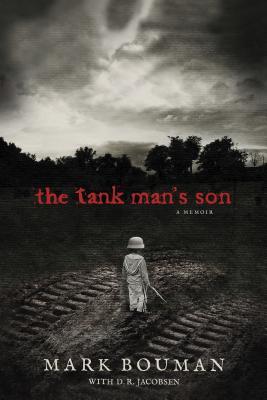
The Tank Man's Son by Mark Bouman
The Tank Man's Son is supposed to be a memoir as powerful as Angela's Ashes. Since I loved that, I had high expectations of this. While the book isn't quite Angela's Ashes (and let's face it, it would be tremendously difficult to live up to that), it is a moving read.
Mark Bouman is the Tank Man's Son. He grew up with an overbearing, Neo-Nazi father, who (as his mother said), "valued things and used people". Among other things, his father got a tank, even though the family was struggling to get by. Hence the reputation as the Tank Man's Son, and a huge struggle to fit in. The story is quite sad for most of the book, but it does have a happy ending, as Mark learns his true worth in the eyes of God and manages to pull his life together and even learn to forgive his father.
Oh, and while there was a trigger warning about language, I found it pretty mild. Or at least, it's pretty run of the mill for most fiction aimed at adults.
In fact, if I were to complain about something, I would say that I was more interested in how a Neo-Nazi managed to get by in America without any one (aka the CIA or FBI) taking note. But the book was short on details. So to me, his dad was more of an abusive dad, which while no less tragic, isn't exactly "neo-Nazi".
Overall, though, I really enjoyed this memoir. While the subject matter was dark, this was an ultimately inspiring book about how God can use anyone.
Disclaimer: I got a free copy of this book from the publisher via NetGalley in exchange for a free and honest review.
Mark Bouman is the Tank Man's Son. He grew up with an overbearing, Neo-Nazi father, who (as his mother said), "valued things and used people". Among other things, his father got a tank, even though the family was struggling to get by. Hence the reputation as the Tank Man's Son, and a huge struggle to fit in. The story is quite sad for most of the book, but it does have a happy ending, as Mark learns his true worth in the eyes of God and manages to pull his life together and even learn to forgive his father.
Oh, and while there was a trigger warning about language, I found it pretty mild. Or at least, it's pretty run of the mill for most fiction aimed at adults.
In fact, if I were to complain about something, I would say that I was more interested in how a Neo-Nazi managed to get by in America without any one (aka the CIA or FBI) taking note. But the book was short on details. So to me, his dad was more of an abusive dad, which while no less tragic, isn't exactly "neo-Nazi".
Overall, though, I really enjoyed this memoir. While the subject matter was dark, this was an ultimately inspiring book about how God can use anyone.
Disclaimer: I got a free copy of this book from the publisher via NetGalley in exchange for a free and honest review.
Labels:
autobiography/biography
,
Christianity
,
NetGalley
,
non-fiction
,
western
Monday, June 8, 2015
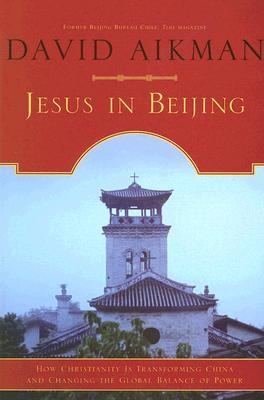
Jesus in Beijing by David Aikman
I remember reading John Sung's biography (or was it autobiography?) a few years ago. Back then, I immediately questioned the accuracy of the stories, because it seemed like miracles were being performed left, right and centre. I remember one being an unsaved woman who died, was brought back to life to accept God, before dying again. My skepticism levels went right through the roof (especially since you don't get this sort of things in Singapore).Reading Jesus in Beijing didn't get me to believe the above miracle, but I do better understand how those miracles could have made it into the book. And ok, I'm a bit more openminded about it - I can't say that it's impossible, especially since I believe that miracles have occurred (I have a tendency towards cessationism, although I can't say I'm firmly in that school of thought).
Basically, Jesus in Beijing is an overview of Christianity in Japan, and a quick biography of the main movers and shakes. Basically, it's like a book of mini-biographies, with a quick history lesson in the front, and a discussion of the role of foreigners and the Church's future at the back. The edition I read is from 2003, and I believe there's been a revised version, so I'm not sure how much stuff I'm missing, especially for the "future" section, because the Beijing Olympics, which was talked about as a good opportunity for spreading the Gospel, has passed.
I really liked this book. For some reason, I found it to be a very convincing piece on how Christianity in China was, and how it is, right now. I liked the appendix, which has the Church's confession of faith, among other documents, although I wish there was a Chinese version as well. I'm not sure how much I can read, but it'll be interesting to take a crack at it.
I wish I read this book earlier. I think having the history of the Church in China explained to me before I started reading autobiographies and biographies of some of the Church leaders would have made the way I read the latter works so much informed, and more balanced.
Labels:
Christianity
,
eastern
,
non-fiction
Thursday, March 26, 2015
A Thousand Lives by Julia Scheeres
I was actually looking for Under the Banner of Heaven in the library when I came across this book. I think I've also seen it mentioned in Longreads, so I decided to pick it up. After all, I've heard of the phrase "drink the kool-aid", but have no idea what's the story behind it.
And the story is... really heartbreaking.
Jim Jones, the founder and pastor of People's Temple Full Gospel Church ("Temple" for short), started out with a message of racial equality. But in the end, he let almost 1000 people, about 300 of them children/infants to their deaths in a mass murder-suicide. Why? This book charts the degeneration of Temple, and the deception of the congregation, who honestly believed that by following Jim Jones, they would be working towards a fairer, better America. But in the end, through fear and persuasion, they all drank poison and died agonising deaths, with very few survivors.
What I noticed, was that the more Jones twisted the Bible, the more he started to use fear, threats, and intimidation to rule his congregation. In the end, Jones declared himself God, but instead of performing miracles, used tricks to keep people in line.
Another thing that struck me is the number of people who are complicit in this crime. Jones grows increasingly deranged and fanatical as time goes by, but if it weren't for the lawyers or members of government (both in the US [at the start] and Gunyana), the press who allowed themselves to be bought and all the members and accomplices that helped him carry out his tricks. True, some defected, but until they defected, they carried out a lot of serious damage. This tragedy wasn't the work of one deranged man, it's the result of a lot of misguided people unknowingly working together to help a madman.
This book is eye-opening. I had not heard of Jonestown and this tragedy before, and I wonder why it has been forgotten. It's a reminder that tragedies are around the corner, and that things with the best intentions can be twisted, and people with the best of intentions can be deceived.
My thought when I finished this book was "what a waste". If Jim Jones had kept his grasp on sanity, and a firm grasp on Scripture, we could be now reading about how the Temple was a driving force for equality and racial integration in America. Instead, we're now reading about how a madman managed to kill so many people.
And the story is... really heartbreaking.
Jim Jones, the founder and pastor of People's Temple Full Gospel Church ("Temple" for short), started out with a message of racial equality. But in the end, he let almost 1000 people, about 300 of them children/infants to their deaths in a mass murder-suicide. Why? This book charts the degeneration of Temple, and the deception of the congregation, who honestly believed that by following Jim Jones, they would be working towards a fairer, better America. But in the end, through fear and persuasion, they all drank poison and died agonising deaths, with very few survivors.
What I noticed, was that the more Jones twisted the Bible, the more he started to use fear, threats, and intimidation to rule his congregation. In the end, Jones declared himself God, but instead of performing miracles, used tricks to keep people in line.
Another thing that struck me is the number of people who are complicit in this crime. Jones grows increasingly deranged and fanatical as time goes by, but if it weren't for the lawyers or members of government (both in the US [at the start] and Gunyana), the press who allowed themselves to be bought and all the members and accomplices that helped him carry out his tricks. True, some defected, but until they defected, they carried out a lot of serious damage. This tragedy wasn't the work of one deranged man, it's the result of a lot of misguided people unknowingly working together to help a madman.
This book is eye-opening. I had not heard of Jonestown and this tragedy before, and I wonder why it has been forgotten. It's a reminder that tragedies are around the corner, and that things with the best intentions can be twisted, and people with the best of intentions can be deceived.
My thought when I finished this book was "what a waste". If Jim Jones had kept his grasp on sanity, and a firm grasp on Scripture, we could be now reading about how the Temple was a driving force for equality and racial integration in America. Instead, we're now reading about how a madman managed to kill so many people.
Labels:
Christianity
,
historical
,
non-fiction
,
western
Subscribe to:
Posts
(
Atom
)