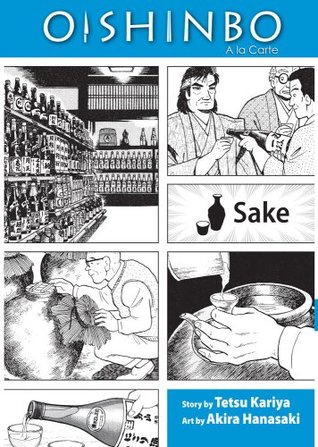
Every time I read Oishinbo, I wish that it was translated and published in English in chronological order like most manga. Having them published by subject means that the overarching plot becomes jumbled and impossible to follow. That said, having them published by subject means that it’s possible to quickly and easily learn about one aspect of Japanese cuisine.
Like the title says, Oishinbo: Sake is all about sake. Sake is actually a generic word for alcohol, what this book focuses on is mostly nihonshu (Japanese alcohol), with one story on champagne. There are six stories in this book and they basically focus on how a lot of sake in Japan is fake sake (diluted with alcohol and additives) which tastes completely different from real sake. And that real sake pairs wonderfully with food and can hold its own against the finest wines.
While most of the stories are short, there is one six-part story called “The Power of Sake” that goes into detail on how sake is made, how to differentiate between the different types of sake, and the sake scene in Japan (at the time it was written - this manga is really old so things probably have changed a lot by now). There is an abundance of information here and I wish that I read this earlier.
As someone who wasn’t fond of nihonshu when I lived in Japan, I wonder if my dislike of the strong alcohol taste was because I wasn’t drinking the real stuff. As a student, our class parties would take place at restaurants with all-you-can-drink options, which I guess makes it natural that they would only serve the cheaper nihonshu.
I would definitely recommend this book (and entire series) to anyone who loves Japanese food! The style of drawing is slightly different from the regular shoujo and shounen manga around today, but the stories are interesting and information-packed. I only managed to read the first few volumes in Japanese, so if I see other English translations, I’m gonna borrow them even though the big storyline won’t make sense.
Showing posts with label food. Show all posts
Friday, June 22, 2018
Thursday, April 27, 2017
Rosé All Day by Katherine Cole (ARC)
I'm not knowledgeable about wine, but I do prefer it to beer. So when I saw this book, I thought it was a good time to learn a little bit more about rosé, which I didn't even realise was a separate category (I thought it was a little bit like champagne rather than a third category).Basically, rosé can be made many different ways. You can use red grapes, you can use white grapes and red grapes and you can basically mix them in a bunch of different ways. And that's everything that I got out of the technical aspect. I will probably have to reread that section.
After the first chapter, which talks about the history what makes rosé, rosé, the book goes into detail on the different regions that produce the wine, as well as the recommended wines from each region. There's a helpful price guide, so if you're budget conscious, you can just look for the single $ sign wines and ignore the rest. Unfortunately, there isn't a list of all the names of wines categorised by price, but there is a list of top 5 wines for each price range, which could be helpful. The book also has a list of websites that you can buy rosé from, though I don't know which countries it sells to.
If you're interested in drinking more rosé and/or learning about it, I think this book will be a helpful guide. Even if you don't want to learn about its history, you could use the rest of the book as a guide to picking out wines.
Disclaimer: I got a free copy of this book from the publisher via NetGalley in exchange for a free and honest review.
Labels:
ARC
,
food
,
NetGalley
,
non-fiction
Wednesday, March 15, 2017
Animal, Vegetable, Miracle by Barbara Kingsolver
I had really high hopes for this book, and the premise is interesting, but it turned out to be only so-so. Animal, Vegetable, Miracle is Barbara Kingsolver's account of the year where she and her family tried to eat only what they raised or was grown locally (with a few exceptions).The premise is interesting and I enjoyed reading some of her accounts, and of course I agree that we should eat seasonal (something that I learnt after coming to Japan - I appreciate the fact that even the big chain supermarkets have corners that are dedicated to local produce), but the book was off-puttingly preachy at times. I probably managed to miss the worst of it by reading only a couple of chapters at the time, but the introductory chapters and "you can't run away on harvest day" were really preachy.
(By the way, I don't know if it helps but I skipped over her husband's columns after one chapter. I persisted with her daughter's columns for a while more but eventually gave up too, since it's basically what her mother says.)
Oh yeah, and the book is basically "we should all eat local and it's totally possible and great for the earth" but doesn't really consider that this is possible only in countries like America. In Singapore, for instance, only 10% of the food consumed is produced locally. An experiment like Kingsolver's is going to be very hard, if not impossible. I even went to Google farmers markets in Singapore and it seems like for at least two, quite a lot of their stuff is imported too - unlike the farmers markets that are so highly praised in the book. A few seem to have more local stuff but they aren't held very often.
Plus, if I'm not wrong, there are studies that say that eating green would be more helpful than eating local - though I'm not too sure and I will not be giving up meat any time soon so I guess I should be choosing the less harmful of the two options.
In short, while I agree that we should try to eat seasonal and local when possible (because it is more delicious - not sure about whether it's cheaper, since Japanese mangoes and grapes are more expensive than the imported ones!), the book is incredibly preachy which makes it hard to read at times.
Labels:
food
,
non-fiction
,
western
Thursday, May 19, 2016
Sushi & Beyond by Michael Booth
After I finished reading this book, I was so, so hungry for good (expensive) Japanese food. And ramen. And soba. And takoyaki. And sushi. And to go see that shoyu factory. In fact, I could probably use this book as a foodie guide book through Japan.
Sushi & Beyond is basically the story of one foodie (and his family's) journey through Japan, eating along the way.
I must admit, I'm actually quite jealous about how much money the author has to have, to be able to fly his family all the way there, travel through Japan (from Hokkaido to Okinawa) and eat so much good food. It's definitely not something that I can afford at the moment.
Oh, and he actually managed to meet Takuya Kimura, but didn't know who he was. I wish I was as lucky as him! I'm going to disagree with the "famous only in Japan" claim because I'm fairly certain SMAP is popular all throughout Asia.
The book may have been published in 2009 (and so, written in perhaps 2007 or 2008?), but apart from the price of Ramen, which can go over 1000 yen now, and perhaps some other things, the rest of the content feels evergreen.
Oh, and judging by the number of times this book was mentions, the author was very clearly more than a little inspired by Japanese Cooking: A Simple Art by Shizuoka Tsuji. In fact, most of his before-trip knowledge came from there.
While I don't agree with all his pronouncements on food - I remember liking some dish he didn't like, but I can't remember what it is or if I dreamt it, it was really enjoyable to read about them. He definitely packed more culinary experiences in his one trip than I have so far.
Oh, and I'm really happy that he likes Fukuoka! To quote the book:
Maybe the Fukuoka tourist board should use this quote. I actually think it's very very accurate, and it explains why a lot of students from Fukuoka don't actually want to leave the place when they're looking for a job.
Overall, I would totally recommend this book if you're looking for a light read on Japanese cuisine. Just don't read it on an empty stomach.
Sushi & Beyond is basically the story of one foodie (and his family's) journey through Japan, eating along the way.
I must admit, I'm actually quite jealous about how much money the author has to have, to be able to fly his family all the way there, travel through Japan (from Hokkaido to Okinawa) and eat so much good food. It's definitely not something that I can afford at the moment.
Oh, and he actually managed to meet Takuya Kimura, but didn't know who he was. I wish I was as lucky as him! I'm going to disagree with the "famous only in Japan" claim because I'm fairly certain SMAP is popular all throughout Asia.
The book may have been published in 2009 (and so, written in perhaps 2007 or 2008?), but apart from the price of Ramen, which can go over 1000 yen now, and perhaps some other things, the rest of the content feels evergreen.
Oh, and judging by the number of times this book was mentions, the author was very clearly more than a little inspired by Japanese Cooking: A Simple Art by Shizuoka Tsuji. In fact, most of his before-trip knowledge came from there.
While I don't agree with all his pronouncements on food - I remember liking some dish he didn't like, but I can't remember what it is or if I dreamt it, it was really enjoyable to read about them. He definitely packed more culinary experiences in his one trip than I have so far.
Oh, and I'm really happy that he likes Fukuoka! To quote the book:
Of all the places we visited in Japan, this was the one we could most see ourselves returning to live in. Small enough to be manageable, but large enough to be interesting, Fukuoka also has a special atmosphere - relaxed, welcoming, fun loving and unpretentious. Throw in a great climate, excellent shops, museums and music venues and a buzzing nightlife district and you have everything you could ever wish for in a city.
Maybe the Fukuoka tourist board should use this quote. I actually think it's very very accurate, and it explains why a lot of students from Fukuoka don't actually want to leave the place when they're looking for a job.
Overall, I would totally recommend this book if you're looking for a light read on Japanese cuisine. Just don't read it on an empty stomach.
Labels:
eastern
,
food
,
japan
,
non-fiction
Wednesday, April 13, 2016
Taste as Experience by Nicola Perullo
I had really, really high hopes for this book. It's basically about exploring what food means to us, and how we can approach it. It is subtitled "The Philosophy and Aesthetics of Food" after all. But, it turned out to be hard to read, which was disappointing.
Basically, Taste as Experience looks as taste from these perspectives:
1. Pleasure: Eating is enjoyable.
2. Knowledge: How does knowing more about the food we eat affect our experience of eating?
3. Indifference: Indifference here means eating without being conscious of the food. Basically, just stuffing it in your mouth.
And finally, "The Wisdom of Taste, The Taste of Wisdom", which is a sort of summary. It did have the most accessible part of the book, which were suggestions on how we can approach food. Among them, "do not have absolute preferences and inclinations" and "only talk about the things you know or experiences you have actually had". To be honest, I'm not too sure how all the suggestions relate to the first three chapters, but that's because I found the book difficult to understand.
Taste as Experience is definitely aimed at an academic audience, and for some reason, I could not understand it. I wish I did, but I didn't. Can anyone give me an easy-to-understand summary?
Disclaimer: I got a free copy of this book from the publisher via NetGalley in exchange for a free and honest review.
Basically, Taste as Experience looks as taste from these perspectives:
1. Pleasure: Eating is enjoyable.
2. Knowledge: How does knowing more about the food we eat affect our experience of eating?
3. Indifference: Indifference here means eating without being conscious of the food. Basically, just stuffing it in your mouth.
And finally, "The Wisdom of Taste, The Taste of Wisdom", which is a sort of summary. It did have the most accessible part of the book, which were suggestions on how we can approach food. Among them, "do not have absolute preferences and inclinations" and "only talk about the things you know or experiences you have actually had". To be honest, I'm not too sure how all the suggestions relate to the first three chapters, but that's because I found the book difficult to understand.
Taste as Experience is definitely aimed at an academic audience, and for some reason, I could not understand it. I wish I did, but I didn't. Can anyone give me an easy-to-understand summary?
Disclaimer: I got a free copy of this book from the publisher via NetGalley in exchange for a free and honest review.
Labels:
food
,
NetGalley
,
non-fiction
,
western
Thursday, March 17, 2016
Tea: The Drink That Changed the World by Laura C. Martin
Let me count the tea-related things I have in my house. I have two bags/boxes of Mlesna tea from my favourite tea shop in Tokyo (specially requested from a friend), I have mulberry tea from Kaogshima, I have the ANA limited edition loose-leaf tea set, and I have the Lotte Milk Tea Chocopie. I even considered buying this overpriced Book of Tea, which is a mook that has 50 samples of tea. Or at least, I considered it until I saw the price. I think it's safe to say that I really, really like tea. Which is why when I heard about this book, and realised it was on Scribd, I had to read it immediately.
This is a non-fiction account of the history of tea, focusing primarily on its history in Asia. The later half does talk about its history in Britain and America, but in not as much detail as in China and Japan, which I thought was a refreshing change of pace. Apart from the historical account of tea, the appendix includes instructions on how to make tisanes, brew a cup of tea, about the types of tea and what time of day different types of tea are best drunk at.
I found it all very interesting, and among other things, I found out that 'low tea' is considered more high class than 'high tea'. Basically, low tea is served on the low tables next to couches and high tea at the dining table. The name comes from the type of table it's served on, rather than the 'class' of the company that is kept. I guess we've been using the word wrongly in Singapore all the while!
And by the way, even though I really love tea, after reading about how tea aficionados can tell where the tea comes from by taste, I feel like I still have a lot to learn about it! Perhaps my tea-lover status should be revoked? I mean, I can tell between the different types of tea, though the variants of green tea are a bit difficult for me (I can tell matcha and non-matcha, and that's it. Black tea vs green tea vs Chinese tea vs Rooibos etc is all fine, because they all taste so different).
This is definitely a good book, and one that I would buy in a heartbeat if I saw it at the bookstore. (assuming a reasonable price) The appendix alone is probably worth it.
This is a non-fiction account of the history of tea, focusing primarily on its history in Asia. The later half does talk about its history in Britain and America, but in not as much detail as in China and Japan, which I thought was a refreshing change of pace. Apart from the historical account of tea, the appendix includes instructions on how to make tisanes, brew a cup of tea, about the types of tea and what time of day different types of tea are best drunk at.
I found it all very interesting, and among other things, I found out that 'low tea' is considered more high class than 'high tea'. Basically, low tea is served on the low tables next to couches and high tea at the dining table. The name comes from the type of table it's served on, rather than the 'class' of the company that is kept. I guess we've been using the word wrongly in Singapore all the while!
And by the way, even though I really love tea, after reading about how tea aficionados can tell where the tea comes from by taste, I feel like I still have a lot to learn about it! Perhaps my tea-lover status should be revoked? I mean, I can tell between the different types of tea, though the variants of green tea are a bit difficult for me (I can tell matcha and non-matcha, and that's it. Black tea vs green tea vs Chinese tea vs Rooibos etc is all fine, because they all taste so different).
This is definitely a good book, and one that I would buy in a heartbeat if I saw it at the bookstore. (assuming a reasonable price) The appendix alone is probably worth it.
Labels:
eastern
,
food
,
historical
,
non-fiction
Thursday, March 10, 2016
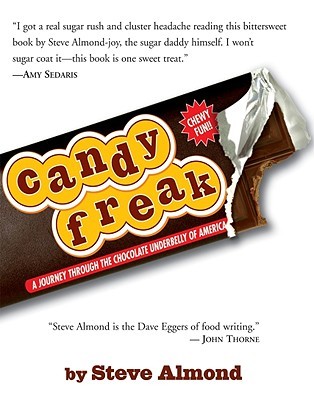
Candyfreak by Steve Almond by Steve Almond
Before I read Candyfreak, I thought I liked Candy. After reading this, I realised that I am far, far from a Candyfreak. Steve Almond is clearly the master here.
Candyfreak is basically about this guy's love story with candy, and about the underdog candy makers (I.e. The companies that are not Nestle and the like). Which is probably why I don't recognise most of the candy here. There's something called the Idaho Spud, there's a Big Hunk, and all sorts of candies that I don't recognise. Clearly when I went to the US, going only Walmarts and Targets meant that I was limiting myself.
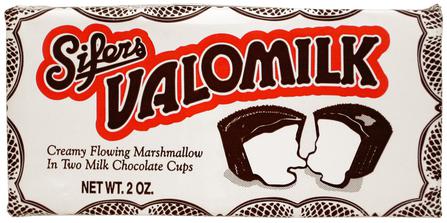
But after listening to Steve describe the candies that he ate, I want to try them all! I especially want to try Valomilk!!
Valomilk is basically a marshmallow cream in a chocolate shell. I imagine it's like Reeses but with marshmallows instead of peanut butter.
I want to try one so badly! But apparently it's only available in some areas of the US, and they don't even deliver to certain regions if the weather is too hot. I don't even know if it's still around, since the book was probably published quite a few years ago.
Anyway, the book has an extremely distinctive conversational style. I find it amusing, but I can imagine some people finding it annoying. But I liked it - it felt like a friend was telling me stories. It was all very amusing, and without you even noticing it, bits and pieces of information - how a candy is made, the history of a company - is slipped into the text. I think I learnt something, though right now, my craving for sweet treats is the most dominant emotion.
If you think you like candy, give this book a go. You might discover that you don't know as much as you think. And if the author didn't live in the US, I'd be tempted to send him some of the bake-able kitkats just to see what he thinks.
Candyfreak is basically about this guy's love story with candy, and about the underdog candy makers (I.e. The companies that are not Nestle and the like). Which is probably why I don't recognise most of the candy here. There's something called the Idaho Spud, there's a Big Hunk, and all sorts of candies that I don't recognise. Clearly when I went to the US, going only Walmarts and Targets meant that I was limiting myself.
But after listening to Steve describe the candies that he ate, I want to try them all! I especially want to try Valomilk!!
![]() |
| Image from Wikipedia |
Valomilk is basically a marshmallow cream in a chocolate shell. I imagine it's like Reeses but with marshmallows instead of peanut butter.
I want to try one so badly! But apparently it's only available in some areas of the US, and they don't even deliver to certain regions if the weather is too hot. I don't even know if it's still around, since the book was probably published quite a few years ago.
Anyway, the book has an extremely distinctive conversational style. I find it amusing, but I can imagine some people finding it annoying. But I liked it - it felt like a friend was telling me stories. It was all very amusing, and without you even noticing it, bits and pieces of information - how a candy is made, the history of a company - is slipped into the text. I think I learnt something, though right now, my craving for sweet treats is the most dominant emotion.
If you think you like candy, give this book a go. You might discover that you don't know as much as you think. And if the author didn't live in the US, I'd be tempted to send him some of the bake-able kitkats just to see what he thinks.
Labels:
food
,
historical
,
non-fiction
,
western
Friday, March 4, 2016
Fizz: How Soda Shook Up the World by Tristan Donovan
Fizz: How Soda Shook Up The World is a history of soft drinks. I used to drink that quite a lot, but after I moved to Japan, I switched to tea and water. Much healthier hahahaha. But still, I was curious to find out the history of soft-drinks.
First off, I had no idea that soft drinks started as carbonated water. Apparently there was an idea that it was good with you. Then people added flavourings. For a while, it was like medicine (Coke started off as medicine, for one). Then it was a treat. And now it's an everyday drink. Although come to think of it, when I was a kid, I think coke (with all the bubbles beaten out of it) was occasionally used as a medicine. I think it was for cough?
I thought it was fascinating how far the influence of soft drinks reached. In particular, Coke, Pepsi and politics. It even spilled over into the race into space.
While the book starts in Europe, most of it takes place in America, since that's where soda was adopted most rapidly. After the war, there's a brief excursion into Japan and other countries. But mostly, it's very Western (particularly American) centric. Well... Looking at the subject matter I guess there's no choice.
I've actually read a related book before - Secret Formula by Frederick Allen, which was an extremely interesting and detailed look into the history of Coca-Cola. I remember saying, in my review for the book, that everything unrelated to coke was brought in only when it affected coke. Well, this book is more about the broader picture, and coke is but one of the many companies it talks about. Fizz is more like a broad look into the soda industry, though in the later half, when companies began to form, it seems to focus more on the leading companies.
So depending on what you're in the mood for, I have two books for you.
If you want a general look at how soft drinks took over the world, read Fizz. If you're a Coke person and you want to know more about your favourite company (as well as all the company politics!), read Secret Formula. Both books are interesting and easy to read.
First off, I had no idea that soft drinks started as carbonated water. Apparently there was an idea that it was good with you. Then people added flavourings. For a while, it was like medicine (Coke started off as medicine, for one). Then it was a treat. And now it's an everyday drink. Although come to think of it, when I was a kid, I think coke (with all the bubbles beaten out of it) was occasionally used as a medicine. I think it was for cough?
I thought it was fascinating how far the influence of soft drinks reached. In particular, Coke, Pepsi and politics. It even spilled over into the race into space.
While the book starts in Europe, most of it takes place in America, since that's where soda was adopted most rapidly. After the war, there's a brief excursion into Japan and other countries. But mostly, it's very Western (particularly American) centric. Well... Looking at the subject matter I guess there's no choice.
I've actually read a related book before - Secret Formula by Frederick Allen, which was an extremely interesting and detailed look into the history of Coca-Cola. I remember saying, in my review for the book, that everything unrelated to coke was brought in only when it affected coke. Well, this book is more about the broader picture, and coke is but one of the many companies it talks about. Fizz is more like a broad look into the soda industry, though in the later half, when companies began to form, it seems to focus more on the leading companies.
So depending on what you're in the mood for, I have two books for you.
If you want a general look at how soft drinks took over the world, read Fizz. If you're a Coke person and you want to know more about your favourite company (as well as all the company politics!), read Secret Formula. Both books are interesting and easy to read.
Labels:
food
,
historical
,
non-fiction
,
western
Wednesday, January 20, 2016
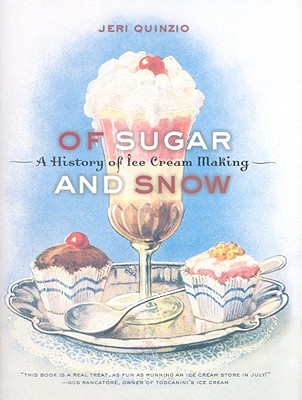
Of Sugar and Snow by Jeri Quinzio
One day, while browsing the library with my mom and bro, I ran across this book. It's supposed to be a history of ice-cream, so of course I borrowed it. I would have borrowed it even if it were a 1000 page monster. But it wasn't, and I was able to bring it with me on a trip. In fact, I actually finished this book on the train, and my conclusion - ice cream lovers, this is for you.
It's basically a very quick history of ice-cream, but with tons of recipes. I don't know how feasible they are, but I suppose if you already have the habit of collecting antique stuff, I think it'd appeal to you. I quite liked reading the recipes, but I doubt I'd make any of them.
Also, Butter Ice-Cream was also a thing. If anyone tries it, let me know how it tastes (and if your arteries clog immediately).
But basically, ice-cream was seen as this really expensive treat, since it was hard to get ice. And the ice-industry used to be people getting natural ice (like the opening of Frozen), and then storing them the whole year round in cellars of some sort. And some people used to believe ice-cream was bad, but ice-cream is ice-cream so people ate them anyway. Now imagine this haphazard summary, but in a much more coherent form, and properly charted across the ages, and you have this book.
Personally, I wouldn't have minded, in fact would have preferred it, if the book spent more time on the various fascinating people involved in the creation of ice-cream (Any history scholars want to write that as a non-fiction series?). It felt like the first few hundred years went by so fast, and that most of the history focused on the American history of ice-ream. That was a bit weird for me, since I would think that the ice-cream in Europe would have continued evolving as America's ice-cream evolved. Maybe with their own varieties or something. Especially considering where ice-cream came from.
Overall, this short and sweet book is a succinct introduction to the delicious cold treat we all like to scream for. I would have preferred to read a more detailed history, but I guess there are other ice-cream history books written for this purpose. This seems to be more for the beginner ice-cream historian (like me), to whet their appetite for more.
It's basically a very quick history of ice-cream, but with tons of recipes. I don't know how feasible they are, but I suppose if you already have the habit of collecting antique stuff, I think it'd appeal to you. I quite liked reading the recipes, but I doubt I'd make any of them.
Also, Butter Ice-Cream was also a thing. If anyone tries it, let me know how it tastes (and if your arteries clog immediately).
But basically, ice-cream was seen as this really expensive treat, since it was hard to get ice. And the ice-industry used to be people getting natural ice (like the opening of Frozen), and then storing them the whole year round in cellars of some sort. And some people used to believe ice-cream was bad, but ice-cream is ice-cream so people ate them anyway. Now imagine this haphazard summary, but in a much more coherent form, and properly charted across the ages, and you have this book.
Personally, I wouldn't have minded, in fact would have preferred it, if the book spent more time on the various fascinating people involved in the creation of ice-cream (Any history scholars want to write that as a non-fiction series?). It felt like the first few hundred years went by so fast, and that most of the history focused on the American history of ice-ream. That was a bit weird for me, since I would think that the ice-cream in Europe would have continued evolving as America's ice-cream evolved. Maybe with their own varieties or something. Especially considering where ice-cream came from.
Overall, this short and sweet book is a succinct introduction to the delicious cold treat we all like to scream for. I would have preferred to read a more detailed history, but I guess there are other ice-cream history books written for this purpose. This seems to be more for the beginner ice-cream historian (like me), to whet their appetite for more.
Labels:
food
,
historical
,
non-fiction
,
reading challenge
,
western
Monday, June 15, 2015
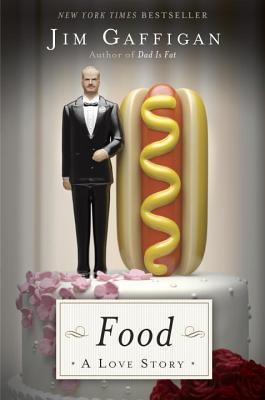
Food: A Love Story by Jim Gaffigan
I'm not sure who recommended this book to me, but I owe them a big thank you. Apparently, I made a reservation for it on NLB, and promptly forgot about it. Good thing the library reminds me when the book is here.
Food: A Love Story is a collection of columns about, you've guessed it, food. It covers topics from the types of food in America to healthy food. For some reason, it reminds me of an American version of Guy Browning's books. Each chapter is a standalone, and as I found out later, is based on Jim Gaffigan's stand-up routines.
Really, I listened to the Hot Pocket routine because it sounded interesting, and I think the later half of the chapter is more or less the routine. So I guess if you're a fan of this guy, you may already know most of the material here.
I think the biggest factor that decides whether you like this book is whether you like the narrative voice. I happened to like it, but at the beginning, I remember thinking "I hope I laugh soon, or I'd get annoyed with the narration fairly soon." Of course, I laughed, and I laughed often. I may not have agreed with him (I love sushi and fish and shellfish and a bunch of other things he doesn't like), but that doesn't matter. It was still funny.
By the way, there's an audiobook version of this book as well, narrated by Jim Gaffigan himself. After watching his routines, I was really excited to listen to it (it's on Scribd!). But, the way he reads the book is different from the way he does stand-up. Stand-up speech sounds a lot more spontaneous, and more expressive. When I listened to the audiobook, I could hear him reading, and it feels like it's more controlled. I'm still listening to the audiobook though, and it was pretty good background listening while I was doing my work.
In conclusion, I found this to be a funny book, and I loved reading it. Whether you will, depends on whether you find the following video funny (yes, I know it's not the Hot Pocket routine, but I think McDonalds is a lot more universal than Hot Pockets):
Food: A Love Story is a collection of columns about, you've guessed it, food. It covers topics from the types of food in America to healthy food. For some reason, it reminds me of an American version of Guy Browning's books. Each chapter is a standalone, and as I found out later, is based on Jim Gaffigan's stand-up routines.
Really, I listened to the Hot Pocket routine because it sounded interesting, and I think the later half of the chapter is more or less the routine. So I guess if you're a fan of this guy, you may already know most of the material here.
I think the biggest factor that decides whether you like this book is whether you like the narrative voice. I happened to like it, but at the beginning, I remember thinking "I hope I laugh soon, or I'd get annoyed with the narration fairly soon." Of course, I laughed, and I laughed often. I may not have agreed with him (I love sushi and fish and shellfish and a bunch of other things he doesn't like), but that doesn't matter. It was still funny.
By the way, there's an audiobook version of this book as well, narrated by Jim Gaffigan himself. After watching his routines, I was really excited to listen to it (it's on Scribd!). But, the way he reads the book is different from the way he does stand-up. Stand-up speech sounds a lot more spontaneous, and more expressive. When I listened to the audiobook, I could hear him reading, and it feels like it's more controlled. I'm still listening to the audiobook though, and it was pretty good background listening while I was doing my work.
In conclusion, I found this to be a funny book, and I loved reading it. Whether you will, depends on whether you find the following video funny (yes, I know it's not the Hot Pocket routine, but I think McDonalds is a lot more universal than Hot Pockets):
Labels:
food
,
humour
,
non-fiction
,
western
Tuesday, March 25, 2014
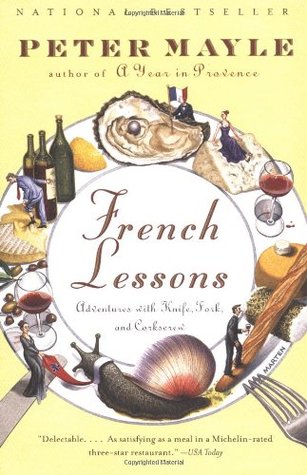
French Lessons by Peter Mayle
I never thought that French cuisine and Singaporean cuisine could have anything in common, but now that I've read this book I think I found one point: both cultures will eat anything. Frogs? Check (frog porridge is really good); snails? sorta-Check (we eat sea-snails, those do count right?). We even have fish head curry. Peter Mayle should totally come to Singapore and do a food tour.
French Lessons isn't about learning French (although considering how entertainingly Peter Mayle writes, he could write a French textbook and I will probably chuckle through it), it's about eating your way through France. It's not a comprehensive guide (in fact, he writes about missing a festival in the book).
In this book, he talks about French chicken, escargot, frogs, and he makes it all sound so good. My favourite festival was probably the slow marathon through the vineyards, because that seems like my kind of exercise. Slow. Another section I liked immensely would be when he and his wife checked into a detox center. It sounds so relaxing yet healthy (so it's win-win!).
Like A Year in Provence (link leads to my review), Peter Mayle writes entertainingly and fondly about France. The only difference is that this is focused on food and covers a wider area of France. He really does seem fond of the country and the way he makes you write made me want to visit.
And yet, he doesn't see France through entirely rose-tinted glasses (perhaps it's only slightly tinted, and only when it comes to food). He writes about a few of his French friends who are pompous and too-smug about their own culture. It's entertaining, but it's not exactly flattering. It's sections like these though, that make me believe what he says, because he seems to be telling the truth.
I believe the book that I haven't read yet is A Dog's Life (wait, have I read it? Or did I just read that one excerpt?) and after reading this, I really have to go and search for a copy.
French Lessons isn't about learning French (although considering how entertainingly Peter Mayle writes, he could write a French textbook and I will probably chuckle through it), it's about eating your way through France. It's not a comprehensive guide (in fact, he writes about missing a festival in the book).
In this book, he talks about French chicken, escargot, frogs, and he makes it all sound so good. My favourite festival was probably the slow marathon through the vineyards, because that seems like my kind of exercise. Slow. Another section I liked immensely would be when he and his wife checked into a detox center. It sounds so relaxing yet healthy (so it's win-win!).
Like A Year in Provence (link leads to my review), Peter Mayle writes entertainingly and fondly about France. The only difference is that this is focused on food and covers a wider area of France. He really does seem fond of the country and the way he makes you write made me want to visit.
And yet, he doesn't see France through entirely rose-tinted glasses (perhaps it's only slightly tinted, and only when it comes to food). He writes about a few of his French friends who are pompous and too-smug about their own culture. It's entertaining, but it's not exactly flattering. It's sections like these though, that make me believe what he says, because he seems to be telling the truth.
I believe the book that I haven't read yet is A Dog's Life (wait, have I read it? Or did I just read that one excerpt?) and after reading this, I really have to go and search for a copy.
Labels:
food
,
humour
,
non-fiction
,
western
Subscribe to:
Posts
(
Atom
)