Showing posts with label economics/business. Show all posts

Tuesday, July 31, 2018

Pound Foolish by Helaine Olen

After reading Dollars and Cents, I decided to pick up another book about money. But unlike Dollars and Cents, Pound Foolish isn't about the wrong ways we think about money, it's an expose of the personal finance and financial industry.

Pound Foolish starts by taking a look at the history of personal finance, starting with S.F. Porter, a personal finance guru who rose to dizzying heights before falling into obscurity. The next chapter continues the examination of personal finance gurus by looking at the controversial Suze Orman and how she changes personalities and advice to suit her audience. Chapter three shifts from people to ideas as the author debunks the latte myth - that our small little luxury spends are what's keeping us from being millionaires. Instead, the book argues that the changes to the economy are so huge and the financial difficulties most Americans face so huge that such small changes will not help.

And that really is the central idea of the book - that personal finance is not personal and that Americans have to change the system of things before they can be financially secure.

Which is why as we read through Chapter four and the rest of the book, the focus slowly shifts from the personal finance gurus to the larger financial industry. Chapter four talks about retirement and criticises the American 401(k) as being inadequate. This chapter also introduces the 'most dangerous woman in America', Teresa Ghilarducci, and her hope to "create a pension plan for all of us by having workers and their employers contribute a minimum of 5 percent of pay into a guaranteed account via mandatory automatic deduction. The government, in turn, would contribute a $600 annual tax credit [...] All this money would be placed in United States bonds which would promise an annual minimum return of 3 percent above the rate of inflation."

That sounded a lot like the Singapore CPF system, in that employees and employers must contribute a certain percentage to a savings account (well actually there are three accounts for different purposes), which have interests rates that range from 3.5% to 5%. Not identical, but similar.

After talking about retirement (and whether Americans can afford it), the book goes on to talk about the culture of commissions in the financial service sector. This was actually pretty disturbing because it's clear that there are people preying on the elderly and not much is being done about it. When the chapter is done, the book continues on the idea of making money through investments (although not necessarily for retirement) by talking about the quest for the perfect investment.

The last three chapters bring the topic back to the topic of personal finance, as they discuss women and money (I know a few people who would have a lot to say about it), how real estate may not actually make you money, and the myth of financial literacy (the author doesn't believe it's possible to be financial literate).

Like I mentioned above, the central idea of this book is that personal finance is not financial and that Americans have been tricked into thinking that it is. To be honest, while a lot of the things here are eye-opening, I'm not entirely convinced by the argument. While it's true that sudden accidents or events can knock you off a financially secure position, advice such as getting rid of debt and cutting down on needless spending isn't bad (that said, some of the debt advice wasn't the best). It almost feels as though the author has no trust in the average American and wants to absolve them of any financial mistakes they might have made because it's the big bad financial industry and personal finance gurus to blame.

I'm not so sure if that's true. I do think that if you teach people how to think about money and to recognise the blind spots in their thinking, it's possible for them to make good decisions. While we probably shouldn't be asking financial institutions to teach people how to be financially responsible, given the conflict of interest, I think trying to make people financially literate is a good goal.

Overall, this was a pretty good book about how the financial environment affects personal finance. Perhaps its because I'm not in America, but I do follow quite a few responsible financial bloggers (although I will admit that there are many irresponsible ones) and I think that they are doing a good job educating people, which is probably why I'm not as pessimistic about the whole thing as the author.

Thursday, July 19, 2018

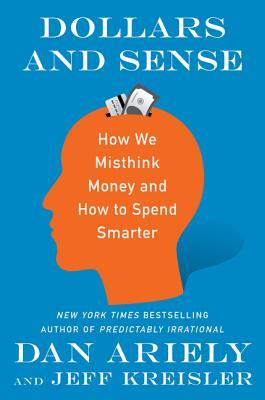
Dollars and Sense by Dan Ariely

Found this book through another Dayrean's review and since I enjoyed Dan Ariely’s other books, I thought I’d give it a go!

Dollars and Sense is a personal finance book, only instead of telling you what to do, the book shows you the financial mistakes you’ve been making and explains why. The first part of the book covers what money is (foundation) and the second, longest, part covers the not-so-rational ways we think about money, such as:

- Relative prices (we’re tempted to buy when we think that we’re saving something even when we’re not)

- Mental accounting (we categorise the ways we spend money which leads to not so prudent financial decisions

- The Pain of Paying (so we value potential loses more than potential gains)

- Anchoring (basing valuation on the first number we see)

- Ownership (if we can see it as ours, we value it higher)

- Whether we think the price is fair (to us and for the effort we see exerted)

- Whether we can restrain ourselves in the present for the sake of the future

- Overemphasising money

- Fancy language and rituals making us value a product more

- Expecting a certain experience vs the actual experience and how that affects our value of it.

After going through all these ‘bad’ thinking habits we have, the book ends on a hopeful note: by offering us strategies we can use. Of course, awareness plays a huge role in helping to avoid such behaviour, but other things we can do is to visualise the future as a concrete thing (save for a specific retirement date, e.g. Dec 1 2050, instead of a vague X years in the future), make good financial habits (like savings) opt out rather than opt in, and other strategies.

I found this book to be very educational and very entertaining! It’s actually co-written by Dan Ariely and Jeff Kreisler; since one of Kreisler’s ‘jobs’ is comedian, it explains the copious amounts of humour in this book. The chapters all focus on one, perhaps two ideas, and are explained using stories that are buffeted by studies.

I would recommend this book to anyone who wants to change the way they think about money. Like another one of Ariely’s books say, we humans are ‘predictably irrational’. That means that we can anticipate certain habits and change them for the better.

Monday, June 11, 2018

The Efficiency Paradox by Edward Tenner

I knew I had to read this book once I saw it because the title is too good to resist. Plus everyone is generally so positive about big data I was quite interested to see some criticism of it.

First, a definition of efficiency. The author defines it as “producing goods, providing services or information, or processing transactions with a minimum of waste”. The book basically goes through the history of the idea of efficiency and then goes on to discuss specific examples: the internet and democratisation of information, teaching, GPS, and medicine.

The way I see it, the entire argument can be summed into: automating things can be inefficient because innovation requires serendipity (which algorithms cannot provide). In other words, innovation requires inefficiency, i.e. ‘wasted’ or failed ideas.

To be honest, I’m not entirely convinced by some of the arguments. I can see how innovation may require ‘waste’, but for specific examples like GPS, it may be that we don’t have enough information to for the algorithms to be useful. Same for teaching - the bigger the database, the easier it is for lessons to be customised for the student.

And for some things, like medicine, I feel that the argument took the wrong direction: the author argues that automated note-taking doesn’t make things more efficient as doctors still spend a lot of time on the computer, but the author doesn’t discuss how the shared information may make the process more efficient if the patient moves between departments. So I felt this was more of a misdirected argument (and not that relevant to the central premise).

Another example would be the argument about ‘waylosing’ (finding something unexpected when you get lost). I agree that it does have benefits, but I don’t think that ‘the inefficient wanderer, on the other hand, will be using his or her time more efficiently by discovering what is less documented, or even undocumented.’ That really depends on your aim in travelling - to learn something new or to get from point A to point B.

Overall, I thought that the book was interesting, but it didn’t really fulfil the ‘promise’ of telling me the limitations of big data. Instead, the arguments in the book talk more about how we’re misusing the platform innovations, which is interesting but not quite the point. Perhaps these are the ‘limitations’ that the subtitle was talking about, but there really should be a clearer line between the limitations and the purpose of each technology.

Tuesday, March 27, 2018

The Captured Economy by Brink Lindsey and Steven M. Teles

I first heard about this book when it was mentioned on episode 829 of Planet Money. The idea that government regulations could lead to increased inequality was pretty interesting, plus the book was written by a libertarian and an American liberal, something you don't really see, so I decided to read the book to find out more.

The Captured Economy is a basically about how rent-creating policies in a variety of fields are leading to an increase in inequality in America. If you don't know what "rent" is, it's basically "the excess payment made to any factor of production (land, labor, or capital) due to scarcity. It's basically the extra money one earns for holding on to a certain factor of production. The book looks at various sectors and argues that there are policies that lead to higher rents, which in turn benefit the people with more money and lead to growing inequality. The sectors are: finance, intellectual property, occupational licensing, and land use.

Strangely enough, the first thing that struck me as very true when I read the book wasn't the rent-seeking part, but this section in the beginning:
"When people feel economically insecure, they grow more defensive, less open and generous, and more suspicious of 'the Other.' When life seems like a zero-sum struggle, gains by other groups are interpreted as losses by one's own group."
I don't think that this is the sole cause of xenophobia, but I do agree that it plays an important role, seeing as many complaints about foreigners tend to come with complaints about how they're 'stealing our jobs'.

The book makes a pretty good case that some pieces of regulation are leading to growing inequality. But, I'm not too sure where is the line to be drawn when it comes to regulation. In the podcast, they mentioned teeth-whitening as an example of excessive occupational licensing. While it may be simpler than other dental procedures, it's not without its risks - in Singapore, some home whitening kits were found to have excessively high amounts of chemicals that would result in overly-sensitive teeth. While excessive regulation is bad, no regulation seems to have the potential to harm consumers as well (especially consumers who don't understand how much of XYZ is safe and may underestimate its effect).

Overall, I thought this was an interesting and thoughtful book. The explanation of rent at the start was clear and the arguments were easy to follow. While the book focuses only on American economics, the theory behind the arguments can be applied to any economy and made me think about how much regulation is necessary in different industries.

Thursday, March 15, 2018

China's Mobile Economy by Winston Ma

Heard about this book from someone on Dayre and it sounded interesting so I decided to borrow it!

China’s Mobile Economy is about the shape of China’s Internet Economy (which is very much shaped by the smartphone). Through ten chapters, the book explores:

- Stakeholders in this mobile economy
- Xiaomi
- Digital retailing
- Entertainment
- The O2O (online to offline) model in the movie business
- The effect of the internet on finance
- Trends, opportunities and challenges of internet and tech companies in China

Within each chapter are columns that explain more about certain cultural terms or norms that may not be immediately obvious to a foreigner.

You don’t have to be an expert on China to read this because the first chapter is on the mobile economy. It will, however, help if you know a little about things like “omnichannels” (which are basically multi-channels but with complete integration).

As you can imagine, this book covers a lot. It’s definitely something to be read a couple of times, because I think it would be very difficult to fully understand everything that this book is talking about on the first read.

Two things mentioned that I thought were interesting were:

- China’s Internet literature: it’s not something I hear a lot, but it seems like the barriers to self-publishing are pretty low and the appetite for serialised, mobile-friendly stories are high. The business model for sites like Shanda Literature is something that Wattpad could learn from (although whether Wattpad’s userbase is open to paying for subscriptions is another matter)

But the fact that online authors exist in great enough number that ranks can be made is very exciting!

- The way the finance industry is being affected. The book specifically mentions WeBank and that it innovates by providing microloans to the public, conducts all operations online, and creditworthiness is analysed by big data.

Personally, I wished for a bit more discussion on the third part because the big data part is very Black Mirror-ish (if you don’t believe me, Wired has a couple of good articles on the issue, including “In China, a three digit score could dictate your place in society”, which has a few not-so-positive first-hand accounts).

Overall, the book is very positive and a good introduction to how China is changing and has been changed by the mobile economy. It doesn’t cover the manufacturing side of things (although it’s arguable related since the infrastructure will play a pretty important role in the future) but I suppose the book would have been far too long if it didn’t have a focus! It’s a bit academic in tone but definitely worth reading if you want to find out what’s going on!

Monday, February 5, 2018

Alibaba's World by Porter Erisman

This was one of the books that I got at the Popular fair last year. I was interested in this because I don’t know much about the Chinese Internet despite black zemi being all about the internet.

Alibaba’s World was written by Porter Erisman, who worked at Alibaba from 2000 to 2008, when it was growing from startup to the juggernaut that it is today. The book focuses mainly on the competition with eBay China and the acquisition of Yahoo! China. At the end, there’s a brief overview of the company and 40 lessons for the reader.

The book is mainly about Alibaba’s history, which was focused mainly on China (they even pulled out their Silicon Valley Office pretty early on), so I think the tagline “how a remarkable Chinese company is changing the face of global business” isn’t very accurate. You won’t really learn the how, although you’ll definitely be able to trace the growth of the company.

What I thought was interesting about my reaction to the book is that I didn’t get the “this company is AMAZING” response that I got when I read biographies of Google (incidentally, Jack Ma met the founders of Google. The meeting did not go well and if you believe this account, it’s Google’s fault). This is despite the fact that the book is highly complimentary towards Jack Ma. While I think that Alibaba’s achievements are amazing, I wasn’t convinced that they’re doing good.

I think part of the reason is because the book doesn’t go much into business ethics (and their stance to counterfeit goods was... standard) and part of the reason is that they don’t seem interested in challenging China’s censorship laws, which I have a pre-existing bias against. Don’t get me wrong, I’m not all in the “all speech should be allowed camp”, but I think that China is way too excessive.

Perhaps this is from the Google meeting, where Jack Ma appeared to be uninterested in getting better search results, unlike the Google People’s (even if they were portrayed as unfriendly).

But I digress.

If you’re interested in learning more about Alibaba, I think this is a good read. It’s not a comprehensive look at the company, but it’s a good, easy to read introduction. And seeing Alibaba’s growing dominance, it may be a good idea to learn more about it.

Monday, October 3, 2016

Overbooked by Elizabeth Becker

When I first flipped through Overbooked, I was rather disappointed that neither Singapore nor Japan got their own chapter. Now that I'm done, however, I feel rather relieved. I like to think that these two countries are doing tourism right, but what if they aren't?

Overbooked is a look at the economy of tourism, and how it's affecting different countries. It's grouped according to a theme, and within each theme, a certain country is highlighted as a case study. The result is an easy to read book that doesn't feel like it's crammed with too much information - on the contrary, the amount of information feels just right.

The themes are:
1. Cultural Tourism
- France sort of does it right
- Venice is probably going to die from tourism
- Cambodia is definitely not doing tourism right and Ankor Wat is at risk (but then again, they do need the tourist money...)

2. Consumer Tourism
- On how big cruise ships suck your money, don't need to follow very high standards (and hence pay terribly low wages and pollute everywhere) and don't really contribute to the economies of the countries they visit. But they'll never admit that
- Dubai: artificially made shopping destination.

3. Nature Tourism
- Zambia is still free of the crowds of tourists (for now)
- Costa Rica seems to be doing it right
- Can Sri Lanka use tourism to help rebuild its economy? (maybe)

4. The New Giant: China
- The government is very, very involved

5. The Old Giant
- Strict visa regulations turn visitors away.

I must say, this book was eye opening in a rather bad way. I've been on cruises, I've been to China and Dubai (and Cambodia on a volunteer trip) and I never really knew how my actions impacted the countries. Especially Cambodia, where my school friends and I went to teach in an orphanage for a day and participated in "dark tourism" (although it was technically an educational trip) - I now wonder if the kids that I taught were orphans, or if they were just bought/taken from their families for the tourist dollar.

The tourist industry is something that is only going to grow bigger, and all of us will be participating in it in one way or the other. I think that it makes sense that we read this book to spark a conversation (if not within a group than within ourselves) on the type of tourism industry that we want in our countries and that we want to participate in.

Thursday, August 4, 2016

Crossing the Chasm by Geoffrey A. Moore

Yes, it's a boring business book review today.

Crossing the Chasm was recommended to me by my teacher, when he found out that my team wanted to do something on social media and why people choose certain platforms over others. While Crossing the Chasm is written for the business looking to bring their product to the mainstream market, I thought it was pretty useful in helping me understand why some products take off while others don't.

The essence of this book is on how to sell to "pragmatists", or the "Early Majority" in the Technology Adoption Life Cycle. I remember an article on how in some cases, laggards can turn into innovators (the case was something on smartphones and kindles or something like that), so I'm not sure how strong the theory is per se, but if you believe the theory holds true, then you're going to be very interested in what the book says.

The strategy in this book is to basically get the company to understand that innovators/early adopters and the early majority are two distinct and separate groups. And because they evaluate and choose products differently, you have to change your strategy when crossing the chasm. This includes targeting niches, positioning yourself and pricing.

There were quite a few examples in this book, but to be honest, I didn't recognise a lot of them (oops?). I guess it really does go to show that the product life cycle is getting shorter and shorter. Either that or I really need to be more observant. But while the examples may be dated, the principles didn't feel so (but I'm not in this industry, so take this with a huge huge grain of salt).

Friday, July 15, 2016

Linked by Albert-laszlo Barabasi

So, I had to read this for a class, which meant that I took notes on every single chapter. So... my review really just consists of my notes. So this review is really just more for me to remember things than for anyone else.

First line:

February 7, 2000 should have been a big day for Yahoo.

The First Link: Introduction - the book opens with the story of mafiaboy, the teenager that managed to bring down Yahoo. Then it changes, quite inexplicably, to Christianity and gives everything to credit. I really don't know if the author simply hasn't read the Bible, or if he's doing one of those things where people pretend that Jesus didn't say the things he said he did. But whatever, the point of this chapter is that the book is about Networks.

The second link: The Random Universe - we have Euler (truly an amazing guy) to thank for the graph theory, which is the basis of how we think about networks. Also, the most brilliant mathematicians are the most eccentric. And from Erdos and Renyi, if we have just an average of one link (connection) per node (e.g. Person), then we have a cluster in which everyone is connected.

The Third Link: Six Degrees of Separation - this concept really emphasises that we live in a small, dense world. Also, I'm starting to get the hang of the story -> concept structure of the book. Interesting, when the author did a study of the web in 1998-1999, the web had 800 million nodes, but it's diameter was only 18.59, aka around 19 degrees of separation. So in other words, the interconnected nature of the network leads to relatively short paths.

Also, 6 degrees of separation may be an overestimation because we don't know everything about our acquaintances and may miss the most efficient route.

The Fourth Link: Small Worlds - The story of weak ties. I remember Dayre-ing about this before, but to quote:

In "The Strength of Weak Ties" Granovetter proposed something that sounds preposterous at first: when it comes to finding a job, getting news, launching a restaurant or spreading the latest fad, our weak social ties are more important than our cherished strong friendships.

Ok, so this chapter is about clustering. Basically, it's an improvement on the Network model by Erdos and Renyi, in that it accounts for both strong and weak ties, making it much more realistic.

The Fifth Link: Hubs and Connectors - This introduces the idea of hubs, which will be familiar to you if you've read Malcolm Gladwell's The Topping Point. The chapter, however, ends by admitting that hubs seem to be a mystery and that they challenge the status quo, so I guess that's the next topic.

The Sixth Link: The 80/20 Rule - From the Pareto rule, we go into the power law, which is related to hubs (hubs being the thing that early network theories said didn't exist). So the question is, why does the power law indicate order coming out of chaos? I don't know, so on to Chapter 7.

The Seventh Link: Rich get richer - The author makes a momentous discovery, writes paper in 10 days. Paper is rejected, but he manages to change editor's mind.

Ok, the actual substance of the chapter is

Real networks are governed by two laws: growth and preferential attachment.

Basically, as the network grows, nodes prefer to form links with other nodes that have many links. I wonder if this is how the first mover's advantage works? I mean, the book calls it "rich get richer", but it sounds like first mover's advantage to me. Something to look into

Oh, and the answer to the question in the previous chapter? The power law isn't about turning chaos into order. It's about "organising principles acting at each stage of the network formation process".

The Eighth Link: Einstein's Legacy - the book anticipated my question, and here, it tackles first mover's advantage. Google is the first case study here - being a success story that was late to the game. Well, to cut the long story short, it's not timing, but 'fitness' (how useful they are, to put it another way), that determine which nodes become hubs. Then there's something about the Bose-Einstein equation, which is quite tough, but the consequences are: "the winner can take all"

The Ninth Link: Achille's Hill - natural systems can withstand high error rates, unlike man-made systems. Except the internet and any network generated on the scale-free network. Apparently hubs keep networks robust? At any rate, error tolerance is a good thing, but it does mean we are vulnerable to attacks (kinda contradictory, imo).

The Tenth Link: Viruses and Fads - what does the spread of AIDS have to do with going viral on the Internet? Both are things that spread over the network. From the Pfizer study, innovations spread from innovators to hubs to the masses, like the product life cycle. Then there is the threshold model, which is the level of evidence we need to accept something new. And if we figure out the critical threshold, we can figure out if the innovation will succeed.

The Eleventh Link: The Awakening Internet - This is kinda like a mini history of the Internet. If you want a more comprehensive look, definitely read Masterswitch by Tim Wu

The Twelfth Link: The Fragmented Web - Continuing from the previous chapters, the Internet is fragmented into smaller communities, which makes sense if you think about it. But it's really hard to find those communities (for researchers).

The Thirteenth Link: The Map of Life - On genetics and networks. To be honest, I don't understand much of it, but basically (I guess) everything is a network.

The Fourteenth Link: The Network Economy - I love the title of this. Totally looking forward to reading it!

And guess what? It turns out that the "old boy's network" is created by small world dynamics. Also, cascading failures (e.g Asian financial crisis) are because of network economies

Networks do not offer a miracle drug, a strategy that makes you invincible in any business environment. The truly important role networks play is in helping existing organisations adapt to rapidly changing market conditions.

Ok, this is very timely. It's easy to see the Network as a panacea, and that as long as we know that it exists, we will succeed. But, as the quote says, the Network isn't necessarily the end, it may only be the means to the end.

The Last Link: Web Without a Spider - to sum: there's a hierarchy of hubs that keep networks close together. But, we haven't completely understood the network yet. Hopefully, though, we can in the future.

And the book is more or less done.

It was an interesting book, but I can't think of anything to say about it that doesn't involve me summarising it. Like, the book anticipated my questions, so... There's not much I can say. And that does sum up the entire review.

Thursday, June 9, 2016

Online Marketing for Busy Authors by Fauzia Burke

I requested this book because it's a topic that I'm very interested in. How can I, as a full-time student who also happens to be job hunting, do online marketing without burning out?

The book is basically divided into three sections:

1. Know yourself
2. Know your audience
3. Ways to reach the audience

Or at least, that's how I see it. The book itself says that it's divided into three phases:

1. Getting Organised
2. Turning your thinking into action
3. Staying the course.

Either way, it's the same thing.

What I liked about this book is that there were concrete exercises on how you can define your author voice and how you can narrow down your target audience. The advice on how to promote pretty much corresponds to everything I've heard and read from self-publishing advice podcasts and books. Actually, I think The Creative Penn, Rocking Self Publishing and the like may be slightly more advanced with the type of marketing they're trying.

Most of the advice seems to be more suited for the non-fiction author, although I think that fiction authors can probably adapt the advice.

The only thing I didn't really agree with was the line "if you are self-publishing your book, you will probably get fewer reviews than if you were published by an established publisher." If you're talking editorial reviews, then I can see how this is the case, but if you're talking about customer reviews (aka Amazon/Goodreads/Kobo/etc reviews), then I don't see how being traditionally published is going to automatically get you more reviews. I think your marketing is going to play a bigger part.

All in all, the advice seems pretty solid and aimed at the beginning author (like me). But, if you're willing to listen to the various podcasts, read blogs, you can probably get much of the same information for free. The next step would be putting it into practice (which I am admittedly lagging behind on)

Disclaimer: I got a free copy of this book from the publisher via Netgalley in exchange for a free and honest review.

Friday, April 1, 2016

The Honest Truth about Dishonesty by Dan Ariely

I read this book while queuing up for some limited edition chocolate cheese tarts (I ended up queueing for two and a half hours, so I actually ended without enough to read). I really loved Predictably Irrational, so I had high hopes for this one. Thankfully, it lived up to my expectations.

Like the title says, the book explores the reasons why people are dishonest. Basically, the Simple Model of Rational Crime (SMORC) doesn't work. If it does, we should be seeing a lot more cheating and crime taking place. So, what propels us to cheat? In a series of experiments, Dan Ariely shows that the truth is slightly more complex.

Basically, there are four forces that decrease dishonest: Pledges, Signatures, Moral Reminders and Supervision. Use these and people will reduce the amount of cheating they do (though it might not be completely eliminated, and can probably be cancelled out).

There are two neutral forces: Amount of money to be gained and the probability of being caught. Although you'd think that people would only cheat if it's worth it or if they wouldn't get caught, apparently, this doesn't make much of a difference.

And there's a long, long list of factors that will actually increase dishonesty:

1. If you can rationalise it
2. If there's a conflict of interest (even if you think you're being impartial, the conflict will influence how you behave)
3. How creative you are (more creative people cheat more, apparently)
4. One immoral act (it's like breaking a diet. One small break can lead to binging on junk food)
5. Being tired/having no energy = no energy to resist temptation
6. If someone else will benefit (so we're being... nice?)
7. Watching others behave dishonestly
8. Culture that gives examples of dishonesty

The book is super readable and extremely easy to understand. If Dan Ariely was my econs teacher, and he teaches like the book, I would probably have chosen to major in behavioural economics. But he isn't, so I ended up doing corporate finance + Industry 4.0/Industrial Internet (technically "Economics of the Telecom industry, but somehow my research for the year was this).

I don't actually have much else to say about the book. It was interesting and informative, and I have no regrets reading it. If you're interested in human behaviour, and what affects it, you should definitely give this book a read. Plus his other book - Predictable Irrational; both books are really excellent. Please don't mistake my lack of things to say as lack of enthusiasm.

Friday, March 11, 2016

Women, Work & the Art of Savoir Faire by Mireille Guiliano

Since I've just entered job hunting season (I even had an all-day event today), I thought this would be a good book to read (who am I kidding, I was reading job hunting books even before the season. Even before I entered university, probably). Plus, it actually kept my attention past the first chapter in a "my Scribd membership is expiring and I have too many books to read" sort of reading death match, where everything that did not catch my interest by the first chapter got filed for "when I'm back in Singapore".

Anyway, Women, Work & the Art of Savoir Faire is meant to be a handbook to women just starting out, to help them navigate the tightrope that is work and life. It's basically full of anecdotes from the author, about her career in the wine business, and what they can mean for the reader.

Personally, I liked the book. I found it engaging, and I liked the author's tone. A lot of what she says makes sense, especially about goal setting and priorities. In particular, the line

"Your heart should be in your work, but that doesn't mean your work has to be something you have always loved."
caught my attention, because a teacher once said something similar. Actually, what my teacher said was "your ideal industry is almost always different from what you think it is, so don't stick to it so closely". I think I like this way of putting it better than my teacher. I mean, I love reading, writing, piano, but I'm not at all of that (i.e. piano), and in fact, what I'm hoping to do in the future is something related to Industry 4.0/Industrial Internet. That's actually pretty broad, so I'm hoping I can find a job that interests me.

Towards the end, she talks about things like the differences between men and women in work, and well, I'm not so sure about that. Other parts of the book, like wining and dining in business, may not be as useful to me, since Japan has a fairly unique dining culture. Although I think with globalisation, what she says is probably going to make sense sooner or later.

Overall, I think this was a good book for me to read at the start of the job hunting season. It managed to calm me down, and remind me to be more selective when picking which events that I want to go to.

Friday, February 19, 2016

Elegant Entrepreneur by Danielle Tate

Since I have an interest in someday starting my own company, when I see guides on "how to" set up one, I tend to request them. And when they're aimed at women, there's no way I'm not clicking that request button.

Anyway, Elegant Entrepreneur is basically geared towards women who want to set up their own companies. It basically takes you from idea (start) to selling your company (end, if you choose). The author is the founder of a business called MisstoMrs.com, which is supposed to be a successful business (I'm not the target of this service (and neither are most people I know), being neither American nor married, so I can't even begin to judge if it's famous or not).

Each chapter is fairly short, with a roundup (Takeaways), a 'How it Feels' (basically action steps) and at least one quote per chapter. Plus, lots of examples of successful women entrepreneurs, which is definitely motivating. There's also a list of relevant books which you can read for more insight at the end of each chapter.

Oh, and there's a glossary of terms at the back of the book too, though I didn't need it at all. But I'm also a business/econs student so quite a lot of this (especially models like SWOT and Porter's Five Forces) are familiar to me.

Actually, I think that this book will be helpful not just to women, but to the men too. The advice is mostly basic but useful stuff, and some of it (like raising funds and seed rounds) are things that I don't really remember seeing in most introductory books. I like that it gives the reader a very concrete idea, rather than vague generalities on getting things done right.

I'd say that this is a very good book to read if you're thinking of starting a business and you're new to the whole industry. It has a lot of resources, it explains things very well, and since it starts from the idea stage, it's perfect for those just starting out. And after you narrowed down what you want to use, more specialised books like The Business Model Canvas might be easier to use.

And yes, all the examples are exclusively female, but in this (hopefully more enlightened era), I believe even guys will find this useful. Plus, if girls could use books that were male-example dominated, there's no excuse why guys can't use a book with examples taken from successful women.

Note: a version of this review first appeared on my Dayre

Thursday, February 18, 2016

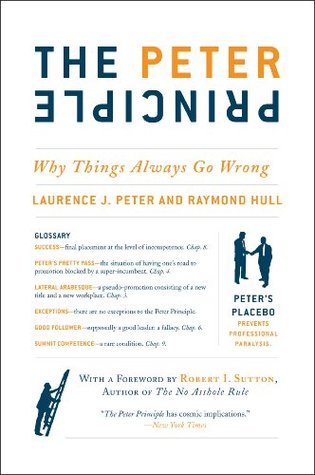
The Peter Principle by Laurence J. Peter

Along with Parkinson's Law ("work expands so as to fill the time available for its completion"), the Peter Principle has got to be one of the most famous unofficial 'rules' of business. While I haven't been able to read Parkinson's Law yet, I did manage to get my hands on The Peter Principle.

Simply put, the Peter Principle is this: "In a hierarchy, every employee will rise to his (or her) level of incompetence". Or in other words, you will be promoted until you become inept at your job, and then you don't get promoted anymore. (And if you're super-incompetent or super-competent, you get fired for disrupting the hierarchy).

The Peter Principle is a general truth written under the guise of satire. The question is, is the Peter Principle, which can be summed up in one line, enough to fill a book?

The answer is... probably not.

The first few chapters were funny, and there were a few chapters at the back which made me chuckle too, but perhaps half the book felt like the author was rehashing the same old thing. True, the examples are amusing, but to be honest, after a certain number, you can more or less tell how it's going to end. Person X is great at Y, then he gets promoted to Z and starts to stink. It was only when the author went into how you can pretend to be incompetent (these are the chapters at the end that I enjoyed) that I felt like the book started talking about something new.

Overall, it's an interesting read, although I think it could have been much shorter.

Thursday, February 11, 2016

The Shift by Lynda Gratton

This was recommended to me by a Japanese friend - he read the Japanese version, which is titled "Work Shift" and confused me because I could NOT find a book by that title. But eventually I found it, and woah, is it a thought provoking read.

The book goes like this. First, the author identifies what she thinks are the most important macro-trends taking place. Next, she looks at six possible aspects of the future, three positive and three negative.

The negative aspects are:
1. Fragmentation - a world where a multitude of things constantly demand our attention.

2. Isolation - a world where the reliance on virtual technology and working from home has led to a dramatic decrease (and almost elimination) of face-to-face meetings.

3. Exclusion - ok, this was a bit hard for me to swallow, because exclusion exists even now. According to the author, the difference is that
"the axis of exclusion has shifted from where you are born to your natural talents and motivations and the specifics of your personal connections." 
To be very clear, I don't think the "specifics of your personal connections" part is a good thing, because it's got a lot relying on who you are born too, which is not something anyone can choose. But the natural talents and motivations bit? It sounds like a fairer world to me. The case study involved a girl who loves World of Warcraft and spends at least four hours a day on it.

Assuming that everyone gets the same baseline education, then I see nothing wrong in a smart and ambitious kid from Vietnam or Cambodia beating out a kid from a Western nation, who prioritises games. If there was a failing in the education system, or some intentional bias in there, then yeah, I see a problem, but other than that, I'm fine with it. I don't think that "where you are born" should determine that you get a better life than someone. "Natural talents and motivations" sounds a lot more meritocratic to me.

Again, I am assuming the same baseline education (i.e. everyone who wants to learn can learn), and that even if you choose to work only part-time because you want to game, you are still able to earn a living. Not a luxurious living, with trips overseas or fancy food, but enough to buy the groceries and pay the bills. I understand the future may be a lot more nuanced, but the way the author expresses the idea means that I don't totally agree that it's a terrible thing. And obviously, the increasing disparity between the rich and the poor is a bad thing too.

The positive aspects are:

1. Co-creation - Working with many people to solve large problems

2. Social engagement - Better work life balance, increased empathy and an option for people who want to, to be able to do meaningful work/take time off from work for long stretches to do volunteer work.

3. Micro-entrepreneurship - People making a living through ecosystems.

After this, the author identifies three shifts that we need to make:

1. From shallow generalist to serial master.

2. From isolated competitor to innovative connector

3. From voracious consumer to impassioned producer.

With recent events like the rise of ISIS and the sudden drop in oil prices may affect the accuracy of the predictions (either by delaying them or changing them), what I appreciated about the book was that it was truly global in outlook. Most of the time, all these books focus on the West, which makes does not really apply to a very large segment of the world. But this book has research done in India, Singapore (our Ministry of Manpower was a sponsor too), and the futures, while do not mention Singapore, are set in Brazil, India etc. I found this very refreshing, and made the arguments more compelling to me, because they seemed more relevant.

 The other thing I liked was the use of 'case studies', where they imagine someone's life in 2025. It makes the concepts a lot easier to understand, especially since things like fragmentation can be a bit confusing.

Overall, this is a though-provoking book, and one that I would encourage everyone to read (Also, you can tell that a book is good when even some time after reading it, it makes a big enough impression that you use it in your arguments on why we do not necessarily need to fear that the future will dehumanise us, even if it is a possibility).

Monday, January 25, 2016

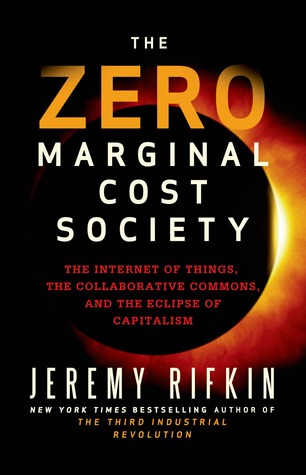
The Zero Marginal Cost Society (Liveblogged Review)

Hey, so a while back, I tried doing a liveblog of this book I had to read for school (and I actually really enjoyed it). It first went live on Dayre (see Part 1 here and Part 2 here), and I thought I'd share it here as well. 

The premise is pretty fascinating. It's arguing that as the collaborative commons rise, capitalism will play a smaller, more streamlined role in the economy.

Makes sense when you think of how we're used to sharing things we make for free (like on Dayre) and using things for free or near free.

While the capitalist market is based on self-interest and driven by material gain, the social Commons is motivated by collaborative interests and driven by a deep desire to connect with others and share.

Chapter 1: Chapter 1 introduces the basic concepts of the book and provides definitions (always good, except now I have yet another definition of IoT (Internet of Things) that I have to work in).

What was new to me was the idea of IoT as the 'soulmate' of the Collaborative Commons. I've been thinking about it in terms of supply chains and productivity, but it does make sense, especially if you're considering it in a broader sense.

While capitalism operates through the free market, free markets don't require capitalism.

Chapters 2,3,4: These 3 chapters are a summary of economic history, and probably a way for the author to reframe our thinking so we're more receptive to his ideas (is that too cynical?)

But basically, the premise is that with the industrial revolutions, we moved towards vertical integration with a central command, but with IoT and the Collaborative Commons (CC), we're moving towards everything integrated but decentralised.

Which begs the question: why are the main movers big companies?

Saw the "study online for almost free" meme. But Coursera does charge for a certified accreditation thing, and that isn't 'nearly free'. So unless employers are willing to accept the free certificates of achievement, MOOCs won't help people who don't have the money to go to university

How then do we ensure an open, transparent flow of data that can benefit everyone while guaranteeing that information concerning every aspect of one's life is not used without their permission and against their wishes in ways that compromise and harm their well-being?

Chapter 5 is about productivity, IoT and free energy. For the energy thing, which was new to me, the author says that renewable energy is the near-free energy, after you recoup the installation (and I suppose switching) costs.

It is true about fossil energies being finite and hence unable to go to free, but I think they do have a role to play in the near future, as we transition. Hence the role of microgrids and virtual power plants.

Smart energy isn't just where the energy comes from, it's also how we manage it. I suspect the IoT/big data methods will apply for all forms of energy - we need to figure out how to adjust supply flexibly and how to predict demand. And of course, on the industrial side, how to use IoT technologies to be more energy efficient.

Chapter 6: 3D printing!! It's something I knew about, but this is the first time that I really see its future tied to the IoT/CC movement. Extremely interesting stuff.

But the author seems to call this movement the Third Industrial Revolution, while in Germany, this is the Fourth Industrial Revolution. Yet another contradiction for my research partners and me...

But I think the concept of moving from mass production to production by the masses is cool. Didn't know Gandhi said something similar:

Knowledge has been enclosed behind the walls of academic institutions whose price of admission excludes all but the wealthiest. That's about to change.

Chapter 7 is about MOOCs and other forms of education. Basically, MOOCs will bring the cost of good education down, and in general, education will become more multidisciplinary and less focuses on rote memorisation.

I mentioned the cost of MOOCs before, but the book is right in saying that it's near free compared to its traditional price. But it may still be expensive and out of reach to the very poor or those with no PayPal or credit cards.

As for the learning style, I love the idea of multidisciplinary themes as the basis of education, but I still feel that for the basics, like the multiplication tables, memorisation is key. Like yes, I can work out multiplication if I needed to, but it's faster to have, say, the times table or Pythagoras theorem memorised, especially when I'm integrating the skill with others.

What I'm saying is that you don't have to memorise stuff, but it might be more convenient to do so.

Chapter 8,9: chapter 8 is about the worker becoming obsolete, while chapter 9 is about the rise of the prosumer, a consumer who also producers. Both are very interesting ideas, although it feels rather America-centric. I'd be interested in seeing how much of what the author is saying is applicable in developing countries (especially the unemployment stuff).

Chapters 10,11,12: These three chapters are grouped together under the section "The Rise of the Collaborative Commons". I think it's a testament to how powerful 'The Tragedy of the Commons' is as an idea that its refutations aren't as well known as the Tragedy is. The chapters also cover topics from Net Neutrality to Copyright and open source/free software.

Do you know that apparently Singapore has the highest rate of illegal downloads (from a 2012 study - looked it up cause my Senpai is doing something similar for his graduation thesis)? So yeah, the copyright thing has me torn.

Like, I totally understand the appeal of getting something for free. But now that I'm about to self-pub, I'm like "RIGHTS RIGHTS RIGHTS". I mean, I probably won't be an overnight sensation, but if I am, I want my rights to help me earn money.

But at the same time, I love the idea of anyone being able to read my words. (Actually I've been considering this problem for some time, along with pricing issues.)

The other interesting idea was designating companies like Google and Facebook and Amazon as 'social utilities'. This is an argument I don't really buy, especially when you start thinking about how much data about us these companies already hold. Plus, they seem giants now, but giants can fall.

Starting on the fourth part, which would be chapters 13 and 14, and saw this very interesting quote redefining freedom. The first past is "The Internet Generation, however, has come to think of freedom not in the negative sense - the right to exclude others - but rather in the positive sense of the right to include others"

Then some elaboration, and then the quote that struck me:

Freedom is measured more by access to others in networks than ownership of property in markets. The deeper and more inclusive one's relationships, the more freedom one enjoys.

Chapter 13, 14: These two chapters make up the section "Social Capital and the Sharing Economy". It might be the most interesting part of the book for me (since IoT disappeared after the first chapter) as it looks at how people are changing the way they share and consume.

I'm not involved in the sharing community, but it sounds really interesting. And I wish that the second chapter, which covers crowdfunding, was a little longer. Actually, I wish both chapters were longer

[...non-book related stuff...]

So I finished the last two chapters. For some reason, they feel like any other book that pushes a new type of thinking/paradigm. That is, it feels very hopeful and like the author has expanded beyond the IoT and econs stuff at the start to talk about an 'economy of abundance'

Or maybe my skepticism is due to the fact that the last two chapters reject the principle scarcity, which is pretty much the first thing that any econs student learns, so it's pretty ingrained in me.

All in all, this is a really good books. It's very thought provoking, and I find it easy to believe/accept a lot of what the author is saying. I do wish there was more emphasis on the IoT side of things, but I think that would be a bit too esoteric for most people, and the Collaborative Commons stuff is the more accessible topic.

Saturday, December 19, 2015

Secret Formula by Frederick Allen

So, are you a Coca-Cola (coke) person or a pepsi person? Personally, I prefer coke (sorry, Pepsi). I think it's because I grew up drinking it, and because Pepsi is too sweet for me.

And now that you know that I prefer coke, it should be no surprised that I requested a book about the history of the Coca Cola company from NetGalley. I wasn't expecting to find the secret formula (that other extremely famous myth about coke) inside, but I didn't expect the history of coke to be this interesting.

For some reason, I always thought coke was a family company. I think it's because of the secret formula thing - if it's taken over, then the formula might be leaked, at least, that was my thinking. But as it turns out, coke was invented by John Pemberton, and then after some business events happen, Asa Candler ended up in control of it, and then Ernest Woodruff (who didn't come across as a very likeable person to me) led a group of investors to take over it, and after that, his son Robert Woodruff. Along the way, the company was listed, World War I and II happened, and coke become a symbol of America (not in that order, obviously).

I should probably just say up front what this book is not. This book is not a business guide disguised as a biography of the company, although I supposed if you wanted, you could learn from it. This book is not a look at America through the eyes of one of its leading companies, although again, since coke did become a symbol of America, it's not surprise that some stuff (like politics, modernisation and social changes) are mentioned, but only as far as they affect coke, or coke affecting them.

This is a book about the history of coke. Everything else, like society, coke's rivals, the legal battles about copyright and drugs in food, all that is brought in as and when it affects coke. If coke was a company that grew placidly and never made mistakes, this book might have been boring. But as it is, coke was dominated by interesting personalities from the start, and the twist and turns of the business made for good read.

Disclaimer: I received a free copy of this book from the publisher via NetGalley in exchange for a free and honest review.

Thursday, November 19, 2015

Creativity Inc by Ed Catmull

This is one of those books that, when I started, was a bit disappointing, but when I changed my mindset, turned awesome and inspiring. There were so many lines that I wanted to save as quotes, such as
Ideas though, are not singular. They are forged through tens of thousands of decisions, often made by dozens of people.
and
For all the care you put into artistry, visual polish frequently doesn't matter if you are getting the story right.

(Although maybe the second quote is only inspiring to me?)

Of course, it makes sense that the book is great for advice on telling a good story - after all, this is a memoir of Pixar, the studio that brought us Monster's Inc, Finding Nemo, etc. Lots of good stories came out from that place.

At first, I approached this book thinking this was going to be a wellspring of story advice. So when I realised it was about the birth of Pixar and what made it Pixar, I was disappointed, to say the least. So I took a break before returning to the book, this time with the mindset of "this is a business biography".

Things really changed after that. Apart from enjoying the history of Pixar, I found lots of gems, such as
When downsides coexist with upsides, as they often do, people are reluctant to explore what's bugging them, for fear of being labelled complainers.
^That is totally true. The fear of being labelled a complainer, especially in a culture that values group harmony, can end up with people getting unhappy and gradually more and more unproductive.

There's a lot of talk about company culture here. The employees are what make Pixar great, and the book talks about how they built the culture, challenges in maintaining it (especially in the face of huge changes), and how problems areas can creep up without anyone noticing - a call to be vigilant, if anything.

The book covers the founding of Pixar to its acquisition/merger with Disney, ending with a note about the author's feelings on the passing of Steve Jobs. Once I changed my expectations, I ended up really enjoying the book, and learning a lot from it. I highly recommend this to fans of Pixar.

Wednesday, August 26, 2015

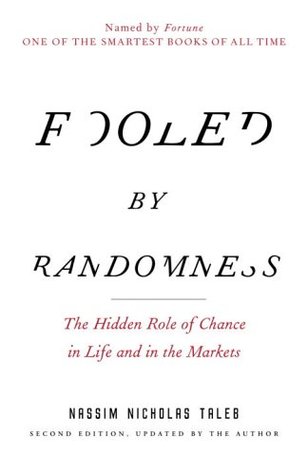
Fooled by Randomness by Nassim Nicholas Taleb

So early this year, I read Predictably Irrational by Dan Ariely, when I mentioned this to one of my teachers, she recommended that I read Fooled by Randomness next, and then The Black Swan.  It took me a long time, but I finally read Fooled by Randomness, and I'll 'tackle' The Black Swan as soon as I can get my hands on a copy.

Fooled by Randomness is written in a very conversational style, and basically makes the case that luck plays a much bigger role in our lives that we expect. We just tend to attribute it to other factors, due to things like survivors bias (but don't worry, you have to work hard if you want to take advantage when luck strikes. So don't stop working just yet).

The book talks about a variety of subjects related to risk and randomness, but the one part that stood out to me came really early in the book - Chapters 1 and 2, in fact. It's the part when Nassim Taleb compares a dentist and someone else (like a lottery winner) and concludes that on average, the dentist is richer. Why? Because the income for dentists don't change much, while only a few people win the lottery. So while the lottery winner may strike it rich (much richer than the dentist, in fact), on average, the average dentist is going to be the richer than the average lottery winner. His/her risk in life is smaller. It's kind of like what one of my teachers said, that if you want stability, you go for a job in the public service (in Japan anyway), but if you want to be rich, you start a company. The catch is that the job in the public service has very little risk, and you know how much you're going to get all the way till you retire. On the other hand, if you start your own business, you may go bankrupt, just break even, live comfortably, or strike it rich beyond your wildest dreams. Which job you choose is a matter of preference, really. There's no right or wrong.

Personally, I enjoyed the extreme conversational style of the book, although I'm not sure if I'd be able to hold myself in a conversation with the author (if I ever met him). There were lots of anecdotes, and lots of references to some guy called Popper. I should probably go read whatever the Popper guy wrote sometime too.

Thursday, April 16, 2015

Coming Up Roses by Cath Kidston

This book was on sale at Popular, so I got it for a song. I've always known about Cath Kidston, and I like the pretty designs, so I figured I'd like a book about how the business was built.

Coming Up Roses was written to celebrate the 20th anniversary of the Cath Kidston brand (I found out that Cath Kidston was founded in the same year that I was born!), and covers things such as her childhood, which influenced her style, her working life before she started the shop, the first few years of Cath Kidston, the growing pains, and so on. And of course, it's lavishly illustrated, with many photos and a series of prints in the middle of the book.

While the book is short, I did enjoy reading about the history of Cath Kidston. The brand came out from Cath Kidston's love of marrying antiques with modernity, and while I don't like every single piece that the brand comes out with, I do like quite a lot of it. It also made me want to go out and buy something from the shop, so I guess it was a fairly successful book.

The thing that I didn't like of the book was that it so heavily borrowed from the interviews with Cath Kidston. That by itself is fine, but it's jarring to read about Cath Kidston in third person, then have pages and pages of text referring to "I". I would have much preferred that the book be written either entirely in first or in third (I like first better, because it's a very warm, engaging voice).

You won't get much business advice in this book - it's very much a follow your heart, try your best and things will somehow be ok type of book - but it's a lovely, encouraging read all the same. It's probably suited to fans of the brand, and for entrepreneurs who need a dose of encouragement.