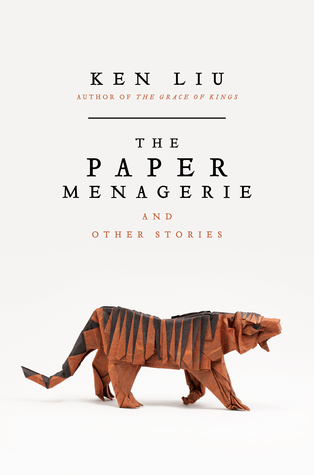
The first time I saw this book, a stranger was reading it in Japanese. I thought it looked interesting, but didn't give it a second thought. But after enjoying The Three Body Problem (which he translated) and having loved The Grace of Kings (which he wrote), I decided to pick this up. As you can probably guess, I had high expectations for this collection.
The stories in this collection are:
- The Book Making Habits or Select Species: This is just an exploration/worldbuilding piece on how other alien species might read. There isn’t any plot but it’s still a cute piece.
- State Change: I loved this one! It’s about Rina, this girl who’s soul is an ice-cube. Her life revolves around making sure her soul doesn’t melt, until she meets an interesting guy in the office. I felt that this was such a great story because it had a good plot with twist, great characters, and a unique setting.
- The Perfect Match: Think of Google’s ledger, if it came to life. But, the story questions of the huge company running the internet is good or bad, which adds another layer of nuance to this story about preferences, algorithms, and free will. Another story that I loved.
- Good Hunting: A story about hunting hulijing and what happens when Western ‘magic’ invades. An East vs West clash kinda story but very captivating.
- Literomancer: Another East meets West story, but this time of an American girl who moves to Taiwan and meets a Literomancer, a man who divines meanings from words. It adds in politics to turn the charming story into a sad one.
- Simulacrum: Another very strong story that I really enjoyed, centered around a father and daughter, about how holograms, recording memories, and what it means to betray another.
- The Regular: Someone is killing high class prostitutes. Ruth Law is asked to find out why. I almost skipped this because the first section is pretty graphic but it turned out to be a good crime story.
- The Paper Menagerie: About a half-Chinese boy who tries to reject his Chinese half, and his mother who makes living, moving paper animals for him. It’s a good story, but somehow, it didn’t touch me.
- An Advanced Readers’ Picture Book of Comparative Cognition: I did not understand this one.
- The Waves: A story about people on the space ship and the choice between immortality and letting your kid grow up. I felt that it started strong but I lost interest halfway, probably because the ending wasn’t really related to the beginning.
- Mono no Aware: It’s the story of this sole Japanese guy on an American spaceship that managed to escape the destruction of earth. Despite the fact that parts of this took place in Kitakyushu and Kagoshima, I didn’t feel like the characters were there at all (I know this is alternate reality but on some level, it should at least feel like the Kyushu I lived in). Which means that I don’t know why he picked a Japanese main character when any other would do.
- All the Flavours, A Tale of Guan Yu, the Chinese God of War, in America: I didn’t think I would like this but I did! It’s about someone who probably is Guan Yu, moving to America to pan for gold, and the little girl he makes friends with. A good story about how different cultures can meld together.
- A Brief History of the Trans-Pacific Tunnel: An alternate history story where Japan became a world power peacefully and there wasn’t WWII. This story didn’t really engage me for some reason. And I was quite puzzled by these lines:
“ “Hoka no okyakusan ga imasu yo. Nani wo chuumon shimasu ka?” Her Japanese is quite good [...] though she is not using the honorific.”
I didn’t quite understand the “she is not using the honorific” line. The Japanese was in standard Japanese, the kind that is fine for strangers and that I’ve heard in many restaurants. So I don’t get why it’s singled out. If the author is referring to “keigo”, then yeah I get it but I would think that if they were going the five-star service way, there’s no way that she would have said “hoka no okyakusan ga imasu yo”, even in the ultra-polite form.
I feel like if I said that at my former workplace, the managers would have told me off for making the customer uncomfortable because we are not to rush them.
- The Litigation Master and the Monkey King: I loved this historical fiction story. It’s based on the Yangzhou Massacre and asks the question: “is it more important to do what’s right, or to keep yourself alive?”
- The Man Who Ended History: A Documentary: The last story in this anthology, it’s about a Chinese-American and Japanese-American couple that claim they can get people to literally experience history. I’m not sure if it’s because of the narrative form, but I did not get this story and ended up tuning out halfway.
Overall, I thought this was a pretty good collection! There were a few stories that I just didn’t get, but that’s more on my part than the story’s (I can see that the story is well-written, but it just did not resonate with me emotionally). I would definitely recommend it to fans of science fiction and fantasy.
Showing posts with label science fiction. Show all posts
Monday, August 13, 2018
Friday, April 13, 2018
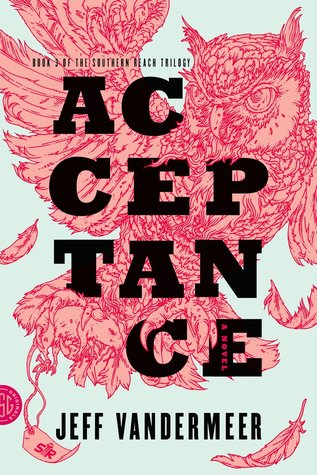
Acceptance by Jeff VanderMeer
I think that compared to other series, I finished the Southern Reach series in the shortest amount of time. But that's a good thing because if the details of Annihilation and Authority were not still fresh in my mind, I doubt that I would understand much of Acceptance. And because of that, expect spoilers for the first two books in the series.
Acceptance picks up directly from where Authority stopped, with Ghost Bird, now revealed to be a clone of the biologist, and Control wandering around Area X. The chapters from their POV are interspersed with chapters from Saul, the lighthouse keeper before Area X was Area X, and Gloria, the director and little girl that used to live in Area X, as she tried to carry out her work. Each person told a different part of the story, but they all filled in one bigger puzzle.
Ghost Bird, Control, and Saul told their stories in third person, but Gloria told hers in second. I'm not too sure what was the effect - perhaps to make us feel closer to her? - but it wasn't unpleasant and I appreciated finding out a little more about Control's mother. I did prefer the third person POV chapters though, because they were a little easier to understand. Then again, perhaps that's why Gloria told her story in second person; it's a little unnerving and she is an unnerving person.
That said, answers are still scant. We do get to find out more about the origin of Area X and why Grace was so hostile to Control, as why as why the Director went on the expedition to Area X, but we don't receive any concrete answers as to why Area X exists or why Control's family is involved. Things are hinted at and I think a second reading might prove more illuminating, but I still have a lot of questions.
If you read as far as Authority, then you need to finish the series and read Acceptance. I feel that these three books are highly dependent on each other (except perhaps the Annihilation, if you're okay with uncertainty over the fate of the Biologist) and these books need to be read in close succession to each other if you want to understand what's going on. And now, I feel like I'm ready for the Netflix movie.
Acceptance picks up directly from where Authority stopped, with Ghost Bird, now revealed to be a clone of the biologist, and Control wandering around Area X. The chapters from their POV are interspersed with chapters from Saul, the lighthouse keeper before Area X was Area X, and Gloria, the director and little girl that used to live in Area X, as she tried to carry out her work. Each person told a different part of the story, but they all filled in one bigger puzzle.
Ghost Bird, Control, and Saul told their stories in third person, but Gloria told hers in second. I'm not too sure what was the effect - perhaps to make us feel closer to her? - but it wasn't unpleasant and I appreciated finding out a little more about Control's mother. I did prefer the third person POV chapters though, because they were a little easier to understand. Then again, perhaps that's why Gloria told her story in second person; it's a little unnerving and she is an unnerving person.
That said, answers are still scant. We do get to find out more about the origin of Area X and why Grace was so hostile to Control, as why as why the Director went on the expedition to Area X, but we don't receive any concrete answers as to why Area X exists or why Control's family is involved. Things are hinted at and I think a second reading might prove more illuminating, but I still have a lot of questions.
If you read as far as Authority, then you need to finish the series and read Acceptance. I feel that these three books are highly dependent on each other (except perhaps the Annihilation, if you're okay with uncertainty over the fate of the Biologist) and these books need to be read in close succession to each other if you want to understand what's going on. And now, I feel like I'm ready for the Netflix movie.
Labels:
fiction
,
science fiction
,
western
Wednesday, November 30, 2016
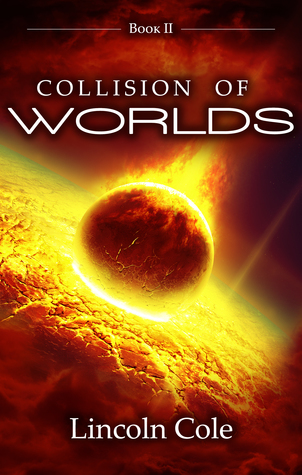
Collision of Worlds by Lincoln Cole
Just finished this second book in the Graveyard of Empires series! I'm happy that I read it soon after I finished the first book, because I suspect that if I left too much time between the two books, I would have another "The Grace of Kings" and "The Wall of Storms" problem where I couldn't remember the main characters for the first few chapters.
Collision of Worlds continues the saga, with a few more pieces moving into place for a huge, explosive ending (which will probably be in a later book). Traq, the kid that we meet in the previous book (the boy that Argus discovers) exhibits more powers. Argus doesn't get as much airtime in this book, but his co-worker, Vivian, does and I really find her character interesting! She has no idea how to raise a child, reading tons of books to compensate, and it leads to her doing some very unorthodox things. Moms may not approve of her.
Maven and Alyssa, the twins in a never-ending battle move their rivalry one step up by betting the lives of Jayson and his teammates. Darius doesn't really appear much, but from Maven's section, I got a much better sense of how the Union operates. And they really, really don't seem much better than the Republic, like I suspected in the first book.
And for the Kristi and her ship - sadly, Kristi and Abigail do not appear as much. Instead, more airtime is given to develop Abdullah, her second in command. And while Abdullah didn't really make that big an impression on me in the first book, (sorry, but Kristi totally overshadowed him) I did remember him and so his enlarged role wasn't as big as a surprise to me.
Two "new" characters are Jim and Oliver. They basically first appeared at the end of the first book, and I totally didn't expect them to start playing a big role. But I find that I quite like their storyline too - Jim's struggles to fit in with the upper class, and his tenuous friendship with Oliver was oddly captivating. And for the record, I find Jim a lot more sympathetic than Oliver, who's more practical and money-minded.
If you liked the first book, you will probably enjoy the second. The cast of characters largely stay the same, with the difference being the amount of page space given to each individual character. I still haven't decided if there's a side that I want to root for, and I look forward to finding out more and more about this world.
Disclaimer: I got a free copy of this book from the author in exchange for a free and honest review.
Collision of Worlds continues the saga, with a few more pieces moving into place for a huge, explosive ending (which will probably be in a later book). Traq, the kid that we meet in the previous book (the boy that Argus discovers) exhibits more powers. Argus doesn't get as much airtime in this book, but his co-worker, Vivian, does and I really find her character interesting! She has no idea how to raise a child, reading tons of books to compensate, and it leads to her doing some very unorthodox things. Moms may not approve of her.
Maven and Alyssa, the twins in a never-ending battle move their rivalry one step up by betting the lives of Jayson and his teammates. Darius doesn't really appear much, but from Maven's section, I got a much better sense of how the Union operates. And they really, really don't seem much better than the Republic, like I suspected in the first book.
And for the Kristi and her ship - sadly, Kristi and Abigail do not appear as much. Instead, more airtime is given to develop Abdullah, her second in command. And while Abdullah didn't really make that big an impression on me in the first book, (sorry, but Kristi totally overshadowed him) I did remember him and so his enlarged role wasn't as big as a surprise to me.
Two "new" characters are Jim and Oliver. They basically first appeared at the end of the first book, and I totally didn't expect them to start playing a big role. But I find that I quite like their storyline too - Jim's struggles to fit in with the upper class, and his tenuous friendship with Oliver was oddly captivating. And for the record, I find Jim a lot more sympathetic than Oliver, who's more practical and money-minded.
If you liked the first book, you will probably enjoy the second. The cast of characters largely stay the same, with the difference being the amount of page space given to each individual character. I still haven't decided if there's a side that I want to root for, and I look forward to finding out more and more about this world.
Disclaimer: I got a free copy of this book from the author in exchange for a free and honest review.
Labels:
science fiction
,
western
Monday, November 21, 2016
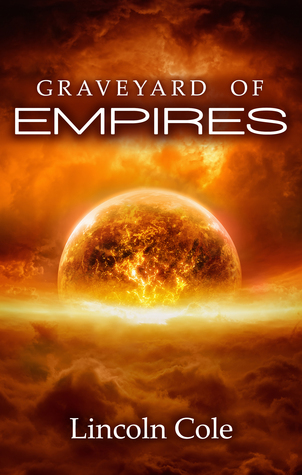
Graveyard of Empires by Lincoln Cole
I just finished this book and it's like woah. Like the title says, this is about an empire. So, expect lots and lots of people.
Graveyard of Empires follows quite a few people. There's Argus, who discovers a very special little boy (Traq) and hands it to his trusted co-worker Vivian for safe keeping. If discovered, it could mean death for the three of them. But because Argus has a heart, he's also hatching a plot to keep his daughter safe and away from the Ministry that he works for. At the same time, there's Kristi, the new captain of her ship. She's new but likes to play 'mind games', which includes accepting Argus's offer to make his daughter her Envoy onboard the ship (an Envoy has a lot of power).
On the other side, there's Darius, leader of the rebels in the Ministry. He doesn't get much page space, but his two right hand women - Maven and Alyssa are sisters who seem to hate each other. Both are really powerful too. There's also Jayson, who's training for something, though he doesn't really know what. All he knows that if he can't make it through the training, he's dead.
And there might be a few more characters but I've forgotten them. I was, to be honest, a bit worried about whether I could keep up with all the characters, but I've found that the main players stuck in my mind so there are no worries there.
This book is really just setting the stage for a (hopefully) long series. People move into places and positions and by the end of this book, it seems like one little spark could turn into a huge flame. Plus, I still haven't quite figured out who is the "bad guy" of this book, since it seems that both Darius and the Ministry (and First Citizen, who's also very powerful) are...not good. Let's leave it at that.
Personally, my favourite characters are Captain Kristi, Alyssa and Maven. Captain Kristi because I'm very interested in seeing how she's going to command her ship, and whether she can get Abi (Argus's daughter) to help her in her plans. Plus, she has Jamar, who seems to know everything but yet we don't know anything about him. Alyssa and Maven, I liked because of their hate-hate dynamic. I look forward to seeing how that develops, and to seeing the reason why they defected with Darius.
If you're a Science-Fiction fan, you'll want to check this out.
Disclaimer: I got a free copy of this book from the author in exchange for a free and honest review.
Graveyard of Empires follows quite a few people. There's Argus, who discovers a very special little boy (Traq) and hands it to his trusted co-worker Vivian for safe keeping. If discovered, it could mean death for the three of them. But because Argus has a heart, he's also hatching a plot to keep his daughter safe and away from the Ministry that he works for. At the same time, there's Kristi, the new captain of her ship. She's new but likes to play 'mind games', which includes accepting Argus's offer to make his daughter her Envoy onboard the ship (an Envoy has a lot of power).
On the other side, there's Darius, leader of the rebels in the Ministry. He doesn't get much page space, but his two right hand women - Maven and Alyssa are sisters who seem to hate each other. Both are really powerful too. There's also Jayson, who's training for something, though he doesn't really know what. All he knows that if he can't make it through the training, he's dead.
And there might be a few more characters but I've forgotten them. I was, to be honest, a bit worried about whether I could keep up with all the characters, but I've found that the main players stuck in my mind so there are no worries there.
This book is really just setting the stage for a (hopefully) long series. People move into places and positions and by the end of this book, it seems like one little spark could turn into a huge flame. Plus, I still haven't quite figured out who is the "bad guy" of this book, since it seems that both Darius and the Ministry (and First Citizen, who's also very powerful) are...not good. Let's leave it at that.
Personally, my favourite characters are Captain Kristi, Alyssa and Maven. Captain Kristi because I'm very interested in seeing how she's going to command her ship, and whether she can get Abi (Argus's daughter) to help her in her plans. Plus, she has Jamar, who seems to know everything but yet we don't know anything about him. Alyssa and Maven, I liked because of their hate-hate dynamic. I look forward to seeing how that develops, and to seeing the reason why they defected with Darius.
If you're a Science-Fiction fan, you'll want to check this out.
Disclaimer: I got a free copy of this book from the author in exchange for a free and honest review.
Labels:
fiction
,
science fiction
Monday, November 14, 2016
Invisible Planets Translated and Edited by Ken Liu
If you read fantasy/steampunk, you may have heard of The Grace of Kings. If you read sci-fi, you may know The Three Body Problem. Ken Liu is related to both these works - he is the author of the former and the translator of the latter. So when I heard that he has translated and edited a collection of Chinese Sci-Fi, I knew I had to read it.
The anthology had stories from Chen Qiufan, Xia Jia, Ma Boyong, Hao Jingfang (who contributed the story that gives the collection its name), Tang Fei, Cheng Jingbo and the man of the hour, Liu Cixin. The authors, while all writing Sci-Fi, all have write in the different subgenres, which makes this a pleasure to read.
I'm not going to review each story individually, but I will say that if you're read The Three Body Problem, Liu Cixin's The Circle will feel familiar to you.
My favourite story has got to be A Hundred Ghosts Parade Tonight, which is about robots, ghosts and even talks about tourism! Actually, I think Xia Jia (the author of this story) is my favourite author of them all because I enjoyed all three stories that were contributed.
Liu Cixin's stuff was good too, though that may be because I already have a very good impression of him. But in general, all the authors wrote enjoyable stories (though I didn't completely understand a few of them).
At the end of the collection, there are three essays: "The world of all possible universes and the best of all possible earths: Three Body and Chinese Science Fiction", "The Torn Generation: Chinese Science Fiction in a Culture of Transition" and "What makes Chinese Science Fiction Chinese?" All three are pretty interesting and definitely worth reading too.
The only part of the book I didn't really agree with was the request not to view the works through Western lens. While I think it's an interesting exercise if the reader wants to, Reader-Response Criticism is a valid way of reading texts. And in its most extreme form (if I'm remembering correctly), the author's intentions don't even factor into the interpretation. I'm all for reading stories the way you want to read them, so asking people to avoid a particular way of reading isn't really something I can get behind. Basically, if you want to read and digest it naturally, go ahead. If you want to try and read without preconceived notions, then go ahead and do that.
Plus, if you have a story about censorship that was censored to pass the Chinese censors, I think it's not a wild/extremely unorthodox thing to read it as being about the censorship by the Chinese government.
If you're looking to widen your reading horizon but still want to stick to the English language, definitely get this collection. It's a good look (though as Ken Liu admits, not comprehensive) at Chinese Sci-Fi.
Disclaimer: I got a free copy of this book from the publisher via NetGalley in exchange for a free and honest review.
The anthology had stories from Chen Qiufan, Xia Jia, Ma Boyong, Hao Jingfang (who contributed the story that gives the collection its name), Tang Fei, Cheng Jingbo and the man of the hour, Liu Cixin. The authors, while all writing Sci-Fi, all have write in the different subgenres, which makes this a pleasure to read.
I'm not going to review each story individually, but I will say that if you're read The Three Body Problem, Liu Cixin's The Circle will feel familiar to you.
My favourite story has got to be A Hundred Ghosts Parade Tonight, which is about robots, ghosts and even talks about tourism! Actually, I think Xia Jia (the author of this story) is my favourite author of them all because I enjoyed all three stories that were contributed.
Liu Cixin's stuff was good too, though that may be because I already have a very good impression of him. But in general, all the authors wrote enjoyable stories (though I didn't completely understand a few of them).
At the end of the collection, there are three essays: "The world of all possible universes and the best of all possible earths: Three Body and Chinese Science Fiction", "The Torn Generation: Chinese Science Fiction in a Culture of Transition" and "What makes Chinese Science Fiction Chinese?" All three are pretty interesting and definitely worth reading too.
The only part of the book I didn't really agree with was the request not to view the works through Western lens. While I think it's an interesting exercise if the reader wants to, Reader-Response Criticism is a valid way of reading texts. And in its most extreme form (if I'm remembering correctly), the author's intentions don't even factor into the interpretation. I'm all for reading stories the way you want to read them, so asking people to avoid a particular way of reading isn't really something I can get behind. Basically, if you want to read and digest it naturally, go ahead. If you want to try and read without preconceived notions, then go ahead and do that.
Plus, if you have a story about censorship that was censored to pass the Chinese censors, I think it's not a wild/extremely unorthodox thing to read it as being about the censorship by the Chinese government.
If you're looking to widen your reading horizon but still want to stick to the English language, definitely get this collection. It's a good look (though as Ken Liu admits, not comprehensive) at Chinese Sci-Fi.
Disclaimer: I got a free copy of this book from the publisher via NetGalley in exchange for a free and honest review.
Labels:
Chinese
,
eastern
,
fiction
,
NetGalley
,
science fiction
,
short story
Friday, August 19, 2016
So You Want To Be a Wizard by Diane Duane
I read this book after a friend recommended it to me. Like she says, it's more science-fiction than fantasy, though there are elements of both.
Basically, the story is about Nita, a girl who is bullied. One day, she finds a book called 'So You Want To Be A Wizard' and presto, she becomes one. She also meets Kit, a fellow wizard, and Fred, a uh, thing from outer space (Fred is adorable though. Seriously my favourite character in the book). As wizards, they have to slow down entropy, but while chasing after Nita's pen, they end up challenging one of the darkest forces in the universe.
I thought the story had some inconsistencies, like Nita and Kit casting a spell to get her pen back even though the first thing she reads is on not to 'waste' magic. It seemed like she didn't grasp what being a wizard was. But that's not a very big quibble because it's not a fatal plot flaw (I mean, it's a bit too convenient since it launches the major events, but I get it).
What I thought was strange (and was probably my fault) was that I couldn't follow most of the second half. I read the first half in one sitting, and at the second, found myself completely unable to follow along. I'm not sure why though. Perhaps it's because of the science-fiction elements in what appears to be a fantasy book. Yes, I know it's SFF, but it's still rather strange to see the tropes mash, and the science-fiction stuff was definitely stronger in the second half (at least to me).
So I'm a bit conflicted as to whether I want to read the second book in the series. What I understood, I liked, but it wasn't a 'must continue' sort of thing for me.
Basically, the story is about Nita, a girl who is bullied. One day, she finds a book called 'So You Want To Be A Wizard' and presto, she becomes one. She also meets Kit, a fellow wizard, and Fred, a uh, thing from outer space (Fred is adorable though. Seriously my favourite character in the book). As wizards, they have to slow down entropy, but while chasing after Nita's pen, they end up challenging one of the darkest forces in the universe.
I thought the story had some inconsistencies, like Nita and Kit casting a spell to get her pen back even though the first thing she reads is on not to 'waste' magic. It seemed like she didn't grasp what being a wizard was. But that's not a very big quibble because it's not a fatal plot flaw (I mean, it's a bit too convenient since it launches the major events, but I get it).
What I thought was strange (and was probably my fault) was that I couldn't follow most of the second half. I read the first half in one sitting, and at the second, found myself completely unable to follow along. I'm not sure why though. Perhaps it's because of the science-fiction elements in what appears to be a fantasy book. Yes, I know it's SFF, but it's still rather strange to see the tropes mash, and the science-fiction stuff was definitely stronger in the second half (at least to me).
So I'm a bit conflicted as to whether I want to read the second book in the series. What I understood, I liked, but it wasn't a 'must continue' sort of thing for me.
Labels:
fantasy
,
fiction
,
science fiction
,
western
Monday, May 30, 2016
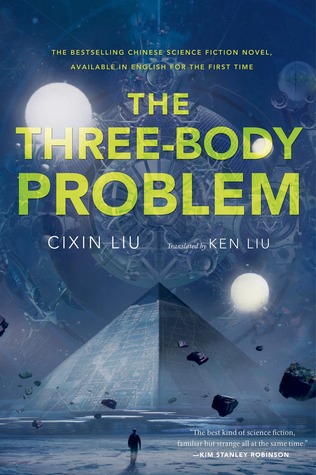
The Three Body Problem by Liu Cixin
Finally, I've finished this ultra-famous book. I first heard of it when it was nominated (and I think it won?) the Hugo's, and well, I heard nothing but good things. So when I saw that the NLB had it, I immediately placed a hold.
And everyone, this was amazing!
The Three Body problem starts off during the cultural revolution, when Ye Wenjie witnesses the death of her father. After a little while, it skips about 40 years, to Wang Miao and the mysterious deaths of various scientists.
This is probably as good a summary as I can give without giving anything away, because the plot is seriously complicated. And it contains a lot of physics.
I have to admit, all the physics stuff just flew right over my head. If I read this in Chinese, I'd probably have to give up the book. So it's a good thing I borrowed the English copy.
By the way, I thought it was quite interesting that the book didn't seem to make that many waves in China.
I mean, the book opens with the Cultural Revolution, and it clearly isn't portraying it in a positive light. And while I can't say much about Tsisolaris culture, they do remind me, in some odd way, of the worst of modern China. Maybe it's the ultra-utilitarian way they view lives, or the fact that they continually destroy civilisation.
Or maybe I'm just reading it wrongly (this is a huge possibility).
At any rate, I thoroughly enjoyed this book, and basically gobbled it up in three days (it would have taken one, but I had school and studying to do. Plus pancakes to eat for dinner).
I would totally recommend this to fans of Science-fiction, especially those who want something different from the norm.
And everyone, this was amazing!
The Three Body problem starts off during the cultural revolution, when Ye Wenjie witnesses the death of her father. After a little while, it skips about 40 years, to Wang Miao and the mysterious deaths of various scientists.
This is probably as good a summary as I can give without giving anything away, because the plot is seriously complicated. And it contains a lot of physics.
I have to admit, all the physics stuff just flew right over my head. If I read this in Chinese, I'd probably have to give up the book. So it's a good thing I borrowed the English copy.
By the way, I thought it was quite interesting that the book didn't seem to make that many waves in China.
I mean, the book opens with the Cultural Revolution, and it clearly isn't portraying it in a positive light. And while I can't say much about Tsisolaris culture, they do remind me, in some odd way, of the worst of modern China. Maybe it's the ultra-utilitarian way they view lives, or the fact that they continually destroy civilisation.
Or maybe I'm just reading it wrongly (this is a huge possibility).
At any rate, I thoroughly enjoyed this book, and basically gobbled it up in three days (it would have taken one, but I had school and studying to do. Plus pancakes to eat for dinner).
I would totally recommend this to fans of Science-fiction, especially those who want something different from the norm.
Labels:
eastern
,
fiction
,
science fiction
Tuesday, May 17, 2016
Teaser Tuesday - The Three Body Problem by Liu Cixin
It's Tuesday, and I'm currently reading The Three Body Problem. Yup, that extremely famous Sci-Fi book. I placed a hold on it, and finally got it a few days ago.
I'm already kicking myself for not reading it earlier, though. There's just something about it that's really addictive (and I'm only halfway through the book!). I don't understand the physics concepts though - I was not good at physics back in secondary school :p
My teaser:
I'm already kicking myself for not reading it earlier, though. There's just something about it that's really addictive (and I'm only halfway through the book!). I don't understand the physics concepts though - I was not good at physics back in secondary school :p
My teaser:
"Wang heard a violin playing something by Mozart. The playing wasn't very practiced, but there was a special charm to it, as though saying: I play for myself."Have you read The Three Body Problem? Did you like it? And what are you reading this week?
Teaser Tuesdays is a weekly bookish meme, hosted by Jenn of Books and a Beat. Anyone can play along! Just do the following:
- Grab your current read
- Open to a random page
- Share two (2) “teaser” sentences from somewhere on that page
- BE CAREFUL NOT TO INCLUDE SPOILERS! (make sure that what you share doesn’t give too much away! You don’t want to ruin the book for others!)
- Share the title & author, too, so that other TT participants can add the book to their TBR Lists if they like your teasers!
Labels:
eastern
,
fiction
,
science fiction
,
teaser tuesday
Monday, December 21, 2015
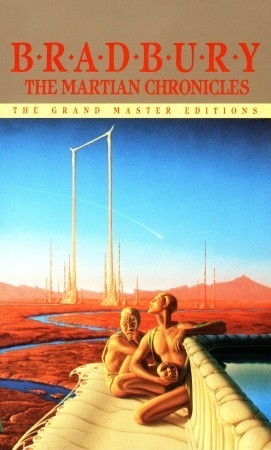
The Martian Chronicles by Ray Bradbury
If you've met me in real life and had an extended conversation for me, you probably know about my love for Fahrenheit 451. So when the coursera course, entitled Science Fiction and Fantasy (course is over, by the way. I made all but two assignments. Waiting for grading now), assigned The Martian Chronicles as a reading assignment, I was over the moon.
The Martian Chronicles is, according to Bradbury, a book of stories pretending to be a novel (the quote is probably paraphrased). It's basically a collection of short stories in the same world, at different times - a world in which humans have travelled to Mars and colonised it.
Not that the colonisation went smoothly. Because you see, Martians are real.
To sum up my feelings about the book, I find it beautiful and strangely sad. Most of the stories do not have happy endings, but I do feel that it was possibly the best ending there could be. Let's just say that The Martian Chronicles does not fill me with hope about humankind.
And oddly enough, the saddest story for me was the second last one, about a house. For some reason, I found a semi-sentient house who was lonely the saddest story in the whole book. Feel free to draw inferences about what that means for me.
I definitely recommend this collection to anyone who's even thinking about reading Bradbury or Science Fiction. It's a great read, and the individual stories are fairly short, so it's possible to savour this in small doses.
The Martian Chronicles is, according to Bradbury, a book of stories pretending to be a novel (the quote is probably paraphrased). It's basically a collection of short stories in the same world, at different times - a world in which humans have travelled to Mars and colonised it.
Not that the colonisation went smoothly. Because you see, Martians are real.
To sum up my feelings about the book, I find it beautiful and strangely sad. Most of the stories do not have happy endings, but I do feel that it was possibly the best ending there could be. Let's just say that The Martian Chronicles does not fill me with hope about humankind.
And oddly enough, the saddest story for me was the second last one, about a house. For some reason, I found a semi-sentient house who was lonely the saddest story in the whole book. Feel free to draw inferences about what that means for me.
I definitely recommend this collection to anyone who's even thinking about reading Bradbury or Science Fiction. It's a great read, and the individual stories are fairly short, so it's possible to savour this in small doses.
Labels:
fiction
,
science fiction
,
western
Subscribe to:
Comments
(
Atom
)