Wednesday, July 26, 2017

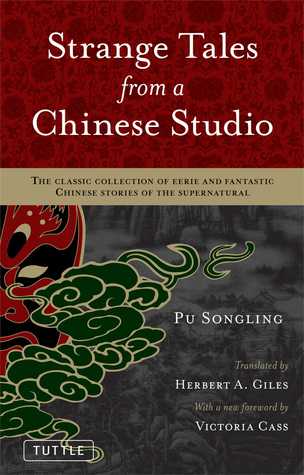
Strange Tales from a Chinese Studio by Pu Songling

This book was recommended to me from the Overdrive app/NLB ebook site, which is the main reason why my TBR is growing uncontrollably the past few days. Given that I've read very little Chinese fairytales/folklore compared to Western and even Japanese tales, I really wanted to read this book.

Strange Tales from a Chinese Studio consists of 164 tales from the 17th Century (I think? Author lived during that time) that involve supernatural creatures/occurrences and 4 appendixes.

The appendixes are about:

1. The Yuli Chao Zhuan (a term that seems to appear only in this book but looks to be about the 'chamber of horrors' in Taoist temples

2. Cultural notes on ancestral worship, bi-location, dreams and much more

3. The translator, Herbert Allen Giles

4. Suggested readings.

There are also pretty comprehensive and interesting footnotes, though sadly the book isn't formatted to allow for easy toggling back and forth (pity, especially since this is an ebook).

As for the tales themselves, quite a few of them were very short and I didn't really get them. I did, however, really enjoy the longer tales, especially those about foxes (maybe because I have been writing about foxes?). Stories that I particularly enjoyed include:

The Painted Skin: about a man who 'rescues' a beautiful girl only to find that she's hiding a very dark secret

Miss Yingning; or, The Laughing Girl: a surprisingly happy story

The Virtuous Daughter-in-Law: where a nagging mother-in-law learns to appreciate her daughter in law in a very painful lesson

Danan in Search of his Father: where a family ended up being "reunited" in a way that completely changed the dynamics for the better.

And more that I forgot to bookmark. And I have no idea if I should be providing full summaries with spoilers or doing these attempts at summaries that don't give away the ending :p

While I generally enjoyed the book, it does have its flaws. It was first published in 1908 by a British national which means that the writing is a little stiff and at times uses very Western expressions like:

"You better call in Yunqi, and tell the fair Eloisa that her Aberlard is awaiting her"

Which feels very out of place given that these are Chinese stories set in China.

Still, if you're looking for Chinese folklore to read, it's worth reading this at least once. Most (if not all) of the tales were new to me and I enjoyed reading through the book.

P.s. There is one thing that I don't get. I'm not sure if it's a translation thing but in these stories, people remarry and concubines are bought and sold pretty easily and I'm wondering if this is so. It seems like the concubinage thing might be so but the remarrying thing seems odd.

Anyone familiar with ancient Chinese customs and can let me know more about this/recommend some reading material about it? I did try Googling but I couldn't find much about it.

Tuesday, July 25, 2017

Baking Powder Wars by Linda Civitello

I admit to not knowing much about baking powder because I am not a big baker. I like to eat baked goods, but if I'm going to bake something, there's a good chance that a mix will be involved (not even a baking class helped). But, I like reading and eating so food history is something that I am interested in reading. The only thing is, I don't really find many books about this topic.

Baking Powder Wars fills a little gap in my huge chasm of ignorance about the history of food. Although it starts off as a history of baking and the troubles that women have traditionally had making bread and other baked goods, the bulk of the book focuses on the companies that made baking powder. Basically, baking powders were marketed as ways for women to successfully make bread and other things involving yeast with much less effort, and in an age where a women's abilities were (at least in part) measured by how well they baked, this must have been a lifesaver to them. But since it was so new, how could they figure out which brand to buy?

And this is how the marketing wars began. From what I understand, the big companies used different types of baking powder - phosphate and aluminium and they used every way they could to exploit the difference for their own gain.

To be honest, I found the marketing aspect a lot less interesting than the history of baking (whoops, not being a very good economics student here). I found the recipes and the snippets of how life was for women back then fascinating and if anyone knows a book that focuses on that aspect, please let me know!

I would recommend this to people who are interested in the history of brands and the (relatively) unknown history behind everyday products. If you're interested in marketing and brands trying to get favourable legislation passed, you'll love this, but even people who are just interested in the cooking will find something to like (mainly at the start of the book, but there are snippets everywhere).

Disclaimer: I got a free copy of this book from the publisher via NetGalley in exchange for a free and honest review.

Monday, July 24, 2017

The Anatomy of Murder by the Detection Club

This is my second Detection Club book and I liked it a lot more than the first one I read (while was Ask a Policeman). Unlike Ask a Policeman, which was a round robin novel, this is a collection of true crime stories written by notable crime writers. To be honest I only recognise Dorothy Sayers because I'm not that well read and tend to stick to a few authors but I really enjoyed all the stories here.

The cases covered here are:

Death of Henry Kinder, written by Helen Simpson
Constance Kent by John Rhode
The Case of Adelaide Bartlett by Margaret Cole
An Impression of the Landru Case by E. R. Punshon
The Murder of Julia Wallace by Dorothy L. Sayers
The Rattenbury Case by Francis Iles
A New Zealand Tragedy by Freeman Wills Crofts

Out of all the cases, the only one that I've heard of is the one about Constance Kent, and only because I've been wanting to read The Suspicions of Mr. Whicher by Kate Summerscale (round of applause for me remembering an author's name)

Each author has their own take on the story but they generally recap the case and then add their views on it. And I'm really amazed that they fit it into a few pages because they felt like really good recaps. I would have read a book about each case.

This makes me a lot more eager to continue reading more from the Detection Club and their members. I would recommend this to anyone who's a fan of mystery and/or true crime. There is also a bibliography if you want to read more.

Friday, July 21, 2017

Used and Rare by Lawrence and Nancy Goldstone

I haven't re-read this in ages but yesterday's book reminded me of it and luckily, it was on the the books that I brought over to Japan with me.

Used and Rare is the story of how the two authors got into book collecting. It all starts with a bet to see who can get the better birthday present within a budget. Nancy gets a lovely hardback copy of War and Peace and that not only allows her to win the bet, but sparks an interest in used books.

At first, they are content with lovely copies of hardbacks and don't care about whether it's a rare book (in fact, they avoid rare books because they think it's overpriced). But then they find a first edition of a book that's 'haunted' them for years and that gets them interested in rare books and points of issue.

Points of issue are basically the things (like typos and other mistakes) that differentiate one book from another. And apparently, you can differentiate between a first edition first printing and a second printing from it because you can't just rely on the words 'first edition'.

What makes this book interesting is the way they mix personalities and books. The dealers are interesting folk and I'd love to meet them, and the books are discussed in a way that was informative and did not interrupt the flow of the narrative. The only 'major' thing I disagree with them is that I liked Modern Book Collecting and didn't find the prose dry.

Re-reading this reminded me that this was the book that first introduced me to Josephine Tey, and contributed to the "TBR pile that may never be read" (especially books that aren't popular today). And I still want to read them - I just have to find them first. Perhaps I should go to Project Gutenberg and see if any of the books are there.

This makes me want to re-read The Yellow Lighted Bookshop and The King's English, both books about bookselling and books that I also brought over to Japan (it's amazing that I didn't go over the luggage limit). The only thing is that I have a pile of books (and ARCs from NetGalley) that I haven't read.

Still, if you're a fan of stories and books, you'll enjoy this. The author's love of books and stories shine through and it is an easy and fairly informative read.