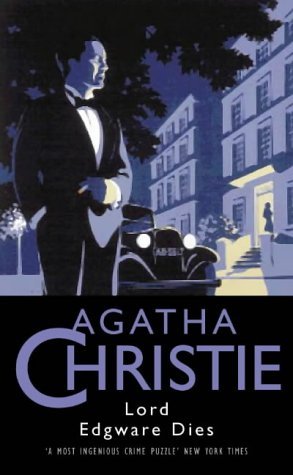
After reading CSI: Binding Ties, it was time to go back to a traditional cozy mystery. And what better than the Queen of Mysteries - Agatha Christie? I managed to find one of her books that I haven't read at Rainbow Plaza, and I thoroughly enjoyed it.
Lord Edgware Dies is a case that misleads even Poirot. And the mastermind is Lady Edgware, a woman who appears to be dumb. But, as she says, it's "a good idea to seem stupider than you are." Is it scary that I once said something similar?
Anyway, the focus of this book is whether Lady Edgware is the killer. She's mentioned many many times that she'd like to kill her husband because she won't give him a divorce. She's even mentioned the way she'll kill him. However, when the murder does happen, in the way she described, she doesn't have a motive and she has an airtight alibi - 12 prominent people who don't really know her were having dinner with her.
It's a case that confuses even Poirot. In fact, the normal braggart but lovable detective considers it one of his failures. Like many Agatha Christie mysteries, once you find out the truth, it seems oh so obvious. However, during my first reading of the book, I (like Poirot), couldn't figure out what was going on.
For a Poirot fan like me, this was a delightful read. Hastings is here as Poirot's Watson, and Poirot's version of psychology is very much in play here. Character motivation is believable and the mystery is full of twist and turns (and not a few red herrings).
Friday, May 30, 2014
Thursday, May 29, 2014
The Rise and Fall of Great Powers by Tom Rachman
In the blurb of this book, the word "bookstore" was used. This is like my kryptonite, so I immediately requested this book on NetGalley. I mean, it's about a bookstore owner! Unfortunately, this book was only 'meh' to me.
This book is about Tooly, a woman who was kidnapped as a child in Bangkok and moved around. She finally "settles" down owning an unprofitable bookstore, until one day, her ex-boyfriend calls with news about Humphrey, a man who raised her. From there on, Tooly goes back, ostensibly to see Humphrey, but really for the reader to find out more about her.
Because this book jumps around in time, it took me till Chapter 8 to understand what the book was about. From Chapters 1 to 8, the book just seemed like a series of unrelated chapters. There were a beautiful sentence about reading, but I felt absolutely no connection to the characters because I had no idea what was going on. And even after chapter 9, I still struggled to connect with Tooly and the other characters.
I'm not sure if this is because the author was trying to be over-ambitious. There is a passage in the book that says:
And for the most part, I didn't care much for Tooly. Her values, which she learnt from Venn, are twisted, to put it simply. She was brought up to be a cynic and not to care. And that make her unlikable to me. Perhaps it's the non-linear narrative, but I never felt that she was searching for herself, I just felt that she ran into a series of events.
Perhaps this book over-reached itself. I haven't read the author's other books, but taken alone, this book isn't very impressive. It does get better towards the end, as I managed to figure out the chronological narrative, but the poor beginning left a bad impression on me that never went away. I will, however, leave you with one beautiful passage from the book:
Disclaimer: I got a free copy of this book from the publisher via NetGalley in exchange for a free and honest review.
This book is about Tooly, a woman who was kidnapped as a child in Bangkok and moved around. She finally "settles" down owning an unprofitable bookstore, until one day, her ex-boyfriend calls with news about Humphrey, a man who raised her. From there on, Tooly goes back, ostensibly to see Humphrey, but really for the reader to find out more about her.
Because this book jumps around in time, it took me till Chapter 8 to understand what the book was about. From Chapters 1 to 8, the book just seemed like a series of unrelated chapters. There were a beautiful sentence about reading, but I felt absolutely no connection to the characters because I had no idea what was going on. And even after chapter 9, I still struggled to connect with Tooly and the other characters.
I'm not sure if this is because the author was trying to be over-ambitious. There is a passage in the book that says:
In made-up stories, he contended, life narrowed into a single tale with a single protagonist, which only encouraged self-regard. In real life, there was no protagonist.Is this a meta-literary sentence, where the author is trying to tell us that there is no one main character? Nope, Tooly is the main character and there's no denying that. The book revolves around her - who cared about her and who didn't. The rest of the characters are just there.
And for the most part, I didn't care much for Tooly. Her values, which she learnt from Venn, are twisted, to put it simply. She was brought up to be a cynic and not to care. And that make her unlikable to me. Perhaps it's the non-linear narrative, but I never felt that she was searching for herself, I just felt that she ran into a series of events.
Perhaps this book over-reached itself. I haven't read the author's other books, but taken alone, this book isn't very impressive. It does get better towards the end, as I managed to figure out the chronological narrative, but the poor beginning left a bad impression on me that never went away. I will, however, leave you with one beautiful passage from the book:
Tooly had read the book already but, as with all her favorites, she'd stopped before its ending. It was dispiriting to witness her printed companions concluding their lives with a blank space at the bottom of the final page, so she halted earlier, returning months thereafter, flipping back several hundred pages to find them as they had been, deep in conversation, conceiving dastardly plants and share retorts.
Disclaimer: I got a free copy of this book from the publisher via NetGalley in exchange for a free and honest review.
Wednesday, May 28, 2014
Benjamin McTish and the Wizards of Coranim by June M. Pace
I must admit upfront, I actually gave up this book halfway. But a dialog with the lovely (and she is lovely, you'll learn more later) June convinced me to carry on.
Now, if you remember my review of Benjamin McTish and the door through Grandfather Tree, I mentioned that the narrative style was a problem for me. I'm really glad to say that this is much less of a problem now. For me, the main problem was that when talking about the world in the book, the author tended to show rather than tell (but this, I found, is because she sees the book like a movie, and she tries to make it as detailed as a movie would be). However, since the reader is supposedly more familiar with the world in the book now, there is less explaining and the story moves along at a good pace. I would say that the second half of this book was very well-written, with a lot of action.
Back to the book and its plot. Benjamin McTish and the Wizards of Coranim is a continuation of the first book, as the three children continue on their quest to save the world. At the same time, their parents and grandparents are drawn into the world after them, and a whole new cast of characters appear. There are a lot more battles, a lot more action and way less explaining.
Of course, with such a large cast of characters, it's a bit harder to keep track of all of them. The book does this mainly by giving them distinctive characteristics, in particular, very unique ways of speaking. It's a good trick, especially for minor characters, since it makes them memorable without needing to spend pages after pages of text to give them a backstory.
The only thing that makes me hesitate would be the message of the book. In the book, it's vital that the children open themselves up to the world. The overall feel I get is something that resembles Zen Buddishm. This was not helped by the fact that words like "Spirit" and "Hope" were all capitalised (the latent lit student in me immediately jumps on anything out of the ordinary and tries to analyse it). However, June explains that
June was very patient with me, and gave me very thorough answers to all my questions - including the reason behind the narrative style. She also assured me that the second half is much more exciting than the first, which is the main reason why I decided to carry on reading.
While this book isn't perfect yet, it's much better than it's predecessor. It seems to have found its voice, and it's developing well. In fact, the heavy handedness that I spoke of in my previous review has been heavily reduced (it's present mainly whenever someone, like Claire - Annabel and Mathilda, has to have something explained, or during a lesson where someone is explaining in very clear detail just why things happen). I think it's because this book has a stronger emphasis on action, while the last book spent a lot of its time pre-occupied with explaining what was going on and where the kids were.
Disclaimer: I received a free copy of this book from the author. I also had an extended email conversation with her, where she answered my questions and encouraged me to read the book. My review, however, is my own opinion, and was not written in consultation with anyone. It is as honest and unbiased as I can be.
Now, if you remember my review of Benjamin McTish and the door through Grandfather Tree, I mentioned that the narrative style was a problem for me. I'm really glad to say that this is much less of a problem now. For me, the main problem was that when talking about the world in the book, the author tended to show rather than tell (but this, I found, is because she sees the book like a movie, and she tries to make it as detailed as a movie would be). However, since the reader is supposedly more familiar with the world in the book now, there is less explaining and the story moves along at a good pace. I would say that the second half of this book was very well-written, with a lot of action.
Back to the book and its plot. Benjamin McTish and the Wizards of Coranim is a continuation of the first book, as the three children continue on their quest to save the world. At the same time, their parents and grandparents are drawn into the world after them, and a whole new cast of characters appear. There are a lot more battles, a lot more action and way less explaining.
Of course, with such a large cast of characters, it's a bit harder to keep track of all of them. The book does this mainly by giving them distinctive characteristics, in particular, very unique ways of speaking. It's a good trick, especially for minor characters, since it makes them memorable without needing to spend pages after pages of text to give them a backstory.
The only thing that makes me hesitate would be the message of the book. In the book, it's vital that the children open themselves up to the world. The overall feel I get is something that resembles Zen Buddishm. This was not helped by the fact that words like "Spirit" and "Hope" were all capitalised (the latent lit student in me immediately jumps on anything out of the ordinary and tries to analyse it). However, June explains that
The reason the words are capitalized is because in the ancient language and the words of the magical beings, these are words of power and importance. If you notice when they speak the word "Forest" it's capitalized as well, because to them the forest is it's own living entity…this is how they honor him. So when the shaman is speaking of truth, he is speaking of Truth, the ultimate expression of Love…see?
The book is not written with the theme of everyone is a piece of God, or Buddhist philosophy…although I can see where you may think this.And this would be the perfect place for a disclosure. I mentioned in the start that I almost gave up halfway through the book. You see, the first half of the book, while better, is quite similar to its predecessor. And the worries about the philosophy behind the book didn't help. So I was ready to call it quits. However, during this time, I was actually in an email conversation with June, the author.
June was very patient with me, and gave me very thorough answers to all my questions - including the reason behind the narrative style. She also assured me that the second half is much more exciting than the first, which is the main reason why I decided to carry on reading.
While this book isn't perfect yet, it's much better than it's predecessor. It seems to have found its voice, and it's developing well. In fact, the heavy handedness that I spoke of in my previous review has been heavily reduced (it's present mainly whenever someone, like Claire - Annabel and Mathilda, has to have something explained, or during a lesson where someone is explaining in very clear detail just why things happen). I think it's because this book has a stronger emphasis on action, while the last book spent a lot of its time pre-occupied with explaining what was going on and where the kids were.
Disclaimer: I received a free copy of this book from the author. I also had an extended email conversation with her, where she answered my questions and encouraged me to read the book. My review, however, is my own opinion, and was not written in consultation with anyone. It is as honest and unbiased as I can be.
Tuesday, May 27, 2014
Teaser Tuesday: Plato and a Platypus Walk into a Bar... by Thomas Cathcart & Daniel Klein
Ok, this book I picked up at Changi airport. I don't know what reputations airport bookshops have (do share), but the ones at Changi are just like any other bookshop. The only difference is that I become strangely drawn to non-fiction books. And this seemed like the perfect book to buy and bring home.
This week's teaser:
This week's teaser:
"So, if Kierkegaard finds you in his closet and asks "What are you doing here?" don't say, "Everybody's got to be somewhere." Our advice: Improvise." (Page 117)What is your teaser?
Labels:
humour
,
non-fiction
,
teaser tuesday
,
western
Subscribe to:
Posts
(
Atom
)


