I thought this was going to be my first non-fiction book review of the year, but apparently not! But it's not surprisingly that it's only January and already I'm reading true crime.
Anyway, Lawyer Games is an account of the four trials of The State of Georgia vs James A. Williams (Apparently there's a really famous book called Midnight in the Garden of Good and Evil that was about the same case). It's not really a "did he do it" sort of book, because as the author tells you straight up, he believes that Williams was guilty. What this book is about, are the four trials that eventually ended in a "not-guilty" verdict for the lucky Williams.
Personally, I think the author did a great job with the book. After reading it, I was thoroughly convinced that Williams was guilty and wished that he didn't eventually go free (even if for a few months). This is despite the reminder I got at the start of the book that the author was biased - I really liked that too, by the way. I like it when an author states his bias upfront, instead of spinning his angle as the truth.
The book itself is divided into a succession of very short chapters (think about 10 pages on the iPad), followed by one extremely long chapter. That extremely long chapter is probably the chapter that goes over all the evidence and testimony in the trial. What that meant for me was that I was happily reading along, thinking "Hey, this book isn't that bad", then WHAM, a long, long chapter for me to dig through. I suppose I wouldn't have minded it much if I wasn't reading it in the train (and had to stop halfway), but I did, so it was a little annoying.
As for the narrative style, the book is definitely not casual. While the author can be sarcastic at times, there is this sense of formality throughout the book. Perhaps it's due to the author's background in the law?
At any rate, this was an interesting book. Like I said earlier, it's not really about truth/who the real murderer is. It's about how expensive lawyers who are willing to do anything can drag out a trial long enough.
Disclaimer: I got a free copy of this book from the publisher via NetGalley in exchange for a free and honest review.
Thursday, January 28, 2016
Wednesday, January 27, 2016
Wild Thing by Luke Kendall
This is going to be a hard book for me to review because I've seen it in its previous form. Yes, this is another book by someone from WriteOn.
Backstory/How I came to know about Wild Thing. Since I'm on a writing site, I do try to give feedback. Normally, though, I give feedback for the first chapter, but if the book is really good, I continue. I don't continue reading most books that I read. But, Wild Thing was one of them, even though I never really finished it. I did read a fair bit before the author decided to use some professional editors.
And woah, the difference is amazing.
Ok, about the actual book. Wild Thing is about a girl called Sara. When she's very young, a prophecy has her sent from the community she was living in. A few years later, she's picked up by a scientist named Dr. Harmon, who has plans to shape her into an archetype at the Institute for Paranormal Dysfunction. But, there's something much larger at work, and in this book, it involves one particular patient at the Institute.
This is probably not relevant to 99% of the people out there, but I really want to say, that the changes in this book was amazing. I liked it before, but now, it's a lot more fleshed out, and the characters feel a lot deeper. It's amazing to see the story that was hiding under that first draft I read.
Anyway, you can probably tell that I liked the book. I really liked Sara - she's amazingly innocent, even though she's deadly. I do worry about her though, because of the way Dr. Harmon raised her. Dr. Harmon is basically the person I love to hate. He's devious, and probably the reason why Sara will never be normal. So there's a slight sense of satisfaction whenever I see hints at the story that no matter how clever he thinks he is, he is not the one controlling Sara's story. Far from it.
I do, however, need to point out that because of the above-mentioned Dr. Harmon, there are pages in the book (towards the later half) that you'll want to skip if you're squeamish like me. [SPOILER ALERT] I mean, Sara might find it very natural, but you and I know that what Dr. Harmon is doing to her is just plain wrong (and definitely sexually abusive - he even plays the classic 'you made me do it' argument. Ugh). My stomach's a bit weak, so I tend to skip the 'steamier' scenes involving them. [END SPOILER ALERT] There weren't that many, but if you have a problem with stuff like this, consider this a warning.
Overall, I really enjoyed this story. It was interesting for me to see the differences in the two versions that I read, and I definitely think that this version is stronger. I seriously hope that Sara will be able to become more independent from Dr. Harmon, and of course, I want to know the ending for this storyline - I have a feeling that it's not completely over yet.
Disclaimer: I know the author, and as I've repeatedly mentioned, I've read this book even before it was published in its current form. All the praise, though, is genuine.
Backstory/How I came to know about Wild Thing. Since I'm on a writing site, I do try to give feedback. Normally, though, I give feedback for the first chapter, but if the book is really good, I continue. I don't continue reading most books that I read. But, Wild Thing was one of them, even though I never really finished it. I did read a fair bit before the author decided to use some professional editors.
And woah, the difference is amazing.
Ok, about the actual book. Wild Thing is about a girl called Sara. When she's very young, a prophecy has her sent from the community she was living in. A few years later, she's picked up by a scientist named Dr. Harmon, who has plans to shape her into an archetype at the Institute for Paranormal Dysfunction. But, there's something much larger at work, and in this book, it involves one particular patient at the Institute.
This is probably not relevant to 99% of the people out there, but I really want to say, that the changes in this book was amazing. I liked it before, but now, it's a lot more fleshed out, and the characters feel a lot deeper. It's amazing to see the story that was hiding under that first draft I read.
Anyway, you can probably tell that I liked the book. I really liked Sara - she's amazingly innocent, even though she's deadly. I do worry about her though, because of the way Dr. Harmon raised her. Dr. Harmon is basically the person I love to hate. He's devious, and probably the reason why Sara will never be normal. So there's a slight sense of satisfaction whenever I see hints at the story that no matter how clever he thinks he is, he is not the one controlling Sara's story. Far from it.
I do, however, need to point out that because of the above-mentioned Dr. Harmon, there are pages in the book (towards the later half) that you'll want to skip if you're squeamish like me. [SPOILER ALERT] I mean, Sara might find it very natural, but you and I know that what Dr. Harmon is doing to her is just plain wrong (and definitely sexually abusive - he even plays the classic 'you made me do it' argument. Ugh). My stomach's a bit weak, so I tend to skip the 'steamier' scenes involving them. [END SPOILER ALERT] There weren't that many, but if you have a problem with stuff like this, consider this a warning.
Overall, I really enjoyed this story. It was interesting for me to see the differences in the two versions that I read, and I definitely think that this version is stronger. I seriously hope that Sara will be able to become more independent from Dr. Harmon, and of course, I want to know the ending for this storyline - I have a feeling that it's not completely over yet.
Disclaimer: I know the author, and as I've repeatedly mentioned, I've read this book even before it was published in its current form. All the praise, though, is genuine.
Labels:
dystopia/utopia
,
fiction
,
western
,
WriteOn
Tuesday, January 26, 2016
Teaser Tuesday - This is Where it Ends by Marieke Nijkamp
Hey everyone! Time for another Teaser Tuesday! And can you believe it's the last week of January already? I thought 2016 just started!
Anyway, I'm currently reading This is Where It Ends, a novel about a school shooting. It's got very mixed reviews, so I'm actually quite curious as to what I'd think when I finish. But I just started (I'm at chapter 2), so I'm currently still in neutral.
My teaser:
What's your teaser this week?
I just came back from cooking class (where we learnt how to make Japanese-style Chinese food), so I'm beat. No long, rambly stuff today. But here's a picture of what I made :D
Anyway, I'm currently reading This is Where It Ends, a novel about a school shooting. It's got very mixed reviews, so I'm actually quite curious as to what I'd think when I finish. But I just started (I'm at chapter 2), so I'm currently still in neutral.
My teaser:
"Principal Trenton may still live in the pre-digital era, but she's like a cyborg. She always speaks until ten sharp, leaving five minutes for announcements before the bell."
What's your teaser this week?
I just came back from cooking class (where we learnt how to make Japanese-style Chinese food), so I'm beat. No long, rambly stuff today. But here's a picture of what I made :D
Teaser Tuesdays is a weekly bookish meme, hosted by MizB of A Daily Rhythm. Anyone can play along! Just do the following:
- Grab your current read
- Open to a random page
- Share two (2) “teaser” sentences from somewhere on that page
- BE CAREFUL NOT TO INCLUDE SPOILERS! (make sure that what you share doesn’t give too much away! You don’t want to ruin the book for others!)
- Share the title & author, too, so that other TT participants can add the book to their TBR Lists if they like your teasers!
Labels:
fiction
,
teaser tuesday
,
western
Monday, January 25, 2016
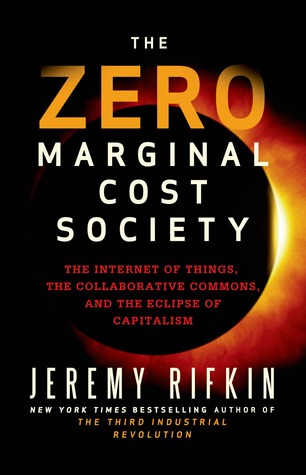
The Zero Marginal Cost Society (Liveblogged Review)
Hey, so a while back, I tried doing a liveblog of this book I had to read for school (and I actually really enjoyed it). It first went live on Dayre (see Part 1 here and Part 2 here), and I thought I'd share it here as well. The premise is pretty fascinating. It's arguing that as the collaborative commons rise, capitalism will play a smaller, more streamlined role in the economy.
Makes sense when you think of how we're used to sharing things we make for free (like on Dayre) and using things for free or near free.
While the capitalist market is based on self-interest and driven by material gain, the social Commons is motivated by collaborative interests and driven by a deep desire to connect with others and share.
Chapter 1: Chapter 1 introduces the basic concepts of the book and provides definitions (always good, except now I have yet another definition of IoT (Internet of Things) that I have to work in).
What was new to me was the idea of IoT as the 'soulmate' of the Collaborative Commons. I've been thinking about it in terms of supply chains and productivity, but it does make sense, especially if you're considering it in a broader sense.
While capitalism operates through the free market, free markets don't require capitalism.
Chapters 2,3,4: These 3 chapters are a summary of economic history, and probably a way for the author to reframe our thinking so we're more receptive to his ideas (is that too cynical?)
But basically, the premise is that with the industrial revolutions, we moved towards vertical integration with a central command, but with IoT and the Collaborative Commons (CC), we're moving towards everything integrated but decentralised.
Which begs the question: why are the main movers big companies?
Saw the "study online for almost free" meme. But Coursera does charge for a certified accreditation thing, and that isn't 'nearly free'. So unless employers are willing to accept the free certificates of achievement, MOOCs won't help people who don't have the money to go to university
How then do we ensure an open, transparent flow of data that can benefit everyone while guaranteeing that information concerning every aspect of one's life is not used without their permission and against their wishes in ways that compromise and harm their well-being?
Chapter 5 is about productivity, IoT and free energy. For the energy thing, which was new to me, the author says that renewable energy is the near-free energy, after you recoup the installation (and I suppose switching) costs.
It is true about fossil energies being finite and hence unable to go to free, but I think they do have a role to play in the near future, as we transition. Hence the role of microgrids and virtual power plants.
Smart energy isn't just where the energy comes from, it's also how we manage it. I suspect the IoT/big data methods will apply for all forms of energy - we need to figure out how to adjust supply flexibly and how to predict demand. And of course, on the industrial side, how to use IoT technologies to be more energy efficient.
Chapter 6: 3D printing!! It's something I knew about, but this is the first time that I really see its future tied to the IoT/CC movement. Extremely interesting stuff.
But the author seems to call this movement the Third Industrial Revolution, while in Germany, this is the Fourth Industrial Revolution. Yet another contradiction for my research partners and me...
But I think the concept of moving from mass production to production by the masses is cool. Didn't know Gandhi said something similar:
Knowledge has been enclosed behind the walls of academic institutions whose price of admission excludes all but the wealthiest. That's about to change.
Chapter 7 is about MOOCs and other forms of education. Basically, MOOCs will bring the cost of good education down, and in general, education will become more multidisciplinary and less focuses on rote memorisation.
I mentioned the cost of MOOCs before, but the book is right in saying that it's near free compared to its traditional price. But it may still be expensive and out of reach to the very poor or those with no PayPal or credit cards.
As for the learning style, I love the idea of multidisciplinary themes as the basis of education, but I still feel that for the basics, like the multiplication tables, memorisation is key. Like yes, I can work out multiplication if I needed to, but it's faster to have, say, the times table or Pythagoras theorem memorised, especially when I'm integrating the skill with others.
What I'm saying is that you don't have to memorise stuff, but it might be more convenient to do so.
Chapter 8,9: chapter 8 is about the worker becoming obsolete, while chapter 9 is about the rise of the prosumer, a consumer who also producers. Both are very interesting ideas, although it feels rather America-centric. I'd be interested in seeing how much of what the author is saying is applicable in developing countries (especially the unemployment stuff).
Chapters 10,11,12: These three chapters are grouped together under the section "The Rise of the Collaborative Commons". I think it's a testament to how powerful 'The Tragedy of the Commons' is as an idea that its refutations aren't as well known as the Tragedy is. The chapters also cover topics from Net Neutrality to Copyright and open source/free software.
Do you know that apparently Singapore has the highest rate of illegal downloads (from a 2012 study - looked it up cause my Senpai is doing something similar for his graduation thesis)? So yeah, the copyright thing has me torn.
Like, I totally understand the appeal of getting something for free. But now that I'm about to self-pub, I'm like "RIGHTS RIGHTS RIGHTS". I mean, I probably won't be an overnight sensation, but if I am, I want my rights to help me earn money.
But at the same time, I love the idea of anyone being able to read my words. (Actually I've been considering this problem for some time, along with pricing issues.)
The other interesting idea was designating companies like Google and Facebook and Amazon as 'social utilities'. This is an argument I don't really buy, especially when you start thinking about how much data about us these companies already hold. Plus, they seem giants now, but giants can fall.
Starting on the fourth part, which would be chapters 13 and 14, and saw this very interesting quote redefining freedom. The first past is "The Internet Generation, however, has come to think of freedom not in the negative sense - the right to exclude others - but rather in the positive sense of the right to include others"
Then some elaboration, and then the quote that struck me:
Freedom is measured more by access to others in networks than ownership of property in markets. The deeper and more inclusive one's relationships, the more freedom one enjoys.
Chapter 13, 14: These two chapters make up the section "Social Capital and the Sharing Economy". It might be the most interesting part of the book for me (since IoT disappeared after the first chapter) as it looks at how people are changing the way they share and consume.
I'm not involved in the sharing community, but it sounds really interesting. And I wish that the second chapter, which covers crowdfunding, was a little longer. Actually, I wish both chapters were longer
[...non-book related stuff...]
So I finished the last two chapters. For some reason, they feel like any other book that pushes a new type of thinking/paradigm. That is, it feels very hopeful and like the author has expanded beyond the IoT and econs stuff at the start to talk about an 'economy of abundance'
Or maybe my skepticism is due to the fact that the last two chapters reject the principle scarcity, which is pretty much the first thing that any econs student learns, so it's pretty ingrained in me.
All in all, this is a really good books. It's very thought provoking, and I find it easy to believe/accept a lot of what the author is saying. I do wish there was more emphasis on the IoT side of things, but I think that would be a bit too esoteric for most people, and the Collaborative Commons stuff is the more accessible topic.
Labels:
economics/business
,
non-fiction
,
reading challenge
,
western
Subscribe to:
Posts
(
Atom
)


