Friday, July 4, 2014

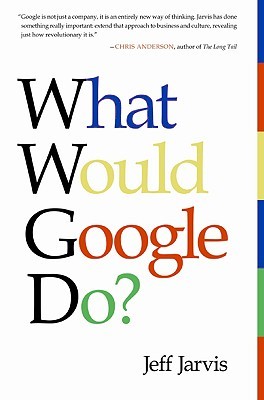
What Would Google Do? by Jeff Jarvis

As part of my Understanding Media by Understanding Google Course, I was assigned several books. Unfortunately, none of them are available in the school library here, but thankfully, Scribd had a two of them. What Would Google Do is one of them,

To summarise the book in one sentence, it looks at what Google does, and how that will impact various fields such as Media, Public Welfare, Utlities, etc. Some of the areas that he looked at seemed very unlikely to be affected by Google, but the basic question asked is: what would happen if there was no middleman controlling the flow of information?

Whether you like the first part of the book, where he talks about how Google is changing things such as publicness, society, economy and others, or whether you prefer the case study is really a personal preference. Personally, I liked the first half of the book, but that's because the arguments brought up there were new to me and thus more interesting. The second half of the book is really an application of what the first half says, so it felt a bit repetitive at times.

This book is so optimistic that it's hard to be skeptical of what he's saying. The author is definitely persuasive when it comes to making a case for his new world. But, I wonder how much of it is applicable to countries such as China. For some, like how the media will change, I found his forecasts to be interesting and believable, but I still remain doubtful about whether his forecasts of things like healthcare will come true.

All in all, this book is an interesting read. If you're curious about Google and its impact on society today (and how it might impact us in the future), this is a good book to read. I'll leave you with a quote that I really like from the book:

We no longer need companies, institutions, or government to organise us. We now have the tools to organise ourselves. We can find each other and coalesce around political causes or bad companies or talent or business or ideas. We can share and sort our knowledge and behavior. We can communicate and come together in an instant. We also have new ethics and attitudes that spring from this new organisation and change society in ways we cannot yet see, with openness, generosity, collaboration, efficiency. We are using the internet's connective tissue to leap over borders - whether they surround countries or companies or demographics. We are reorganising society. 

Thursday, July 3, 2014

Dancing Shoes by Noel Streatfield

I have long heard about the book Ballet Shoes. Apparently they're a childhood classic, and Dancing Shoes is in the same series as them. What I didn't know was that one of my childhood favourites - The Painted Garden, was also by this author! Thankfully, I liked Dancing Shoes, so I wasn't disappointed :D

Dancing Shoes follows Rachel and Hilary. Hilary is Rachel's adopted sister, and because of something that Rachel's mother said, Rachel is convinced that Hilary is cut out to be a dancer. However, when their mother dies, Rachel's aunt, who owns a dancing troupe takes them in. Not only is Mrs Winters a mean person who cares only for her selfish daugher Dulcie, they're doing the wrong sort of dancing! Although Hilary enjoys the dances, Rachel does her best to keep Hilary from making what she thinks is a mistake.

This book was a really fun read! Rachel and Hilary have a very adorable relationship - Rachel is goal-minded while Hilary is carefree, so their personalities were adorable together (made for some clashes though). Mrs Winters was a good villain, and had an interesting backstory. Dulcie was the type of girl that you'd hope to see fail, and when [SPOILER] both her cousins upstage her, you can't help but cheer a little. There's also a good supporting cast of characters, each with their own distinctive trait.

Most of the conflict in this book comes from the fact that everyone doesn't understand why Rachel is so opposed to Hilary dancing. As a result, most of the adults around her think that Rachel's a selfish and jealous sister. But since I, as the reader, know what's going on, it just made me like her more. I really admire how much she cares for Hilary, so much that she's willing to be misunderstood.

Hilary, on the other hand, I didn't like so much. She's a bit lazy, and I found her to be rather selfish, But I think that out of the two, Rachel is the real protagonist, and so I enjoyed the book for most part.

I'm way older than the target audience, but I would love to read the rest of the books in this series! And I really want to re-read The Painted Garden now. It seems like it's time for my second childhood!

Wednesday, July 2, 2014

The End of Innocence by Allegra Jordan

This is rather off-topic, but when I first saw this title, I was reminded of another book. It wasn't until I finished the book that I remembered - The Age of Innocence by Edith Wharton. However those two books are nothing alike, although they do involve love and relationships.

In The End of Innocence, Helen Brooks is struggling to find her place in male-dominated Harvard. At the same time, Wils, a German noble (who's talented at poetry) is struggling to survive an increasingly anti-German American society. When the two of them meet, they fall in love. Complicating matters would be that Wils's cousin Riley, who also falls in love with Helen.

Personally, I loved the first part of the novel. The ending and later half? Not so much. While the current ending is definitely more realistic than the one I was hoping for, I felt as though the book ended, and a new book began. I can't talk about specifics without giving away spoilers, but I think it would be obvious where the new section began.

As for the characters, I think Wils was my favourite. His chapters were very well-written, and I was rooting for him from the start. As for Helen, I'm neutral towards her. I think that I didn't completely understand her character (especially at the end, because it seems different from how she was portrayed at the start), but I'm guessing most people will like her. These are the two main characters, and the other characters just feel like background characters to me.

But what I really liked about the book was how it explored issues such as women in higher education and American neutrality in the war. The second issue is definitely what drives this novel forward, and the book really opened my eyes. I remember reading about how Japanese-Americans were treated in World War II (Kira kira anyone?), but this is the first I've read about Germans in America during World War I.

All in all, this is a pretty good World War I novel. I like how it covers issues such as America's neutrality in the war. The main characters are well-written, and it's definitely an enjoyable novel.

Disclaimer: I received a free galley from the publisher via NetGalley in exchange for a free and honest review.

Tuesday, July 1, 2014

Teaser Tuesday - The Nanny Diaries by Emma McLaughlim and Nicola Kraus

It's time for.... TEASER TUESDAY :D

This week, I'm reading The Nanny Diaries. I'm not sure how I heard of it, but I heard good things, and when I saw it at Rainbow Plaza, I decided to take a chance and read it. I'm liking it so far.

My teaser:

I sit down on my duffel bag and fight the urge not to throw up as only someone can who's just flown twenty-five minutes on a six-seater plane through torrential downpours, unrelenting fog, and massive turbulence with four adults, three children, a goldfish, a guinea pig, and a golden retriever. Only my consideration for the Horner girls prevented me from screaming at every drop. (page 298)
Teaser Tuesday is hosted by MizB of ShouldBeReading. To participate, just submit a two sentence teaser along with the title and author of the book.

What's your teaser?