Showing posts with label crime. Show all posts

Monday, January 22, 2018

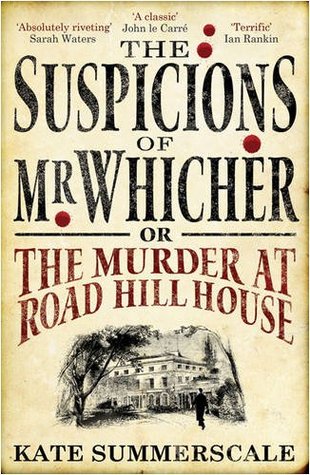
The Suspicions of Mr Whicher by Kate Summerscale

It took me two tries to finish this book. I think that the first time I tried to pick it up (one or two years ago), I wasn’t quite in the mood for it because I gave up after a chapter. But this time, after having read The Wicked Boy and gotten used to the author's style, the book grabbed me and I enjoyed it very much.

The Suspicions of Mr Whicher is about the murder of Saville Kent and the detective, Jack Whicher. At a time where the Englishman’s home was considered inviolable territory, Jack Whicher (a working-class man, compared to the middle-class victims) had the nerve to ask the uncomfortable questions and show the ugly side of the family to the public.

Unfortunately for him, while he had fingered the right person for the crime, she was not prosecuted and he ended up in disgrace. At least he was vindicated when a confession was made and he managed to get back his career and confidence.

If you’re looking for a book that focuses solely on the crime or the detective, you are in the wrong place. While there is a lot of information on the family, the investigation, and even the career of Jack Whicher, the book also spends a lot of time discussing the influence of the case, on both the public and writers such as Wilkie Collins and Charles Dickens. This case has inspired The Secret of Lady Audley, The Moonstone, and the unfinished work, The Mystery of Edwin Drood, among others. There is also plenty of discussion about how the detective came about, which I found to be very interesting.

I suppose the thing to note about the book is its style. It’s very factual and dispassionate, and I didn’t even sense the author’s opinions until the end. If you’re used to more personal true crime books, such as The Stranger Beside Me, you may find this a little dry.

Overall, I found this to be a very fascinating book. It goes beyond the murder mystery and explores the mood and thinking of the times. If you’re a fan of Charles Dickens, Wilkie Collins and detective novels, you’ll probably want to read this to find out more about how the detective came about and how this case and it’s detective influenced the early writers of the mystery genre.

Thursday, September 14, 2017

The Man From the Train by Bill James

I requested this from NetGalley because I find true crime fascinating and I read that the author is a baseball statistician so I was hoping that this is a book that uses data to solve the crime. Unfortunately, while the cases are extremely tragic and told in a fascinating way, the book suffers from a lack of focus.

So from around 1900 to 1912, a series of murders started to take place near railway lines. All of them were senseless, cruel murders which had a few points in common - such as an axe being a weapon, no robbery, no warning, and a few more. The authors are convinced that this is the work of one man, something that the press only seemed to realise a few years after the murders start (and by then a few people had been convicted for the murders).

While I do agree that the there was probably a serial on the loose, I'm not really satisfied with the arguments made. There are sentences like "No source says so, but the Meadows family had to have hunting dogs; I just can't see a family like this not having hunting dogs" (used when hypothesising how the crime might have taken place) which are quite scary because I would not want anyone to assume things that cannot be proven as fact.

Plus I was expecting a more mathematical look at the crime and the closest that the book came to maths was to ask how many murders would one expect there to be with the characteristics of the crime and say "the mathematical answer is 0."

I don't know if I'm remembering my stats wrong but while the answer may by very close to zero, I wouldn't have expected an answer like this. I did expect the author to calculate the probability of such a case happening and then derive the number of murders so a flat out "answer is 0" with no working made me disappointed.

Narrative-wise, the book basically goes through all related crimes and only discusses the probable murder at the end. This is probably a personal preference but I wish only the relevant cases were discussed. There are a lot of murders as it is, and to read something horrific and then see something along the lines of "but we don't think this was part of the serial killing" feels like there wasn't much thought into what should have ended up in the book.

As for the murderer, he seems to have been identified with a gut feeling because all I saw was an account of his 'first case' which was like all the others. Not much else was presented to show how he was linked to the murders, although the authors did theorise that he's behind a gruesome killing in Kaifeck a few years later.

This book also has one of the strongest authorial voices that I've read and I suppose it's so that we end up believing what the author believes. I suppose whether you like or dislike the book will also depend a lot on whether you like the authorial voice and how heavy it was. Personally, I'm not a fan of the puns and the digressions but it didn't make me want to stop reading the book.

Basically, this book introduced me to this horrific crime that I never knew existed. I do agree with the authors that this was the work of a serial killer, but I'm not a fan of how the case was made and I'm not entirely convinced that the man that they fingered is the real culprit (although he did commit a terrible murder too). It's too bad that the book didn't use much maths to make a case - that would have been interesting.

Disclaimer: I got a free copy of this book from the publisher via NetGalley in exchange for a free and honest review.

Tuesday, September 12, 2017

Teaser Tuesday - The Man from the Train by Bill James

I'm back with a Teaser Tuesday after what feels like forever! I've been finishing books before Tuesday/not reading a book on Tuesday and didn't really feel the urge to share. But I'm in the middle of a book now and thought I'd just share a teaser!

The book is The Man from the Train and basically tries to unravel/prove that one man was behind a string of gruesome axe-murders. It's really interesting, but I do with that the book is more focused.

Teaser:
"John Zoos, a Polish immigrant, worked in a plumbago mine, got home about dusk, found his family murdered. (The world plumbago is now only used for a flowering plant. A hundred years ago, however, it was primarily used for graphite)."
The teaser sort of shows one of the problems I have with the book - there are all these inserts that I don't really think are necessary.

What about you? What are you reading this week?

How to participate in Teaser Tuesday:  
•Grab your current read 
• Open to a random page 
• Share two (2) “teaser” sentences from somewhere on that page 
• BE CAREFUL NOT TO INCLUDE SPOILERS! (make sure that what you share doesn’t give too much away! You don’t want to ruin the book for others!) 
• Share the title & author, too, so that other TT participants can add the book to their TBR Lists if they like your teasers! 

Monday, April 24, 2017

A Clockwork Murder by Steve Jackson

I managed to get the weekend off (not so much "get" as "was lucky to be given the weekend off") so I celebrated by finishing a book on Friday! Luckily for me I had a place to sit and read while my friends browsed BookOff and I tried to practice self-control(;

A Clockwork Murder is a true-crime book about the murder of Jacine Gielinski. She was brutally raped and forced to hear her killers discuss how they would kill her before she finally died. It was a slow, painful death and the worst part is that she was randomly chosen.

Thankfully, her killers were caught almost immediately and couldn't carry out any more crimes. Not thankfully, it took over 3 years before Jacine's parents got any closer because despite the fact that both of her killers confessed, their defence attorneys still tied the whole thing up in paperwork. And perhaps most despicably, tried to manipulate her parents into giving up.

Both of them were found guilty but they did not get the death penalty in the end.

And the relationship between the two killers was... really odd. Her killers were these two guys called Lucas Salmon and George Woldt and they had an extremely dysfunctional relationship. George was violent and sadistic since young, and though Lucas was his opposite and constantly humiliated by his 'friend', he still did all he could to keep in George's good graces.

Overall, this was a really good read. There was one part where I thought the book was starting to lag (we were going into a bit too much detail about the lawyers for my taste) but it soon got back on the trial and I found myself reading all the way to the end.

Disclaimer: I got a free copy of this book from the publishers via NetGalley in exchange for a free and honest review.

Thursday, March 16, 2017

Avery by Ken Kratz

Full disclosure time: I've never had the chance to watch Making a Murderer. I have heard that it exposes the injustices of the justice system, but I don't have Netflix so I never did get around to watching it. And if we're talking about true-crime, I ended Serial thinking that Adnan Syed was guilty, and after looking at the full case files, felt even more certain that he was.

So I thought this book would be interesting, to see how 'the other side' explains itself. And since I've already heard about the injustice of the system, I read with an eye out for that sort of thing.

Avery is a surprisingly gripping and readable account of the Theresa Halbach case. And if even half of what the book says it's true, then the Making a Murderer people are committing an injustice by trying to get a guilty man out.

What makes me doubt Steven Avery's innocence is the fact that his own defence (and the Making a Murderer team) has to bend over backwards to make him seem innocent.

That cat incident? Avery chased down the cat, doused it in oil and threw it into a fire. That is clearly not goofing around.

His ex-wives talks about his abusiveness, and one called him a monster (claims are corroborated by an article in The Rolling Stone)

And the show itself splices courtroom video together in a way that changes the meaning of the conversation entirely. Lines are cut, to the extent that a "yes" becomes a reply to a question that was left out, rather than the question in the video.

That, I think, is very problematic.

As for the justice system part, I am inclined to take Ken Kratz at his word because of how honest about his sexting scandal he is, and the remorse he feels.

Plus, I also agree that framing Avery requires a ridiculous amount of effort and hatred would be needed, and that the cops that were involved (who were only involved because they weren't involved in the previous case and because of a lack of manpower) had no reason to have so personal and deep a grudge.

The writing in this book is enjoyable and engaging, though overly emotional at times. And while most of the book was spent on the claims and evidence against Avery, I appreciate the fact that the book starts with a portrait of Theresa, to remind everyone just who the real victim was in this case.

Disclaimer: I received a free copy of this book from the publisher via NetGalley in exchange for a free and honest review.

Friday, October 7, 2016

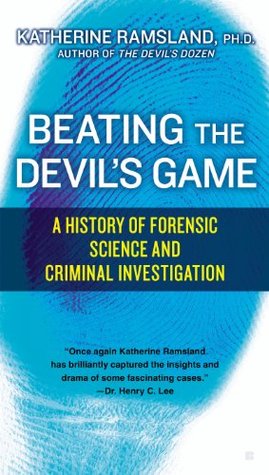
Beating the Devil's Game by Katharine Ramsland

I'm not sure where I heard of Katherine Ramsland, but I really enjoyed Beating the Devil's Game. It's basically a history of forensic science, from its origins in China to the present day.

What I really liked about this book was that it was told through cases. So it wasn't a dry recital of which discovery came when it was case after gruesome case of how certain technologies helped (or did not help) solve crimes and get justice.

The cases also prove that mankind has been twisted for as long as history. The recent cases definitely weren't more ghoulish than the previous ones. (And on a related note, it also proves that terrible crimes aren't committed by only one race/country)

Apart from China, which was one of the early readers, the book didn't really touch on developments in Asia. I'm not an expert, though, so I can't tell if it's because Asia didn't progress or if it's an unconscious bias.

Overall, though, this is an easy to read and interesting book. It doesn't only talk about the successful methodologies - it mentioned the now-obsolete and ineffective ones (that were used for a time). If you're interested in how forensic science works and the history behind it, this is a good book to read. (Although fans of shows like CSI or Bones - and don't get me wrong, I love both as well - may get disappointed that the science isn't as cool as the shows. Hence the whole 'CSI effect' thing)

Monday, June 6, 2016

The Wicked Boy by Kate Summerscale

I first heard of this book in an article about the penny dreadful, and luckily for me, it was available on NetGalley.

The Wicked Boy is a true-crime story, following Robert Coombes, who killed his mother in 1895. At that time, penny dreadfuls, which were serialised adventure stories popular with boys, were partially blamed for the murder. But, Kate Summerscale shows that this may not be the case.

I'll admit, the book was hard to get into. I'm used to the author liberally inserting him/herself into the narrative (the "this is how hard I worked to find the information" shtick), and Kate Summerscale's no-nonsense account was different from what I expected. Plus, she started from the aftermath of the crime, so I had to adapt to a completely different world instantaneously.

But, I quickly adjusted, and I realised that I like this method. True, the style is rather understated, but it helps bring a sense of rationality to the end.

I do wish, however, that there was a bit more investigation into Robert and Nattie Coombes home life. There are hints that they are turbulent, but it's not discussed and proved as conclusively as I hoped it would be. Most of the time, this was a narrative account of the affair.

Oh, and the epilogue was great, because it showed a different side to Robert Coombes (and marked the first and only appearance of the author). It suggested that in the end, the sentence he got might have helped, and that he wasn't a "wicked boy" after all.

And by the way, I really like the way Broadmare (asylum for the criminally insane) works. It's humane, and I think it does help with the rehabilitation.

If you're looking for a nuanced view of a Victorian matricide, I highly recommend this book.

Disclaimer: I got a free copy of this book from the publisher via NetGalley in exchange for a free and honest review.