Since I quite enjoyed the first Grimm novel, despite some complaints, I decided to read the second book in the series - The Chopping Block. Set between "The Waking Dead" and "Goodnight Sweet Grimm", this book features a secret Wesen society.
It all starts when bones are found. Portland may be weird, but cooked bones are disturbing, even to Nick and Hank. As more cooked bones are found, Nick, Hank, and Monroe find themselves on the trail of a secret, cannibalistic Wesen society.
The subplot has Juliette trying to find out the cause of a dog's sickness. I don't like Juliette and it's got nothing to do with the main plot, but it was pretty cute. She didn't really intefere with the main plot too, which is a bonus.
I found that I enjoyed this more than the first book. This is mostly because Hank was much less annoying. In The Icy Touch, Hank was all about revealing the Wesen world to outsiders, which is obviously something that Should Not Be Done. Here, Hank didn't do anything like that; I suspect it's more to do with his injuries than anything else, but it was refreshing.
Like with The Icy Touch, I really enjoyed how Monroe is such a big part of the book. We get to see a bit more about Monroe's journey to becoming a Wieder Blutbad and how hard it is. It was a pretty good way to know more about the Wesen world, and it worked very well as part of the main plot.
If you liked The Icy Touch, or even if you didn't really like it but still like Grimm, you might want to check this out. I think this is a bit truer to the series than the first book and it was fun to read.
Tuesday, October 9, 2018
Wednesday, October 3, 2018
Village Diary by Miss Read
After the extremely enjoyable Village School, I made sure to pick up the second book in the series - Village Diaries - the next time I went to the library. Much like the first book, Village Diaries is another year-round account of Miss Read's life as the headmistress of the school at Fairacre. While much of the year is the same, a reunion with an old friend and a newcomer to the village provide plenty of drama.
Many familiar characters appear in this book, such as Joseph Coggs, Mr Willet, and Mrs Pringle, with a few new characters appearing. Most of the book is told from Miss Read's point of view, as she is the one chronicling everything in her new journal. Luckily for us, someone told her about Jim Waites' trap for Arthur Coggs (Joseph's father) because that account of an unsuccessful theft was hilarious. I did miss hearing from Mrs Coggs, Joseph, and the other characters, though. I thought they added a nice amount of variety, since Miss Read can't possibly be everywhere.
I mentioned in my previous review that the book doesn't shy away from mentions about difficult situations. While this book still remains light, there is considerably more discussion about less happy topics, such as funding issues for rural schools, sexism, and even domestic abuse. In the first few pages, there's even talk about how "civility... was a vital necessity to a wage-earner". Sadly, these things seem to be taken as normal by most people.
Overall, Village Diaries manages to keep the same charming and cozy tone as the first book, while managing to introduce a bit more about the hardships of life in that particular period of time. I am definitely looking forward to reading more from this series.
Many familiar characters appear in this book, such as Joseph Coggs, Mr Willet, and Mrs Pringle, with a few new characters appearing. Most of the book is told from Miss Read's point of view, as she is the one chronicling everything in her new journal. Luckily for us, someone told her about Jim Waites' trap for Arthur Coggs (Joseph's father) because that account of an unsuccessful theft was hilarious. I did miss hearing from Mrs Coggs, Joseph, and the other characters, though. I thought they added a nice amount of variety, since Miss Read can't possibly be everywhere.
I mentioned in my previous review that the book doesn't shy away from mentions about difficult situations. While this book still remains light, there is considerably more discussion about less happy topics, such as funding issues for rural schools, sexism, and even domestic abuse. In the first few pages, there's even talk about how "civility... was a vital necessity to a wage-earner". Sadly, these things seem to be taken as normal by most people.
Overall, Village Diaries manages to keep the same charming and cozy tone as the first book, while managing to introduce a bit more about the hardships of life in that particular period of time. I am definitely looking forward to reading more from this series.
Tuesday, October 2, 2018
The Book of Lost Books by Stuart Kelly
I pretty much knew that I had to read this book when I saw this because... it’s a book about books!
Like the title says, this book introduces you to various lost books that you definitely can’t find in bookstores. The book defines a lost book as:
1. A book that existed at one point in time but is now lost
2. Books that never got written because the author died before he could start/finish them
Since none of these books exist, the chapters are almost mini author biographies, since information about these books are found in the author’s lives and correspondence. Sometimes the biography part overshadows the part about what the book probably was, especially in the middle chapters.
I am not familiar with all the authors here, but from looking at the topics that I do know a little about, it seems like the author can sometimes present a one-sided picture. A nuanced, debatable issue becomes over-simplified. This is probably because each chapter is only a couple of pages long, but it might be useful to use the information here as a starting point for more investigation rather than as the ending conclusion.
Overall, I thought this was a fun book. I don’t know if the world is worse-off because all these books are lost (there is almost one case where it’s better the book remained lost), but there are so many books to read that I probably won’t lose sleep over the books mentioned here.
Like the title says, this book introduces you to various lost books that you definitely can’t find in bookstores. The book defines a lost book as:
1. A book that existed at one point in time but is now lost
2. Books that never got written because the author died before he could start/finish them
Since none of these books exist, the chapters are almost mini author biographies, since information about these books are found in the author’s lives and correspondence. Sometimes the biography part overshadows the part about what the book probably was, especially in the middle chapters.
I am not familiar with all the authors here, but from looking at the topics that I do know a little about, it seems like the author can sometimes present a one-sided picture. A nuanced, debatable issue becomes over-simplified. This is probably because each chapter is only a couple of pages long, but it might be useful to use the information here as a starting point for more investigation rather than as the ending conclusion.
Overall, I thought this was a fun book. I don’t know if the world is worse-off because all these books are lost (there is almost one case where it’s better the book remained lost), but there are so many books to read that I probably won’t lose sleep over the books mentioned here.
Labels:
about books
,
non-fiction
,
western
Monday, October 1, 2018
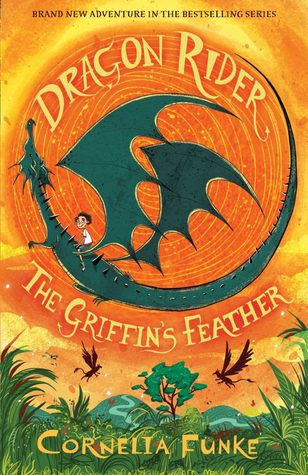
The Griffin's Feather by Cornelia Funke
After finishing Dragon Rider, I quite eagerly continued on to The Griffin’s Feather, which takes place a few years later.
In The Griffin’s Feather, Ben is now a happy part of the Greenblooms, living in a sanctuary for marvelous creatures and helping to save those in danger. One day, word arrives that the mare of one of the last pegasi has passed away. Without her, her eggs can’t hatch and the Pegasus fowls will die. Their only chance of survival is with a sun-feather from a Griffin, the mortal enemy of dragons...
Like The Dragon Rider, this was a fun read. We alternate between Ben’s chapters, where he and Barnabas Greenbloom search for a Griffin with Guinevere’s chapters, which emphasises the short deadline that Barnabas has. I enjoyed seeing both Greenbloom children, especially since Guinevere didn’t have as much page-time in The Dragon Rider. It was touching to see how much care they had for others.
And poor Ben, struggling with his feelings! He loves his new family, but he so clearly misses Firedrake. And with Firedrake’s children about to hatch, which means fewer visits from the dragon, Ben has to make a choice about where he wants to live.
Firedrake was great, as usual. A bit wiser than the first book, which is to be expected. Sorrel, on the other hand, seemed a bit meaner (rather than just grumpy) compared to the first book, especially at the start. But that might be due to the narration rather than a change in character.
Speaking of the narrator, it isn’t Brendan Fraser this time. It’s a bit of a pity, because I really enjoyed his narration and the voices he used in The Dragon Rider. But once I got used to everyone’s new voice, I found that I quite enjoyed this version. Plus the background music and effects were very well-done.
Overall, The Griffin’s Feather is a great sequel to The Dragon Rider. There is a much greater sense of “you must care for the earth” in this book, and luckily that message never becomes preachy. I think younger fantasy fans will really enjoy this.
Disclaimer: I received a free audiobook from the publisher in exchange for an honest review.
In The Griffin’s Feather, Ben is now a happy part of the Greenblooms, living in a sanctuary for marvelous creatures and helping to save those in danger. One day, word arrives that the mare of one of the last pegasi has passed away. Without her, her eggs can’t hatch and the Pegasus fowls will die. Their only chance of survival is with a sun-feather from a Griffin, the mortal enemy of dragons...
Like The Dragon Rider, this was a fun read. We alternate between Ben’s chapters, where he and Barnabas Greenbloom search for a Griffin with Guinevere’s chapters, which emphasises the short deadline that Barnabas has. I enjoyed seeing both Greenbloom children, especially since Guinevere didn’t have as much page-time in The Dragon Rider. It was touching to see how much care they had for others.
And poor Ben, struggling with his feelings! He loves his new family, but he so clearly misses Firedrake. And with Firedrake’s children about to hatch, which means fewer visits from the dragon, Ben has to make a choice about where he wants to live.
Firedrake was great, as usual. A bit wiser than the first book, which is to be expected. Sorrel, on the other hand, seemed a bit meaner (rather than just grumpy) compared to the first book, especially at the start. But that might be due to the narration rather than a change in character.
Speaking of the narrator, it isn’t Brendan Fraser this time. It’s a bit of a pity, because I really enjoyed his narration and the voices he used in The Dragon Rider. But once I got used to everyone’s new voice, I found that I quite enjoyed this version. Plus the background music and effects were very well-done.
Overall, The Griffin’s Feather is a great sequel to The Dragon Rider. There is a much greater sense of “you must care for the earth” in this book, and luckily that message never becomes preachy. I think younger fantasy fans will really enjoy this.
Disclaimer: I received a free audiobook from the publisher in exchange for an honest review.
Subscribe to:
Posts
(
Atom
)