After Ilustrado I wanted to read something light and since I had this in the wish list section for the NLB (no idea why I chose to save it), I decided that it would be a good choice.
Bright Young Things is set in 1929 and basically follows 3 girls: Astrid, who is rich and pretty and dating Charlie. Cordelia Grey, who runs away with her best friend and turns out to be Charlie's half-sister. And finally, Letty, Cordelia's best friend who wants to be a star. Cordelia and Letty quarrel pretty quickly after they arrive in New York so the story quickly becomes Cordelia + Astrid's world and Letty's world, and the two stories are quite separate.
Out of the three girls, Astrid was my favourite. Even though she's obviously a 'poor little rich girl', I thought she was pretty well-written and I found her story to be the most interesting. Her and Charlie's relationship is probably not healthy but it is addictive to read.
The character I liked least was Cordelia because I wanted to shake her so many times. She comes all the way to New York to find her father, which she does, and then she promptly falls for this boy who's the son of the enemy of her father. You can all see where this is going. Maybe it's because I tend to be picky about romances, but I totally didn't buy the relationship between her and the guy and she seemed as a very ungrateful girl for most of the book. But she does get better towards the end.
Last and sadly least (of the three) is Letty, the most forgettable main character for me. I think it's because she has the least time and because her story is so separate from the other two, but I only became interested in what she was doing towards the end of the book. Other than that, I was more interested in how the other two were faring.
Complaints aside, this was an easy and fairly addictive read. If you want something dramatic and fun to read, this is probably something you want to read. (Also, I finally looked at the author's other books and I think I saved this book because of another one called The Luxe. But I'm not sure if I've read that or if I want to read it.)
Monday, March 6, 2017
Sunday, March 5, 2017
Giveaway!
I thought that I've shared this here, but it seems like I totally forgot since it was around the time of the move (if you want to see where I've moved to, I just blogged about my apartment here). Anyway, I'm holding a giveaway!
I'll be giving away paperback copies of The Nutcracker King and Beauty's Daughter, which are my (fairly dark) takes on what happens after the fairytale ends.
The giveaway is being hosted on my other blog, so just click on this link to get there. The giveaway is on until March 23rd, so there's still plenty of time to enter. If fairy tales are your thing, you have nothing to lose(:
All the best!
I'll be giving away paperback copies of The Nutcracker King and Beauty's Daughter, which are my (fairly dark) takes on what happens after the fairytale ends.
The giveaway is being hosted on my other blog, so just click on this link to get there. The giveaway is on until March 23rd, so there's still plenty of time to enter. If fairy tales are your thing, you have nothing to lose(:
All the best!
Friday, March 3, 2017
Ilustrado by Miguel Syjuco
I have finished my second book for the SEA Reading Challenge! Ilustrado is written by Miguel Syjuco, a Pinoy writer. It's got tons of good reviews from prestigious places, and I decided to read it because it sounded interesting - a writer commits suicide and his magnum opus disappears. His friend goes back to the Philippines to find out about him and what happened to the manuscript.
Sounds like an interesting mystery, right?
Well, it was extremely hard work.
The story is told through: blog posts and comments, excerpts from the dead writer's work, excerpts from a biography of the dead writer, narration from the protagonist (first and third person) and probably a few more that I've forgotten. It's a tricky form of narration and unfortunately, it doesn't quite work for me. Apart from the fact that the story was hard to find, everything sounded the same.
There was some good stuff in there - I particularly like the observations about writers living overseas and writing in a language non-native to their country yet receiving acclaim as a representative voice. The frustration (and envy) of the local writers was understandable and I wish this was explored in more detail in the book.
The seedy world of the rich and powerful was also intriguing, though it reminded me of Crazy Rich Asians. I suppose some things don't change.
I didn't quite get the connection between the [SLIGHT SPOILER ALERT] political unrest/riots at the end of the story and the story itself. It seems like there is a connection, but I can't see the point.
If I had read this in IB, I supposed I would have enjoyed the book a little more. The author has clearly put a lot of work into this: the protagonist is named after him, and the start of the book reads like non-fiction, which I think is to blur the lines between fiction and reality. But, I'm in the stage where a book has to be first and foremost entertaining, and any literary message a plus (not impossible: see Fahrenheit 451, To Kill a Mockingbird, and tons of other classics).
Finally, I wonder who this is aimed for. For Filipinos? For the literary elite of the country? Or is it for the literary elite in the West?
Sounds like an interesting mystery, right?
Well, it was extremely hard work.
The story is told through: blog posts and comments, excerpts from the dead writer's work, excerpts from a biography of the dead writer, narration from the protagonist (first and third person) and probably a few more that I've forgotten. It's a tricky form of narration and unfortunately, it doesn't quite work for me. Apart from the fact that the story was hard to find, everything sounded the same.
There was some good stuff in there - I particularly like the observations about writers living overseas and writing in a language non-native to their country yet receiving acclaim as a representative voice. The frustration (and envy) of the local writers was understandable and I wish this was explored in more detail in the book.
The seedy world of the rich and powerful was also intriguing, though it reminded me of Crazy Rich Asians. I suppose some things don't change.
I didn't quite get the connection between the [SLIGHT SPOILER ALERT] political unrest/riots at the end of the story and the story itself. It seems like there is a connection, but I can't see the point.
If I had read this in IB, I supposed I would have enjoyed the book a little more. The author has clearly put a lot of work into this: the protagonist is named after him, and the start of the book reads like non-fiction, which I think is to blur the lines between fiction and reality. But, I'm in the stage where a book has to be first and foremost entertaining, and any literary message a plus (not impossible: see Fahrenheit 451, To Kill a Mockingbird, and tons of other classics).
Finally, I wonder who this is aimed for. For Filipinos? For the literary elite of the country? Or is it for the literary elite in the West?
Labels:
eastern
,
fiction
,
SEA reading challenge
Wednesday, March 1, 2017
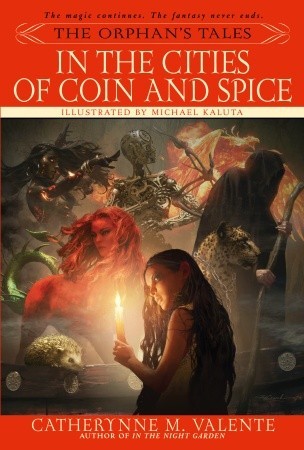
In the Cities of Coin and Spice by Catherynne M. Valente
After I finished this book, I realised that I definitely waited too long after reading "In the Night Garden" (the first book), because In the Cities of Coin and Spice continues the tale etched on the eyelids of the girl in the garden. It's the same framing device, but it feels much more fleshed out this time. And a good thing too, because the 'framing device' turns out to be important (not gonna give any spoilers, so don't worry).
Like the previous book, each tale the girl tells is a tale within a tale within a tale and all tales are linked. It's extremely layered and the writing is as beautiful and descriptive as the previous book. I really enjoyed the fact that myths and fairytales from all around the world were referenced too.
The only weakness of the book is that because the story is so interconnected, one weak story can throw disrupt the book for a good period of time. Thankfully, this only happened once but that was more than enough. Plus, if I put the book down, I ended up being confused when I restarted, because of how complicated it was (so I guess you should just read the book in one sitting).
Oh yeah, and you're going to want to read both books one after the other because if not, you will get confused. I was like "who is this Zmeya person?" (Wait, she appeared in book one, right? I can't remember), which slightly marred the ending.
If you're a fan of lyrical writing, intricate stories and have a lot of time, you should definitely pick up these books.
Like the previous book, each tale the girl tells is a tale within a tale within a tale and all tales are linked. It's extremely layered and the writing is as beautiful and descriptive as the previous book. I really enjoyed the fact that myths and fairytales from all around the world were referenced too.
The only weakness of the book is that because the story is so interconnected, one weak story can throw disrupt the book for a good period of time. Thankfully, this only happened once but that was more than enough. Plus, if I put the book down, I ended up being confused when I restarted, because of how complicated it was (so I guess you should just read the book in one sitting).
Oh yeah, and you're going to want to read both books one after the other because if not, you will get confused. I was like "who is this Zmeya person?" (Wait, she appeared in book one, right? I can't remember), which slightly marred the ending.
If you're a fan of lyrical writing, intricate stories and have a lot of time, you should definitely pick up these books.
Subscribe to:
Posts
(
Atom
)