Showing posts with label about books. Show all posts

Tuesday, October 2, 2018

The Book of Lost Books by Stuart Kelly

I pretty much knew that I had to read this book when I saw this because... it’s a book about books!

Like the title says, this book introduces you to various lost books that you definitely can’t find in bookstores. The book defines a lost book as:

1. A book that existed at one point in time but is now lost

2. Books that never got written because the author died before he could start/finish them

Since none of these books exist, the chapters are almost mini author biographies, since information about these books are found in the author’s lives and correspondence. Sometimes the biography part overshadows the part about what the book probably was, especially in the middle chapters.

I am not familiar with all the authors here, but from looking at the topics that I do know a little about, it seems like the author can sometimes present a one-sided picture. A nuanced, debatable issue becomes over-simplified. This is probably because each chapter is only a couple of pages long, but it might be useful to use the information here as a starting point for more investigation rather than as the ending conclusion.

Overall, I thought this was a fun book. I don’t know if the world is worse-off because all these books are lost (there is almost one case where it’s better the book remained lost), but there are so many books to read that I probably won’t lose sleep over the books mentioned here.

Tuesday, May 1, 2018

The Invisible Library by Genevieve Cogman

I keep hearing about the invisible library series from Wendy at Literary Feline and every time I see her reviews, I put the book on my TBR list. After a pointlessly long time, I finally read the first book in the series and it is fantastic!

This series is about a Library and the Librarians are spies! They go into different alternate realities to steal, um I mean acquire, different rare books that help to refine the Language, which is a language that can be used to command people or things.

Irene is a Librarian who’s suddenly given someone (Kai) to mentor and the task to retrieve a book. It should be an easy task, since it’s Kai’s first mission, but Irene and Kai soon realise that there is far more than meets the eye and that an old nemesis of the Library may be behind everything.

I loved everything about this book! Firstly, there’s the world-building. I love the concept of the Library and the Language, which pulled everything together. The worldbuilding was also very well-done, with the information coming at a good pace that didn’t interfere with the plot.

The characters are also well-done. I really loved Irene, who loves books too and is a bit of a badass. She’s perhaps a bit too unquestioningly loyal to the Library, but she’s a fantastic mentor and I rooted for her from the first page. Kai, her mentee, was also really interesting and I sense a possible romance between them.

The plot was also good. The mystery of the book she has to steal was really engaging and I liked how she tied it to the larger plot. And while the main plot is wrapped up by the end, Cogman has left enough threads hanging that I can see that it’s the start of a series and I’m very eager to read the next book!

If you like books, kickass heroines, a mystery surrounding a book and lots of fun, I’m pretty sure that you’ll enjoy The Invisible Library. I know I’m looking forward to reading the next book.

Thursday, April 19, 2018

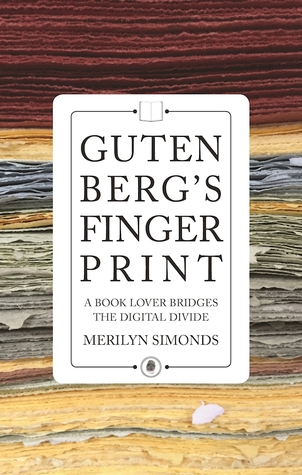
Gutenberg's Fingerprint by Merilyn Simonds

I chanced upon this on the library and it was an immediate borrow for me! Gutenberg’s Fingerprint is a story about how a book is made and the history of books (and ebooks).

Gutenberg’s Fingerprint starts when Marilyn teams up with Hugh, from Three Hellbox Press, to publish a limited edition run of her collection of flash fiction called The Paradise Project.

As Marilyn digs deep into the process of making a book - from making the paper to typesetting to stitching the papers together - she talks about the history of the book. At the same time, she’s preparing an ebook version of The Paradise Project, which gives her opportunities to muse about ebooks and the future of books.

Merilyn is clearly passionate about books, both as an object and for the things they mean. When she talked about picking a font, I started getting interested even though I’m normally a default font kind of person (although I admit that I like to write in Garamond).

She’s also even-handed about ebooks too. While she loves the printed word, she also talks about the advantages of ebooks as well.

That said, she’s not very accurate when it comes to self-publishing. The stats she cites are those that don’t include Amazon, although it would have been easy enough for her to go to Author Earnings (and the book was published in 2017 so the data should have been available when she wrote it).

Plus, she makes the claim that it’s harder to survive as a writer now when a quick look at people like Mark Dawson, Joanna Penn, or even the people at Kboards make a convincing case that it is, in fact, easier than ever to make a living as a writer.

Overall, I really enjoyed this. This book is basically an exploration of the book with a fellow bibliophile, making it a very fun read. I’m glad I read this in the printed form too.

Monday, March 26, 2018

The Labyrinth of Dreaming Books by Walter Moers

I borrowed this book because I really enjoyed The 13 1/2 lives of Captain Bluebear (my introduction to the author) and because the title has the word 'books' inside. What I didn't realise that this is part of a series and that I probably should have read The City of Dreaming Books before reading this.

The Labyrinth of Dreaming Books is set two hundred years after the events of The City of Dreaming Books. As the narrator and protagonist Optimus Yarnspinner will gladly tell you, he's grown incredibly rich and popular since the events of the previous novel. However, the 'orm' has left him and he is unable to write. Intrigued by a letter claiming that the Shadow King has returned, Optimus returns to Bookholm and discovers that much has changed since he left.

Although the start of the book promises a mystery and adventure about this Shadow King, most of the story is concerned with the ways that Bookholm has changed. In a way, this is a travel guide about a fictional place in narrative form. The reader gets to see (through illustrations) Bookholm, learn about its different inhabitants, and even enjoy some puppet shows. The novel does end with the Shadow King, but it seems like the rest of the story is being kept for another book.

Despite the lack of plot, I really enjoyed this story. Bookholm is a fascinating place and I enjoyed reading about it. And since I didn't read The City of Dreaming Books, everything felt new to me so I wasn't bored at all. The only thing I didn't like was that there was a section of the book that used a Gothic font which made it a little hard to read.

Optimus is also an entertaining narrator. He's fairly pompous, but he clearly enjoys stories and I found him to be very endearing. I also enjoyed his interactions with his old friends in the later half of the book and that made me want to read The City of Dreaming Books.

Overall, this is a book that will appeal to bibliophiles looking for their ideal fictional city. I'm not quite sure if I want to live in Bookholm, but I definitely want to pay it a visit.

Wednesday, November 1, 2017

The Social Life of Books by Abigail Williams

Note: I'm currently in the middle of moving back to Singapore and don't have access to wifi in Fukuoka. I'll be back in a few days, once I'm back home(:

I borrowed this book because... why wouldn't I? It's about books, which is one of my favourite things.

To be clear, this is not an easy read. It's about the ways people read in the 18th century and it's written in very dry, academic language. I almost stopped several times because of the language and the only reason I continued reading was because of the subject matter. To be fair, the fault is mine for assuming this would be an easy read.

The book covers 8 topics:

1. Reading aloud (the primary way people read then) and what that meant

2. How the act of reading was part of social life

3. How books were read

4. How people managed to get their hands on books

5. The pervasiveness of poetry

6. The difference between reading aloud and acting and what that meant

7. How people viewed fiction

8. How people viewed religious and scientific works.

I mentioned that the language was very academic and dry, but the subject matter is really interesting and I picked up a lot of interesting facts. For example, people used to read parts of books rather than from cover to cover, which explains the structure of older books.

And in the section on the novel, it is written that 'the novel might be seen as the antithesis of sociable reading' and so communal reading was encouraged to negate the 'isolating' effects of the novel. This second point was quite surprising to me because the novel is seen as helping to develop empathy nowadays, not encouraging people to become isolationists.

Oh, and if you're a fan of Jane Austen's Mansfield Hall, you'll enjoy the chapter on acting vs reading aloud because it helps to explain why it was so scandalous for the young people in the book to put on a play.

Overall, if you're interested in reading about reading and/or the history of reading, you should pick up this book. The style is a bit intimidating (I probably need a few more reads to properly get everything!) but the information is fascinating.

Saturday, October 21, 2017

Bookish Mystery - Meanderings of Memory

A week or two ago, I noticed that I was approaching 1500 posts for this blog. I thought it would be nice to do something special for that post and stumbled across this bookish mystery soon after.  Coincidence?

Yes, probably but what a happy coincidence it is.

According to the Wikipedia article on this, Meanderings of Memory is a lost book. Despite the fact that it was cited as a "first or early source for over 50 entries" in the first edition of the Oxford English Dictionary (OED), the current OED editors (and presumably by extension, everyone else) have not been able to locate a copy.

This mystery came to light in 2013, when a staffer involved in the ongoing revision of the OED sought to verify the earliest citation of the work but couldn't find the source (Meanderings of Memory). After looking at the original archival slips, it appears that these citations were from someone called Edward Peacock, who by all accounts was a credible source.

Unable to find the book, the OED posted an open appeal for information (this was before they found out that who the contributor was). While it is possible that the book never existed, Edward Peacock's other contributions were reliable, and the book has been found in several catalogues, making it unlikely to be a hoax.

Meanderings of Memory is supposed to have been written in 1852 by someone named 'Nightlark' (which was probably a pseudonym). Veronica Hurst, the chief bibliographer hypothesizes that based on the language, Meanderings of Memory may be a "flowery" book of poetry "five to ten pages long". It's also possible that the reason why a surviving copy doesn't exist is because the book was pornographic or published through some unusual method.

Both the comments on the OED appeal page and a Reddit thread throw up some interesting theories, such as the possibility that Edward Peacock was Nightlark. Another theory I read suggests that since the Latin epigraph of the book (which we know from the catalogues) reference a Philomena, who in Greek mythology transformed into a nightingale, this could mean that Nightlark was a lady poetess. If you're interested, I would suggest reading both pages for more information and theories.

I'm not sure if this is a mystery that will ever be solved, but it's certainly one of the more interesting bookish mysteries that I've come across!

Monday, September 18, 2017

Lost Classics edited by Michael Ondaatje, Michael Redhill, Esta Spalding, Linda Spalding

This book sounded interesting and I figured that I was either going to give up within 50 pages, or I'd love it so the most I'd waste is a little bit of time. Books about books tend to be polarising like that. Luckily for me, this book was under "love it" for me.

Lost Classics contains 74 recommendations from various authors (I've heard of two of them, have read maybe one). All the books recommended here are somehow lost, and some of them are just books that the authors met and was unable to read on their reading journey.

What I enjoyed about this book was the sheer variety of books that were recommended. Not every book appealed to me but plenty of them did and now I have a list of books that I'd want to read but probably won't get the chance to. And just so I've written them down somewhere, the books are:

- Too Late to Turn Back by Barbara Greene

- Codex Seraphinianus by Luigi Serafoni

- Glimpses of World History by Jawaharla Nehru

- Classics Revisited by Kenneth Rexroth

- The Five Nations by Rudyard Kipling

- Bernadette, French Girl's Annual

- Beyond the Pawpaw Trees by Palmer Brown

- Address Unknown by Kressmann Taylor (sounds like a really powerful short story set in Nazi Germany)

- The Gate of Horn by G. R. Levy

- The Mouse and His Child by Russell Hoban (it sounds like a lost fairytale which is amazing)

- The Peterkin Papers by Lucretia P. Hale

- The Ten Thousand Things by Maria Dermout (apparently this book is set in Indonesia)

- Jigsaw by Sybille Bedford (sounds like a great autobiography)

The problem with having all these books on my TBR list is that they're lost. I hope that with the advent of the ebook, most of these books will once again be available to the general public. After all, one of the advantages of ebooks is that you don't have to print hundreds of books at a time, which means that you can have books available for the proverbial "long tail."

Fingers crossed.

P.s. Anyone have their own lost book? I have quite a couple but I'm working on getting a copy of them. It's a good thing that the internet exists because I doubt I'd find the books in Singapore or Japan (and anyway I need the internet to find their titles).

Some of my "lost classics"

- The Girl With the Green Ear by Margaret Mahy: It took me forever to find this book (which was really lovely and I reviewed it here), but it was totally worth it. It makes me want to go and find more of my personal "lost classics".

- The Year of Miss Agnes: I do not remember much about the book, except that it was about a wonderful teacher and I read it while on vacation or just before a vacation (to Genting - anyone used to go there all the time too?) and I don't know, it just stuck with me. Can't even describe why. And I remember the smell of fish.

- True Blue: Read with The Year of Miss Agnes and I went back to MG and snuck into the library to search for this.

- The Search for the Lost Keystone: Actually found this in Singapore, so yay! But I loved the description of the house in this book and that stuck with me for a long time. I also forgot the title but remembered it had the word "stone" in it and eventually found it. Rereading it was pure joy.

Monday, August 7, 2017

The Prisoner of Heaven by Carlos Ruiz Zafon

After reading The Shadow of the Wind, I immediately started on The Prisoner of Heaven because it was a gift from a friend (and the reason why I read The Shadow of the Wind). I was super excited because The Shadow of the Wind was fantastic so I had unreasonably high hopes for the book. While this wasn't as good as The Shadow of the Wind, it was still fantastic.

In The Shadow of the Wind, we are introduced to Fermin, who's this really smooth-talking and super amusing character who becomes a best friend to the protagonist, Daniel. In The Prisoner of Heaven, someone from Fermin's past comes back and the story behind Fermin comes to light.

Much like the previous novel, the story toggles between past and present to give the reader a bird's eye view of how things connect to each other. The characters from the previous novel are still there, and I really, really enjoyed reading about how their lives have been since the ending of the first book.

However, I felt that the climax was not as exciting as the first book. While it was satisfying, it didn't have the same intensity of reveal that The Shadow of the Wind had. Plus the cemetery of forgotten books didn't have as big a role as I would like. But looking at Book 2 (which I didn't manage to get my hands on and skipped), it seems like reading that would have enhanced the reading experience The Prisoner of Heaven.

Did I like the book?

Of course!

Am I going to read The Prisoner of Heaven once I find it?

Definitely (and I suspect that it will, like the other two books, drag me in).

But is this as good as The Shadow of the Wind?

Nope, not really. I would still recommend it heartily and if it were any other book I suspect I would be fawning over it a lot more, but I've got the first book on my mind and it sadly does not compare.

(This is still a 5 star book, don't get me wrong. I couldn't put it down once I started but I'm still comparing it to the first book and that was way too awesome.)

Friday, August 4, 2017

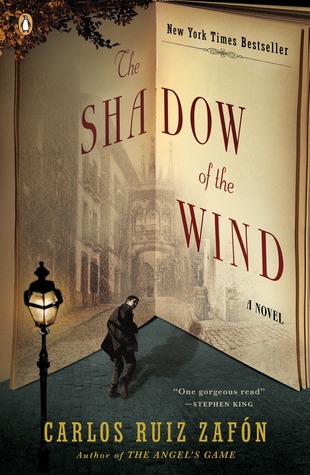
The Shadow of the Wind by Carlos Ruiz Zafon

Few things leave a deeper mark on a reader than the first book that finds its way into his heart.
This is definitely one of the best books of this year!! Thank you so much Gen for sending me the third (?) book in the series and hence getting me to start with this. Now I'm half-excited and half-scared to start the book that you gave me cause I don't know if it's as good!

Unlike the previous book-themed mystery (and I'm definitely classifying this as a mystery), this was fantastic and seriously amazing. The Shadow of the Wind starts when Daniel is taken to the Cemetery of Forgotten Books by his father. There, he is allowed to take one book back and the book that calls to him is an unknown novel called The Shadow of the Wind by Julian Carax (which I also want to read)

In his quest to find out more about the author, he discovers that someone has been buying (or if unsuccessful stealing) copies of Julian Carax's novels and burning them. Plus a menacing and definitely corrupt police officer shows up. These lead to a years-long mystery that ushers Daniel into adulthood.

I'm actually not sure if the above summary does the book justice because it is a lot more complex with a whole cast of characters. Apart from Daniel, the character that made the strongest impression on me was Fermin, a homeless drunk with an amazing ability to find books. He also has a silver tongue and a past with that menacing Inspector. He becomes one of Daniel's most important allies in his quest to find out what really happened.

I feel that the cast of characters and their relationships to one another were so well-written that they helped balance the whole book. It's easy to let the mystery dominate or the growing up Daniel has to do dominate, but since the characters are involved with both and each half cannot be untangled, everyone comes together in one seamless whole, and the journey for the truth becomes Daniel's path to adulthood.

Even the romance was something I enjoyed reading. Not gonna give spoilers (I hope! I will try!) because it is something that happens pretty late in the book, but I thought the false love lost and real love found arc was really good. By the way, adult themes are in this book although it's never explicit and there is swearing so don't give this to children and maybe younger teens (depending on their maturity).

The ending is happy, although not completely. There is one character and one relationship that doesn't end well (or as well as I'd hope) but I find that the little bit of sadness makes the happiness that Daniel and the rest get feel much more real.

I would recommend pretty much everyone (who isn't a kid, like I mentioned before) read this, especially if you like books and mysteries surrounding books. I loved everything about this - the plot, the characters (except the bad guys, though there was one character redemption that was surprising but still believable) and the writing.

Friday, July 21, 2017

Used and Rare by Lawrence and Nancy Goldstone

I haven't re-read this in ages but yesterday's book reminded me of it and luckily, it was on the the books that I brought over to Japan with me.

Used and Rare is the story of how the two authors got into book collecting. It all starts with a bet to see who can get the better birthday present within a budget. Nancy gets a lovely hardback copy of War and Peace and that not only allows her to win the bet, but sparks an interest in used books.

At first, they are content with lovely copies of hardbacks and don't care about whether it's a rare book (in fact, they avoid rare books because they think it's overpriced). But then they find a first edition of a book that's 'haunted' them for years and that gets them interested in rare books and points of issue.

Points of issue are basically the things (like typos and other mistakes) that differentiate one book from another. And apparently, you can differentiate between a first edition first printing and a second printing from it because you can't just rely on the words 'first edition'.

What makes this book interesting is the way they mix personalities and books. The dealers are interesting folk and I'd love to meet them, and the books are discussed in a way that was informative and did not interrupt the flow of the narrative. The only 'major' thing I disagree with them is that I liked Modern Book Collecting and didn't find the prose dry.

Re-reading this reminded me that this was the book that first introduced me to Josephine Tey, and contributed to the "TBR pile that may never be read" (especially books that aren't popular today). And I still want to read them - I just have to find them first. Perhaps I should go to Project Gutenberg and see if any of the books are there.

This makes me want to re-read The Yellow Lighted Bookshop and The King's English, both books about bookselling and books that I also brought over to Japan (it's amazing that I didn't go over the luggage limit). The only thing is that I have a pile of books (and ARCs from NetGalley) that I haven't read.

Still, if you're a fan of stories and books, you'll enjoy this. The author's love of books and stories shine through and it is an easy and fairly informative read.

Thursday, July 20, 2017

Modern Book Collecting by Robert A. Wilson

To start with something completely unrelated to the book, I now enjoy lunch on my own. I get time to read and play phone games without being rude, and half an hour reading time is quite valuable nowadays. So the previous book I read (Once Upon a Spine), though it was not my favourite read, made me want to read more about collecting books. So I picked up Modern Book Collecting, which is actually in my NLB TBR list.

So I have always liked the idea of collecting books. And while I think this book is the most practical book I've seen on how to get started (got to go and check because I think I own a book on the experiences collecting books?), it has also convinced me that I'm not going to be a serious collected. Most of the time, I'm fine with owning an ebook. The medium doesn't matter as much as the story.

Most of the time.

In certain cases, I get emotionally attached to covers and then I must get those. Like the Graveyard Book (had to get the edition that I first read - I think on ROCS? Can't remember but for some reason I love that cover), Fahrenheit 451 (Sec 3 and 4 lit book!) and a scant few others, none of which are first editions. So I shall happily resign myself to just amassing books rather than being a collector.

That said, this was a fascinating and easy read (plus each chapter is relatively short so I picked it up whenever I had time and finished it in two days). The author clearly loves books and it shows through the numerous stories that he has about his collection. He's also no book snob, which I appreciate.

The book (now we finally get to the book!) covers topics like what to collect (by author, by topic, etc), the merits of collecting unknown authors, the best ways of buying books (dealers vs authors vs secondhand shops and thrift stores), how to identify first editions, and even if books are worth it as an investment. And there's even a look into how a book is made (not sure how accurate it is now) which I found fascinating.

One thing I picked up is that it's very rare to find an undervalued book in a second hand bookstore because the owners tend to know if stuff is valuable, but it's possible to do so in a thrift shop/garage sale, especially if the people in charge aren't familiar with the value of books. Of course, things might have changed because this book is probably more than 30(?) years old.

Oh and this book actually has illustrations about the parts of the book so I actually can follow what the author is talking about. The information on how books can get damaged and the discussion on how to store them will probably be useful to any book lover, because no one wants to see their precious books disintegrate.

The fifth appendix is a list of internet resources (not sure if it's a recent edition but yay) so I will be checking that out. Especially the one that seems to be a sort of guide - lists I'll probably skip.

This book has made me want to read more about collecting books and serious collectors, even though my own collection will only be for reading and sentimental purposes.

Thursday, November 10, 2016

The Bad-Ass Librarians of Timbuktu by Joshua Hammer

This could have been a great book. I mean, look at the title. Doesn't that make you want to read it immediately? However, while the title promises a fun time, the book itself proves to be rather dull.

The Bad-Ass Librarians of Timbuktu is supposed to be about Abdel Kader Haidara, who saved thousands of incredibly rare manuscripts from Al Qaeda militants. And you know, all the parts of the book that concerned him were fantastic. I really loved reading about him and how he collected the books then protected them. This would be the first half of the book, which I found very enjoyable.

However, the book spends too much time on backstory. And not the kind that I was looking for. I thought the history of the scribes in Timbuktu was important and well written, but the history of Al Qaeda and Islamic purists in the region? Not what I wanted to read. Quite a few chapters could have been summarised into a page or less, because while the background is important, I didn't pick up the book to learn about that.

So while I started out very positive and liking this book, by the time I finished, I was rather disappointed. The story of how priceless manuscripts were preserved was completely overwhelmed by history and detailed explanation of how Islamic militants were taking over and operating in Timbuktu and the region.

Sunday, August 28, 2016

Book Fair at Harris!

I don't know how many of my blog readers are in Johor, Malaysia, but if you're there, you should definitely head down to Harris at Tebrau city right now! They have a book fair going on, and there are a few tables full of books going at RM5 (nett) each.


That's about SGD 1.68 or USD 1.24, which is extremely cheap. Even the second hand books in Singapore cost more than that.

I managed to pick up five books myself (though I nearly suffered from choices overload and couldn't decide at first)


The books are:

Android Karenina (haven't read, totally looking forward to it)
A Case for Solomon (finished today, extremely good)
Sisters of Fortune (not sure what it's about, but it looks good)
A World of Curiosities (some kind of book of interesting facts so I'm looking forward to that)
How Not to Read (the humour and I didn't agree, so I gave it away to a friend)

Proper reviews to come!

Thursday, August 18, 2016

Unlocking Worlds by Sally Allen

This is a book for story lovers or people looking for reading inspiration. It's basically a book filled with book reviews, roughly categorised into 15 lists.

The lists range from Children's Books to War novels to books about Russian life and British novels, so there's definitely a wide variety of books.

At first, I was a little hesitant as to whether the author's tastes and I would match, because she raved over The Goldfinch (and happened to meet someone who loved it too, and generally made it sound like everyone loved it), when only 44% of The Goldfinch's readers actually managed to finish the book. After reading through her recommendations, however, I may end up giving The Goldfinch a go.

The books she recommends, however, seem to be varied (though with an emphasis on literary fiction, which she admits to being partial too). And since apart from the Children's list, I haven't read many of the other books, I found myself mentally putting a few books on the TBR list.

And I did keep an eye out to see if it was all trad published books, but since she doesn't mention it in her review, I only know for certain that one book is self-published.

That one 'definitely self-published book' sounds fantastic though. I'll definitely have to read that.

I also found one other commonality with the author (apart from a love of reading) - the habit of buying a book at the airport bookstore. I don't know why, but I liked the book a lot more after I read that.

Overall, this seems like a good inspiration book for book lovers. It's easy to go to specific sections and find something that sounds interesting.

Disclaimer: I received a free copy of this book from the publisher via NetGalley in exchange for a free and honest review.

Wednesday, November 12, 2014

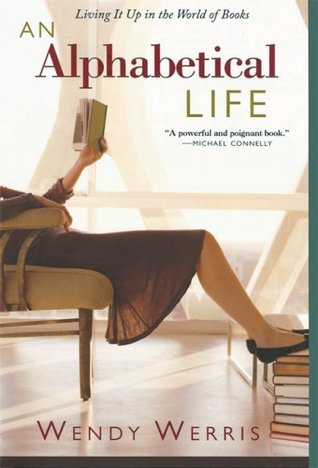
An Alphabetical Life by Wendy Harris

I picked this book up at the library because, let's face it, it's about books. About a life working with books. Sadly, I didn't like the narrator of the book, which meant that I didn't like the book much.

An Alphabetical Life is Wendy Werris's memoir of how she started a career in books, first in a bookshop, then as a publisher's representative. I'm pretty sure this is also supposed to be about how it's like working in a male-dominated profession, and how she works to overcome various obstacles. Unfortunately, I never really connected with her, or felt that there was a larger story than whatever anecdote she was currently relating.

Even after reading the book, I'm not how being a woman publishing rep between then and now has changed. I don't see any clear changes, and it might as well be as chauvinistic as when Ms Werris first started out. And yes, her surviving that long is a really great thing, but it's really because she decided to conform, not because she made waves and changed the industry or something. So lesson here: if you're in a male-dominated world, act like what they expect, and they'll let you survive.

Plus, Ms Werris comes across as very self-centered. She has siblings, but I didn't see any evidence of her living a life with them until she mentions things like having to borrow money from one of them. Well, actually, this is pretty admirable, if the siblings don't want to be in a book. But then again, she does blame her parents for her screwed up family dynamics (of which, she appears to play a central role), so it doesn't particularly seem as though she's censoring for the sake of her family. In fact, what made me think she was self-centered isn't the lack of family in her book, but the way she treats others and her job. She got fired quite a few times, and each time, I couldn't help but think that she deserved to get fired for acting like a child. And of course, she wanted to get fired at that time. Not very responsible, in my opinion.

The book wasn't all bad though. I have a feeling that if I had the same character as Ms. Werris, I would have enjoyed it very much. She's not a bad writer, because her account of her rape was well-written, and I really felt for her then. I thought she was very brave in the way she handled it.

So overall, the one part of the book that made me feel for the author wasn't related to books. I would say that as an account of a life with books, it doesn't work out.

Monday, October 27, 2014

BloggerBlackout: Because Stalking is Not Cool.

Image from Bookthingo
Ok, I know that I'm really really late to the bloggerblackout, but in my defence, I just heard about it today from The Passive Voice. And once I heard about it, I knew I had to join.

Wait, what's this bloggerblackout whatchamacallit? 

Recap of the incident (and why I don't believe what Kathleen Hale says). Feel free to skip if you've already read it. 

Simply put, it's a response by bloggers to the atrocious behaviour of Kathleen Hale. Kathleen Hale received a one-star review from a reviewer who initially liked the book, but was then turned off by PTSD jokes and statutory rape that seemed to be condoned (in her piece, Hale says that there is no rape [she fails to specifiy statutory rape]in the book, but it's mentioned in that reviewer's thread several times by more than one person that there is statutory rape. Hale also completely fails to address the PTSD joke, instead going on and on about the rape, so I assume that it's in the book and she doesn't want to admit it). Hale is so upset that she pays for a background check, visits her house and even calls her at her place of work. This is clearly harassment. But according to Hale, she was being catfished by the blogger.

To quote Inigo Montoya, "You keep using that word. I do not think it means what you think it means."

The definition of cat-fishing is (according to dictionary.com) "to deceive, swindle, etc, by assuming a false personality online." (when used as a slang verb). Please take note of the word "swindle". It's most commonly used for cases where the victim was cheated out of money. From what I can find on the net, the blogger simply used a pseudonym, and didn't actually try to get the author to give her money or free books or something like that.

Personally, my suspicions of the piece were first raised by the fact the author used Stop the Goodreads Bullies (STGRB) as source of information. If you didn't know, STGRB is a bully side dedicated to doxxing "bullies". In other words, bloggers who post critical reviews. I guess to them, the function of book bloggers is to love every single book and promote it for free.

And the second thing that convinced me that there were serious holes with the stories were the lack of screenshots. Or even a link to the offending review. Evidence is everything, especially on the internet, where you can capture webpages straightaway.

So what we have is an extremely one-sided piece, with indications that there are serious doubts as to how truthful the author is being. From searching on the net, it seems that there's no evidence to support her case.

So, what's with all the bloggers up in arms? 

This concerns our safety. Of course we're going to be worried. I'm lucky enough that I live far far away from most writers I review (and anyway, I don't really do snark because I'm atrocious at it - and I tend to pick books that I like so....). But other bloggers aren't so lucky.

If you don't believe what I'm saying, take some time to read this blogger's account of how she was hit over the head with a wine bottle by an angry author.

We book bloggers spend our time reading and reviewing books not because we're trying to be rich or famous, but because we love reading. We love reading, and we want to spread the word. We're not in this for the money or fame, and we shouldn't have to be afraid for our safety because we dare to speak our minds about books.

Hence, the #haleNo and #bloggerblackout trends on twitter.

So what's your blogger blackout going to entail? Are you posting non-reviews? Only reviews of authors long gone? 

My blackout will last till Nov 1 and I will not be posting anything new. I know some bloggers are posting non-review posts, and I might do that (if I find something to say), but for now, I want this post to stay at the top of my blog.

So give me something to read when you're gone! 

Gladly. Here are the most useful links:
Brianna from Pages Unbound did a wonderful post discussing "Who has the "Authority" to review books?"
Bibliodaze has two great posts, an Open Letter to Kathleen Hale and more about #HaleNo, blogger blackout and the non-existent war between bloggers and authors.
Smart Bitches, Trashy Books talks about The Choices of Kathleen Hale
Dear Author explains why pseudonyms are used by some bloggers (and why the pseudonym should be respected) in On The Importance of Pseudonymous Activity

Saturday, November 2, 2013

Long Reads #22

After so long! I'm back with another Long Reads post! It's book-themed and I hope you enjoy it!

'Ain't nothin' gonna break my stride': or WTF YAlitchat by April (Good Books & Wine)- This is really just a blogpost/rant, but it's awesome! I may be a small blogger without much influence, but I know there are blogs whose reviews can sell books. And as a reader that does buy book, bloggers do play a part - if it's a blogger I admire and that I've agreed with before, I tend to give more weight to their reviews. Even if it's a blogger with whom I differ (in terms of taste), their review matters too - sometimes, I'll like something someone else doesn't and vice versa.

Book Bloggers Are People, Too by Amanda Hocking - This is a response to the above post, and it's by an author that support book bloggers. If you weren't convinced by April, you should be convinced by an author right? She even tells you straight out that book bloggers do sell books.

Ten Questions on Jane Austen by John Mullan - You know, I think I read a book like this before. And after a bit of searching, I realised that I've reviewed the book from which this came before: What Matters In Jane Austen by John Mullan. So if you don't know about this book, you could read my review ^, read the article and then buy the book ;D

Diary: Fanfic by Katherine Arcement - I used to read a lot of fanfic. I still do actually, and contrary to the author's experience, not all of it is erotica. I remember reading one moving Teen Titans fanfic about Bulimia, and well, now I read those heart-warming (mafia)family fics for KHR. The article is an interesting look at the world of fanfiction - and it's something that I think does not get enough credit.

I actually have more book-related essays that I haven't read, but I think I'll save that for a later post.

If you need the links to any of these essays (none of them are behind a firewall), let me know!

Monday, May 13, 2013

How to Read Literature by Terry Eagleton

As you can see my the title, I'm in the "I'VE FORGOTTEN ALL MY LITERATURE HELPPP" sort of mood. Yeah, it pops up every now and then now that I no longer have literature as a class (I know, I'm weird).

So this book is a sort of refresher course. It's divided into five parts: "Openings", "Character", "Narrative", "Interpretation" and "Value". Of the five parts, I liked the last two the best. Why? Because it was something that I hadn't really considered before. The first three..... well, it would be useful if this is your first exposure to Literature, but if you've studied it before, you might find what he says to be a refresher.

Let's think about "Interpretation". We (my lit classes), used to joke that as long as you give enough supporting evidence, you could argue anything for a piece of text. And Terry Eagleton does exactly that. He interpreted the nursuary rhyme "Baa Baa Black Sheep" into a poem that depicts a power struggle very well, assuming that there are two speakers. If you didn't grow up singing the rhyme, you would probably think "hmmmm he's got a point." If you're like me and have three younger siblings, you'll probably have listen/sung the rhyme so much the first reaction is "yeah right". So which response is right? Well, he spends the rest of the chapter debating the subject. That alone would make the book worth recomending, but he adds on the "Value" chapter.

"Value" looks at the age-old question "What makes a book literary?" This question is way more important than you think, because face it, would you consider Harry Potter literary? (Especially if you think that the Narnia series does). What about Twilight or any similar books?

Lastly, writing style. The author, I think he's trying to be funny. I don't know because his type of humour is not my type of humour. I can see when he's being funny, and I can imagine people laughing, but my reaction is ".... ok". It's really a personal preference thing.

For the discussion in those two chapters alone, I'd recommend the book to Literature students. However, if you're a total beginner, I'd recommend "How to read Literature" or "How to read a Novel" because the writing style is more accesible.

Thursday, April 4, 2013

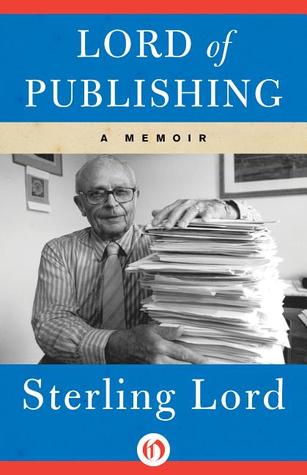
Lord of Publishing by Sterling Lord

I freely admit that I know nothing about the publishing world, and of course, nothing of the role of an agent. But that didn't get in the way of enjoying this humorous auto-biography.

Lord of Publishing talks of Sterling Lord's career as an agent. It starts with him talking about Jack Kerouc, one of his most famous authors. After that (in chapter two), is the story-telling of how he got into the author-agent business. The first two chapter arrangements felt a bit strange to me (The starting was a bit abrupt at first), but I can see that if the two chapters were switched around, it wouldn't have as much of a hook.

The rest of the book talks about the different types of books and authors that he has worked with, including the time where he declined a former American president's offer to be his representative. Even though I don't read quite some of these genres, they're still fascinating, and offer a glimpse into the world of publishing.

Plus, Mr Lord sounds like a nice guy, with a sense of humour.

I really enjoyed reading this book. It was entertaining and educational (well, educational if you want to learn about the publishing industry). In fact, I have a lot more authors that I want to look up now, his passion for the authors he represents is so strong that it made me want to read their works! (Which is probably the best explanation of how he sold their books).

My favourite quote from the book would be this:

"What you should do as early in life as you can is find an occupation or line of work in a field that really interests you. If you get involved and become committed and stay with it, you can live a long time and enjoy it, and have a rich life."

He was talking about his own career, but I think this applies to everyone across all field.

An awesome book, I highly recommend it.

Disclaimer: I got a free copy of this book from NetGalley in exchange for a free and honest review.

Saturday, December 8, 2012

Long Reads #16

This time, I've been reading mainly book-ish articles.

Don't Support Your Local Bookstore by Farhad Manjoo - It makes a very interesting case of why you should not shop at an Independent Bookstore. Personally, I like the limited selection, because it's a very good way to browse and find something completely new. Something that rarely happens on Amazon (I may find something different from what I intended, but it all starts with a search term)

Amazon's Jungle Logic by Richard Russo - This is actually the article that sparked Don't Support Your Local Bookstore as a response. So you can tell, it's a defense of the bookstore. Or rather, the defense of the reputation of the bookstore, as more than merely a place for buying books.

They Cracked This 250 Year-Old Code, And Found a Secret Society Inside by Noah Schatman - It's a really interesting article on how computers can be useful. And of course, teamwork too. It's also a really indirect case for inter-disciplinary coorperation - there's no one expert who has the definitive word.

Don't Look for e-Literature in Novels by Dan Holloway - I will be the first to admit, I don't understand most modern Literature. Or Modern Art. Personally, I prefer the times when (to quote Clarice) "pictures showed people or even things" (approximate quote). The same goes for novels, I like the narrative to be understandable. I still haven't mastered Ulesyss by James Joyce. It took me very long to read Mrs Dalloway, and I still don't understand it. In fact, one of my favourite authors to study is Shakespeare. But if you like the new styles of writing, give this article a go.

The Story Behind a Non-Fiction Novel  by George Plimpton - Can Nonfiction be Literature? Well, I studied The Art of Travel for Literature so I'm guessing yes. And if you think about it, I Know Why The Caged Bird Sings, is an awesome autobiography that utilises fiction techniques. So the answer is definitely yes. The article gave me another book to look up: In Cold Blood by Truman Capote

My 6,1288 Favourite Books by Joe Queenan - If you remembered, I reviewed One For The Books by the same author some time back. And after I posted it, Yvonne from Fiction Books posted a comment alerting me to this article. If you haven't read One For The Books (and you should), go look up this article. You can treat it as a teaser for the book.

What articles have you been reading?