Showing posts with label fashion/beauty. Show all posts

Monday, July 18, 2016

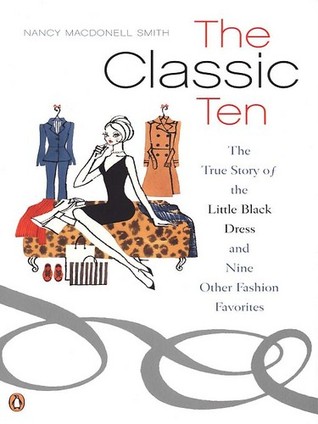
The Classic Ten by Nancy Macdonell Smith

This is my second time reading The Classic Ten, and I'm still glad that I got the book. I've forgotten most of the information already, so it might as well be my first reading.

The Classic Ten is a collection of the histories of ten pieces of fashion items, from the LBD to sneakers.

Each chapter looks at the history of the item, and how it impacted society of that time (and of course, when it was in style). Plus, what the author thinks of the style item - these sections are pretty short and almost always just one anecdote, so I quite liked them.

If you're familiar with pop culture/pop history, you'll probably recognise many of the references here. For me, Audrey Hepburn and The House of Mirth are the things I know. The pro-sports players and fashion icons: not so much. It was interesting, though, and I've got a hankering to watch Breakfast at Tiffany's again, given that the movie and Audrey Hepburn get their fair share of ink.

Another book she mentions a lot is a book called Elegance by Gabrielle Dariaux. I wanted to read it, so I did a quick Google search, but the only book I could find that resembled it was by a Genevieve Dariaux. This is starting to feeling like Princess Starla/alt name and the Jewel Riders again. At any rate, the selected bibliography is a few pages long, and I saw quite a few books that I'd like to read.

If you're interested in the history behind some (not all, since I doubt many people in a tropical country will own a trench coat - I don't own one either. Just a regular coat) of our everyday items, this is a good book to pick up.

Thursday, July 9, 2015

In Your Face by Shari Graydon

We may not think about it, but advertising and the beauty industry affects our perception of beauty. How is it that fat used to be beautiful, but now skinny is in? It's probably marketing (I think. Never take a marketing class unless you want to suspect everything is a form of advertising). At any rate, In Your Face: The Culture of Beauty and You tries to peel back the layers to look at how beauty is defined, and examine our perceptions of beauty.

When I say "our", I really mean "the Western standard of beauty", but "our" was much easier to write. Besides, I think it's safe to say that Western beauty standards have influenced much of the world.

Topics covered by In Your Face include fairytales and beauty, the history of beauty, double standards for men and women, whether being beautiful is an advantage. All in all, there are ten chapters, each exploring a different aspect of beauty. Most of the focus is on Western beauty, although there are brief mentions of African/Asian/Other parts of the world (mostly as a comparison to the West, so it's not really examining their culture of beauty).

Each chapter is written in a conversational style, and laid out like a magazine. It's bright and colourful, with fancy fonts and quite a few images. At the end of the chapter, there is a one page summary, with each point in a box.

I really liked this book. I wasn't expecting a serious treatise on how we view beauty (the cover set my expectations), and when I look back at the book, it seems to have covered a lot more than I thought it would. I think that this serves as a good introduction to the idea of beauty, and how it has been seen throughout the ages.

Disclaimer: I received a free copy of this book from the publisher via NetGalley in exchange for a free and honest review.

Tuesday, January 20, 2015

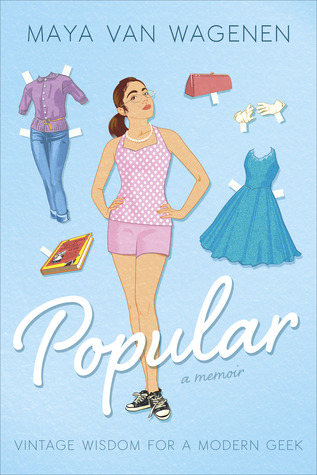
Popular: Vintage Wisdom for a Modern Geek by Maya Van Wagenen

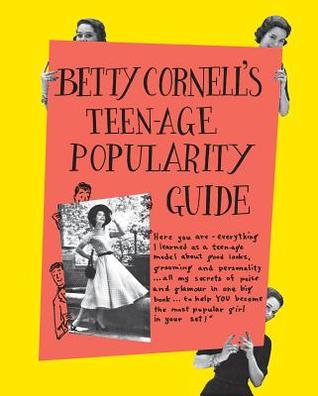
This is actually a two book review in one. I saw this book and the book that inspired it (Betty Cornell's Teenage Guide to Popularity), and figured that since they were both there, I should just read them both.

Popular: Vintage Wisdom for a Modern Geek is a memoir by Maya. She's at the lowest rank of the school hierarchy. So when she finds Betty Cornell's Teenage Guide to Popularity, she decides to spend one month per chapter in a bid to be popular (as defined by her at the start of the book).

Betty Cornell's Teenage Guide to Popularity is exactly what the title says. Covering topics like health, dressing, skin care, make-up, how to behave and more, it's reminds me of finishing school, but in a book.

So what happens when you put an (admittedly dated) guide book with a geek living in a less-than conventional place (this ain't the suburbs after all)?

Well, something approximating what I expected. Maya does make more friends, but it's not because she suddenly becomes popular, like a teen movie. No, she starts to make friends because she starts reaching out to people. And in the process, she realises that how you treat people that's more important than how you look (although how you look can influence your self-esteem, so that's no excuse to slack off).

Despite the fact that Maya and I come from very different backgrounds, I really empathise with her. I know what it's like to not belong to one group, but I think how Maya ends up - friends with everyone, is the best way to end up. You get to meet a lot more people that way.

Popular actually contains enough excerpts from Betty Cornell's Guide that you don't have to read both of them. You can just reading one. But, I found it interesting to read the guide (even though I won't follow anything). After all, it's always fun to peek into the mindset of another age.

When I get back to Singapore, I should go hang around the used bookstores a little more. I might find something cool like this.

Wednesday, January 14, 2015

Alligators, Old Mink and New Money by Allison Houtte

I'm not sure why I picked up this book. But, it was in Scribd, and I do have a subscription, so I thought I'd take a chance on it.

At first, I thought this book was going to be about Allison's modelling career, but turns out, it's about running a vintage shop. Allison's shop Hooti Couture sounds fun, even though I don't generally have luck with vintage and/or second hand clothes. I look awful in them. Must be my lack of fashion sense.

Each chapter of this book starts with a small vignette, and then it enters the real topic. It could be about the shop, about a certain aspect of vintage selling, a great find, anything. It's roughly chronologically arranged, but it feels more like a series of snapshots rather than an autobiography of a store.

I quite enjoyed this book. The author sounds like a really fun person, and I'd love to meet her someday. The only thing I wish the book has is more photos. She describes all these outfits, and it makes me want to see them.

Hmm... this review is short even by my standards. I suppose it does sum up this book - it's a light and fluffy read. You won't learn any deep business or fashion principles, but it is a good distraction if you need one.

Thursday, November 13, 2014

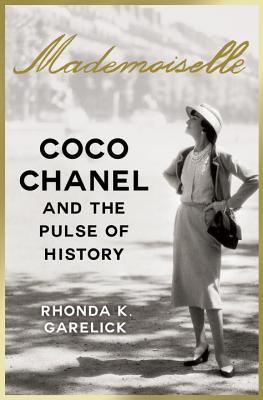
Mademoiselle by Rhonda K. Garelick

Even though I don't own any Chanel, and barely understand fashion, for some reason, I'm always fascinated by Chanel. I suppose that's how far the Chanel mystique extends.

This book aims to be a fair and comprehensive biography of Chanel, no small feat since Chanel had no qualms about lying (and changing her lies) about where she came from. What impressed me was that the book acknowledged Chanel's mystique right from the start. It's as though it says "I'm trying my best to be impartial, but Chanel is really charming, so remember that."

I can't quite remember what the other Chanel biographies I read contained (and I left the book in Singapore/lent it to my teacher), but I'm pretty sure that I learnt a few things that I didn't know before. For example, Chanel's connection to the Nazi's and her very strong anti-Semitic views are unflinchingly described, and there is no attempt made to excuse her for what she said. The author notes the mode of thinking of the set Chanel mingled with, but that doesn't become a convenient excuse for why Chanel held those views. After all, Chanel was an intelligent and savvy businesswoman.

Another thing that I liked was the amount of detail in the book. For every lover or close friend of Chanel, there is a short biography. It might seem like a digression or too much to some people, but I enjoyed reading about it as it helped me build up a more complete picture of the times Chanel lived in.

Finally, the book ends with a short description of Chanel's legacy and her impact on fashion. And in my ebook ARC from Netgalley, there's about 100 pages of footnotes, so those wanting to go deeper into the story will have a lot of sources they can start chasing.

I won't turn into a Chanel convert just because of a well-written biography, but my fascination with her still continues.

Disclaimer: I received a free copy of this book from the publishers via Netgalley in exchange for a free and honest review.

Wednesday, November 5, 2014

So You Want to Work in Fashion? by Patricia Wooster

I requested this book because... because... I'm not sure why. I guess I requested this book because I'm reaching the stage in my life where I need to start thinking about my future goals, and I figured I should learn as much about different industries as possible.

Personally, I'm rather impressed with this book. It covers many areas of the fashion business, from the "obvious" jobs like blogging and modeling to things like stylist, production, photographer etc. At the end, there's a guide as to what you can choose to study, and how to take your first steps (there are activities scattered throughout the book as well), alongside a glossary of terms. Interspersed with the descriptions are interviews with various people working in the industry.

For some reason, a few of the interviews made me feel as though you need connections (or a lot of luck) to make it in the fashion business - especially if you intend to be a designer. I'm not quite sure if that's what they're trying to convey, but I got that impression. Also, I should probably note that I skipped over quite a few of the interviews because they bored me, and because I found the "introduction" font hard to read. But, I think if you're interested in the fashion business, you'll find the interviews to contain a lot of useful information.

Overall though, I think this provides a level-headed view into the fashion business. I like how they covered all the different aspects equally, and seem to provide good advice to people who want to be in the business.

Disclaimer: I got a free copy of this book from NetGalley in exchange for a free and honest review.

Monday, September 1, 2014

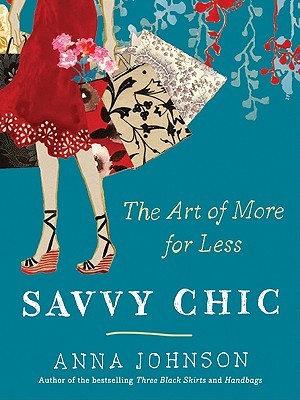
Savvy Chic by Anna Johnson

I saw this book... a few years ago I think. It was a month or two before I left Japan, so about 3 years? Anyway, I tend to be cautious about buying books (unless I'm in an airport bookstore, then it's "take a risk), and prefer to research about a book before I get it. This was one of the books that I put on my mental "to Google" list, and then promptly forgot about, with the excitement of moving to a new country.

When I saw this book in Scribd, and got a chance to read it as a part of the subscription library, I jumped at the chance. And well, I'm glad that I didn't plonk down the (rather substantial) amount of cash for this book back then.

Don't get me wrong, Savvy Chic is a nicely written book and I would have loved it - if I had a more bohemian style. While I admire the style, it's not something I wear, and the lifestyle is not something that I live. Which makes the book more or less useless to me.

I would have just enjoyed the book if it weren't for the fact that I disagreed strongly with a few points.

One piece of advice is
"When you throw a housewarming have each friend bring you a beautiful, completely individual wineglass and plate."
Admittedly, this is coming from a Singaporean point of view, but no. If I throw a housewarming, it's to celebrate my new house, and not to get something from my friends. If they ask what they should bring, that's another matter, but I won't demand things. I'd rather buy the wineglass and plate one at a time, while at flea markets and stuff.

Another would be her advice on bargaining. She advises you to bargain, but then remember, the store-owner has to make a living too! It's all very contradictory, and it confused me.

And there are other points, but those I disagreed with because I'm not bohemian, so it's really a personal thing.

Bottom line, if you're bohemian and proud of it, get the book. You'll probably love it. If you're like me, then you may just want to borrow the book first, to see whether it's worth it. Sure it's well-written and amusing, but if you're not going to use the advice, what's it for?

Tuesday, April 8, 2014

Charm by Stephen Bayley

Do you think you're charming? Well, I'm not, considering that I can have an abrasive personality. Do I think that this book is charming? Well, to put it bluntly, no.

Charm is supposed to be a book on charm - what it is and what its history has been. Unfortunately, it suffers from one serious problem: a lack of focus. The author tends to skip from one thing to another and I never really knew what was going on in this long essay/mini-book. I would have much preferred more focus, for example, a clear structure that went either thematically (of looking at the possible elements of charm) or historically (charm through the ages). But perhaps the author thought that his method was more charming, I don't particularly agree, but style is subjective.

Charm for the male and female is apparently two different things. A charming man has "curiosity without being intrusively inquisitive. He has a confident, but not swaggering, bearing that's modified by a sensitive and intelligent reticence in the way he holds himself. He does not sulk, nor does he strut. It's a matter of balance and he finds a physical posture in between. He engages. He listens. He is empathetic. He has curiosity, is never short of something to say, but he knows the value of a pause." In other words, he is a Gary-Sue. I might also add that this definition makes me want to add 'he is also one stop short of being insufferable'.

What about the female? Well, a charming woman is "not an expression [the author would] readily use since to call a woman 'charming' is. in [his] view, to suggest a lack of other attractive properties". But no worries, he provides a definition in the following sentence: "First, looks. She would be gamine, pert, with a lively intelligence that settles, and then moves about her face. Her eyes are bright, but questioning, and she carries herself with relaxed elegance. Both literally and metaphorically, a charming woman would be light on her feet. ... The charming woman has more power than reserve, although that's not to say that the power's not actually kept discreetly in reserve." Part of this description actually reminds me of Elizabeth Bennet (and her 'fine eyes'). As well as Emma. So being a 'charming' woman would be a good thing.

One thing of this book struck me: when the author called Peter Mayle's book A Year in Florence charming. I whole-heartedly concur with this.

But, this book felt more flighty than charming. It had an interesting subject, but I think that the author didn't do it justice. I would be interested in reading a more detailed and focused book on this subject. Any recommendations?

Disclaimer: I got a copy of this book from the publisher via NetGalley in exchange for a free and honest review.

Tuesday, May 21, 2013

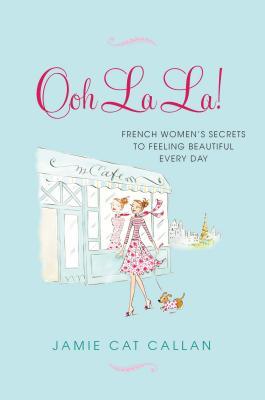
Ooh La La! by Jamie Cat Callan (ARC)

If I had to identify myself as a "country"-phile, I would probably use the word Japanophile. But, that doesn't mean books like these don't interest me! I've never really felt the whole "French women are somehow better" thing that the author seems to feel, but I am interested in a culture of women who have made such an impression that they are perceived as glamorous.

On the whole, I'm quite impressed with this book. I thought it was going to be a beauty and style secrets kind of book, but it tries to go beyond that into helping you live a happier life. And yes, I can sum the book up into one sentence:

Be yourself.

And that really is the whole point of the book. The author talks with different French women of different ages and different personalities, and she gives different tips at the end of each chapter, but the entire book is about finding yourself and being happy in your own skin.

Which is actually good advice. There's this line about expats that struck me: "And so, they are lost somewhere in the middle, never feeling quite at home." That statement hit me pretty hard. It's something that I will deal with for the rest of my life. I know that I will never belong in Japan 100%, even if I'm constantly mistaken for a Japanese. But I also know that even if (or rather, when) I move back to Singapore for good, I will always feel a disconnect because a part of my heart will stay in Japan.

Because of this, the whole "be yourself" message in the book really impressed me. I can't say that I'll be following a lot of her concrete tips, but I will be keeping in mind that I shouldn't try to conform for the sake of conforming - I should be myself, even if that makes me the nail that sticks out.

Disclaimer: I got this book for free via NetGalley in exchange for a free and honest review.

Friday, November 23, 2012

By Invitation Only by Alexis Maybank and Alexandra Wilkis Wilson

I wonder if you've heard of Gilt Groupe? The first time I heard of it was because it was a pre-installed app on my phone (and I can't get rid of it). But I am always interested in the stories of how businesses succeed. And this book is way more than just a story.

Apart from being just a story, By Invitation Only aims to put "forth our story with the goal of offering concrete suggestions on how to handle some of the challenges that lie ahead". And yes, the book does fulfill that promise.

First, the story aspect. The story of Gilt Groupe is really exciting. I'm not a fashion-girl, so these ideas would never agree to me. But the friendship of the A's and the whole start-up team made me support this company (alas, I don't have the money to financially support it). It also presents a candid look at how a start-up works, and how it changes as it gets bigger and starts earning money. The prose was very readable and the story was compelling.

Next, the advise part. One very useful thing is that after milestones, the book provides Checklists that help solidify the lessons learnt. I know some people will be able to gather these lessons just by reading the stories, but for the slightly obtuse like me, the checklists are very helpful. And of course, woven into the narrative itself are bits and pieces of good advice. It didn't interrupt the flow of the re-count at all.

I really do wish that my textbooks were all like this. It's way more interesting to learn from a story (that also explicitly tells you what you're supposed to know) than to keep reading the same dry theories. Although admittedly, my Business and Management textbook is pretty interesting.

Disclaimer: I got this book free from NetGalley in exchange for a free and honest review.

Tuesday, July 3, 2012

The Knockoff Economy by Kal Raustiala

I don't know why, but I enjoy reading books like this. They're not strictly business/economics textbooks, but they're much more interesting than the normal treatise. If I remember correctly, the last similar book I read was Overdressed by Elizabeth E. Cline. (and I have another one waiting to be read. I think).

The Knockoff Economy aims to examine the link between Copying and Innovation, and if copying has an effect on the industry itself. In the face of conventional wisdom, the book shows that in the industries studied (although it may not apply to all industries), copying can actually help to grow the industry and spur innovation.

The industries examined in the book are: fashion (which is why it reminded me of Overdressed), cuisine, comedy, football, fonts, finance, etc. They're a fairy diverse range of industries (although most of them are in the Quaternary industry - and I'm not sure if football counts as an industry) which means that the odds that this phenomenon is a statistical anomaly/limited to one industry is slightly less.

But in summary, the argument is that copying can help propel something into a trend, or the slight delay is enough for a first-mover advantage so there isn't much need for IP (or in some cases, like food, it's very hard to copyright stuff).

She ends with an epilogue on Music as a low-IP industry, something that I found very interesting considering the current state of the music industry.

Each chapter is really well-written, with a lot of examples. This being an advanced copy, I didn't get to see a lot of the graphs, but considering the fact that I normally can't understand them, I imagine that I didn't lost much. The only "downside" was the length of the chapters. For some reason, each chapter felt very very long.

Of course, this book focused very much on the American industries. I can't remember many references to China, but considering that China has managed to copy things like Apple stores and entire companies (e.g. NEC), I'd be very interested in a book talking about whether the new level of imitation that China has achieved is positive or negative.

So, is imitation the best form of flattery?

Disclaimer: I got a free copy of this book from NetGalley in exchange for a free and honest review.

Saturday, April 28, 2012

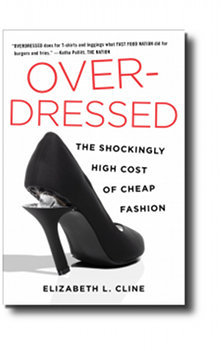
Overdressed by Elizabeth E. Cline (ARC)

I remember reading a book like this before. It was about branding and clothes and through this topic, I actually understood a lot more about IP rights and stuff. Sadly, I forgot the title so I can't share it with you. But, what I'm trying to say is that this book is just like that - excellent, amusing and educational.

Overdressed: The Shockingly High Cost of Cheap Fashion takes a deeper look into the implications of cheap fashion like H&M, Target, etc It's actually a very well-down piece of research, seeing how the author actually went to China and other countries to understand how the clothes are produced.

Even though I myself hardly buy clothes (really, why buy clothes when you can buy books?) I thought this book was very interesting. It seems to cross genres, cover personal experiences, the business managements part, the economics behind this industry, etc. There's even some history in it, if you count the fact that she traces how consumer expenditure on clothing has changed throughout the years, and the socio-economic conditions that accompany/cause each change.

I actually agree with the main thrust of the book. Cheap clothes are a vicious cycle. It makes sense that if you pay less, you value the object less (well, unless it's a book). And if you look at things like Economies of Scale and profitability margins, then the quality of the good has to go down since quality is inversely related to price (think of demand and supply).

Honestly, growing up, I always wore hand-me-downs, so I don't really have the "disposable clothes" mentality that she had. I did try shopping at a cheap fashion store once (I think it's bankrupt now), but I really didn't like the clothes (...so loud...so garish...-shudder-). I tend towards pink(:

If you like the book (and I did), then you should be pleased to know that there is also a blog! It's called The Good Closet and the posts there are thought provoking and interesting (there's a nice mix of both types).

Disclaimer: I got a free copy of this book from NetGalley in exchange for a free and honest review.