Showing posts with label dystopia/utopia. Show all posts

Wednesday, January 31, 2018

Feed by Mira Grant

This was one of the books I saw in England that made me go “hmmm” (but wasn’t attractive enough that I actually bought it). Luckily, the NLB has a copy so I managed to borrow it.

Feed is basically a thriller (political thriller?) set in a zombie-infested dystopian America. I was attracted to the premise of blogging + zombies. So basically, in zombie-infested America, blogging is the new news (there are still newspapers but blogs are dominant now). There are basically three types of blogs - Newsies, for your information needs, Irwins, for when you want to poke a zombie with a stick but don’t want to be there when it happens, and Fictionals, for poetry and stories.

In this world, George (Georgia), her brother Shaun, and their friend Buddy, are Newsie, Irwin and Fictional. When they land a plum job following Senator Ryman’s presidential campaign, they think they’ve found their big break. Instead, they find themselves uncovering a huge conspiracy and have to ask themselves - how far are they willing to go for the truth?

While Zombies greatly influence the world - from the laws to the security procedures and people’s lifestyles, this isn’t really a zombie book (as I understand it. Zombie dystopians aren’t something I have extensive experience with so I might be wrong). There are zombie attacks, but the book isn’t about surviving a zombie attack. Instead, it’s more about truth and politics in a world where zombies are a part of life.

I found that I really enjoyed this. George was a good narrator, and I really liked her relationship with Shaun and Buffy, not to mention the world. The world felt believable - like I could see people reacting to a zombie attack like this, and it was different from most political thriller-type novels.

The book is mainly from George’s POV, with quotes from their blogs beginning and ending the chapters. I found that I liked the quoted blogs, because it provided a good look into their world. I actually wish that I could read more blogs from the world (like can this be a mini site?) because their blogs-as-news concept, with the idea of rankings and traffic, was pretty cool. By the way, the word ‘blog’ in the book covers both the written form and vlogs. It basically means ‘internet content’

The plot also moved along at a fairly quick pace. The tension was consistently high, and I definitely did not predict the ending (which to be honest is a little heartbreaking).

If you’re looking for a different type of zombie and/or political thriller, this is a book that you’ll want to read. It manages to blend the two genres together pretty successfully, although the political thriller element is a bit more dominant.

Tuesday, November 7, 2017

Land of the Meat Munchers by Nicholas Yong

Now this is the kind of stuff that I wanted to read when I started the SEAReadingChallenge . An ordinary zombie story but set in Singapore and by a Singaporean author. I started this yesterday so I guess this is why I had that zombie dream.

Slight digression: I don't know why, but when I search for ebooks (not print books - I assume the situation might be different there) set in South East Asia and by South East Asian authors, I see a lot of literary fiction and stories where the South East Asian protagonist moves to a Western country. Which is cool because we need all sorts of books, but why must SEAsian culture be so overwhelmingly written about in relation to Western culture? Can't we just have books about us without comparing us to other countries?

Or maybe the only reason why I see this phenomenon is because most of the books made into ebooks are these literary & cultural conflict type and there's a lot of other books line Land of the Meat Munchers that exist only in print (really hope this is the case).

/Digression over

Land of the Meat Munchers is a tale of zombie Singapore. A mysterious zombie virus hits Singapore, leaving Jim and other survivors alone to fend for themselves. Chased while out on a food hunt, Jim must make his way back to his group in Tiong Bahru MRT station, with only his new friends - Selina and Raj, for help.

I admit, it was initially weird to see Singapore and hear Singlish in a zombie book. Then I caught myself and realised that there is no reason for this to feel weird. If the US or the UK can be the setting for a zombie apocalypse, then Singapore (and Malaysia and Indonesia and Thailand and everywhere else) can be a setting too. It shouldn't be weird.

The setting was very Singaporean, which was great. At first, I was a bit worried that it would be like a typical zombie book, but with a few names changed. But apart from Singlish dialogue, the book also has Beng zombies, HDBs, the word "ponding" and much more, all well-woven into the story itself. This wasn't a zombie world with Singapore added to it, this was a Singaporean zombie world.

I also found myself really enjoying the fact it was set in Singapore and how Jim, Selina, and Raj were learning to work together. Each of them had their own traumatising past and seeing them learn to work together (or not) was something that I enjoyed reading. Although Jim is the main character, I felt that all three were equally fleshed-out and well-written.

I also liked the fact that the book considered the question of how a zombie outbreak would occur and why we would be isolated. Though the question was never answered because all communication lines and power lines were down, the fact that the characters wondered about this made the setting feel a bit more realistic. If there ever is a second book, I hope the question of why Singapore would be left alone would be answered (or if the zombies managed to travel the causeway)

If you're a fan of zombie books or just looking for fiction set in Singapore, I think you'll really enjoy this. A lot of thought clearly went into making this zombie story Singaporean (including a zombie all in white that continues to try to shake people's hands even in death) and I found this to be a really fun read.

P.s. There is some mature language in this book so it may not be suitable for kids.

Wednesday, January 27, 2016

Wild Thing by Luke Kendall

This is going to be a hard book for me to review because I've seen it in its previous form. Yes, this is another book by someone from WriteOn.

Backstory/How I came to know about Wild Thing. Since I'm on a writing site, I do try to give feedback. Normally, though, I give feedback for the first chapter, but if the book is really good, I continue. I don't continue reading most books that I read. But, Wild Thing was one of them, even though I never really finished it. I did read a fair bit before the author decided to use some professional editors.

And woah, the difference is amazing.

Ok, about the actual book. Wild Thing is about a girl called Sara. When she's very young, a prophecy has her sent from the community she was living in. A few years later, she's picked up by a scientist named Dr. Harmon, who has plans to shape her into an archetype at the Institute for Paranormal Dysfunction. But, there's something much larger at work, and in this book, it involves one particular patient at the Institute.

This is probably not relevant to 99% of the people out there, but I really want to say, that the changes in this book was amazing. I liked it before, but now, it's a lot more fleshed out, and the characters feel a lot deeper. It's amazing to see the story that was hiding under that first draft I read.

Anyway, you can probably tell that I liked the book. I really liked Sara - she's amazingly innocent, even though she's deadly. I do worry about her though, because of the way Dr. Harmon raised her. Dr. Harmon is basically the person I love to hate. He's devious, and probably the reason why Sara will never be normal. So there's a slight sense of satisfaction whenever I see hints at the story that no matter how clever he thinks he is, he is not the one controlling Sara's story. Far from it.

I do, however, need to point out that because of the above-mentioned Dr. Harmon, there are pages in the book (towards the later half) that you'll want to skip if you're squeamish like me. [SPOILER ALERT] I mean, Sara might find it very natural, but you and I know that what Dr. Harmon is doing to her is just plain wrong (and definitely sexually abusive - he even plays the classic 'you made me do it' argument. Ugh). My stomach's a bit weak, so I tend to skip the 'steamier' scenes involving them. [END SPOILER ALERT] There weren't that many, but if you have a problem with stuff like this, consider this a warning.

Overall, I really enjoyed this story. It was interesting for me to see the differences in the two versions that I read, and I definitely think that this version is stronger. I seriously hope that Sara will be able to become more independent from Dr. Harmon, and of course, I want to know the ending for this storyline - I have a feeling that it's not completely over yet.

Disclaimer: I know the author, and as I've repeatedly mentioned, I've read this book even before it was published in its current form. All the praise, though, is genuine.

Thursday, December 17, 2015

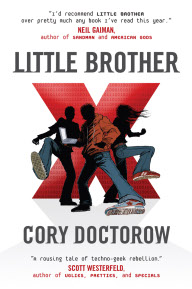
Little Brother by Cory Doctorow

Little Brother by Cory Doctorow is about a teen who gets illegal detained and tortured by the Department of Homeland Security (DHS) after a terrorist attack. The nation steps up its surveillance in the name of safety, and the teen (Marcus) vows to get back at the DHS.

So he creates the xnet, which is an underground network, and before he knows it, he's the face of a movement. Well, not technically, because he operates under a pseudonym, but his pseudonym is considered a leader.

The good about this book: it can be really scary. I'm guessing most of the technology the book describes is already here, and may be in use. The detaining and stuff are here too. So this is a ramped up version of what's going on today.

The bad: the technical stuff can get a little heavy at times. It would be OK if it's for world building, but parts of it reads like a manual for kids. Which it probably is, but I'm not found of instructions/messages disguised as stories. The political message was much better handled, since I guess the whole story was inspired by it. The story is the message, so the need for preaching was reduced.

Oh, and I'm not sure if this is a good or bad thing, but each chapter starts with a dedication to a certain bookstore. I love bookstores a lot, but when I'm in a story, I just want to read what happens next. I'm not as interested in knowing where I can buy the book - I already have places where I regularly get my book fix (plus, a lot of these bookstores aren't available in Japan/Singapore). I learnt how to ignore the dedications pretty quickly though.

Even with the technical overload and the bookstore stuff, would I read the next book?

Absolutely.

Once you finish reading the first half of the book, which is where the explanation of the TOR stuff and all that is, the book starts to pick up speed and I really started worrying for Marcus and his friends, hoping that the DHS would get their comeuppance. And they did (in a a manner that totally rocked).

By the way, the author chose to give the ebooks for free, so if you want to read it, just google and I think you can download a copy.

Thursday, November 12, 2015

The Heartless City by Andrea Berthot

Maybe it's because I read this alongside Broken Dolls, but while The Heartless City is a decent story, it didn't have that spark that Broken Dolls had for me.

The Heartless City follows two characters - Elliot Morrissey, the son of the city's most famous doctor and Iris Faye, a strange American. Iris was born unusual, Elliot made himself unusual (although not quite in the way he hoped). Both of them live in isolated London, which was cut off from the rest of the world when the Hyde monsters were let loose. When chance threw them together, Elliot finds himself attracted to Iris, and Iris finds a chance to get revenge. But more than that, the two of them will have to work together to find out who or what's behind the Hyde phenomenon.

First things first, I thought the concept of the Hyde monsters was unusual and well-done. I was definitely intrigued by that from the start. The story too, was decent, and flowed at a good pace. All in all, I should have been satisfied.

But, there was something missing from the book. As soon as Elliot and Iris met, I could see how their relationship would turn out. Once I was introduced to Elliot's best friends Cam and Andrew, I could see how that was going too. The philosophising by Elliot didn't really help either. The most original character of the lot had to be Philomena, who's clever and breaks all the rules.

I suppose I may have expected too much. The concept of the story was original enough that I expected the plot and the characters to be different. Unfortunately, while they were decent enough that I would have enjoyed it (had I gone into the story without any expectations), my expectations were just a bit too high, and the story didn't sparkle for me like it could have.

Disclaimer: I got a free copy of this book from the publisher via Netgalley in exchange for a free and honest review.

Wednesday, March 11, 2015

Undead Obsessed by Jessica Robinson

From the title of this book, I expected this to be a mainly literary exploration of the portrayal of zombies in various mediums (film, books, etc). However, as the first chapter defines it, using "film, literature, and interview with experts, this book examines how zombies portray real-world fears such as epidemics, mind control, what may or may not exist in space, the repercussions of playing God, and the science behind the fears."

The chapters in Undead Obsessed can be roughly grouped into three types - what I call "science" chapters, which look at the possibility of certain types of outbreaks/ways of becoming zombies, how we react to zombies, and the types of zombies.

For me, I had this impression that this book focuses more on film than literature (although Frankenstein makes its fair share of appearances). I'm not familiar with a lot of the films, but the author manages to provide quick summaries, so I managed to follow along.

Out of all the chapters, I liked "Haitian Zombies" (or should it be "Zombis") the best, as it dealt with the history of a particular type of zombi, and how it was seen in the community it was. Following that, I liked the chapters which analysed movies according to a certain theme, like "power", because I used to be a literature student.

What I didn't quite like were the science chapters, which made up the first part of the book. It may be my natural tendency to science, but apart from showing me just how possible a zombie attack was, it didn't tell me anything about human nature. I would have been interested if there was a chapter on the false science/rumours behind the possibilities of zombies, since that would talk about the fears of mankind, and our limitation to understand science/our tendency to misinterpret scientific news.

Two additional notes from my readings:

First, on jiangshi, or Chinese zombies. Apart from what the author mentions (throw rice on the ground), apparently, if you hold your breath, they won't be able to notice you either. I was hoping for more about Asian zombies, but apart from a mention in chapter 2, they were neglected in the book.

Second, about spreading zombie-making diseases through water: I wonder what the author thinks of Newater? Newater basically uses things like reverse osmosis and UV disinfection to turn used water into drinkable, super clean water. I'd be interested to know how that stands up to diseases, because Singapore is so small that we'll probably be quickly overrun by a zombie invasion.

Overall, this book will probably appeal to the person who's interested in a serious study of zombies. So, enthusiasts and writers looking to do research.

Disclaimer: I received a free copy of this book from the author in exchange for a free and honest review.

Wednesday, December 3, 2014

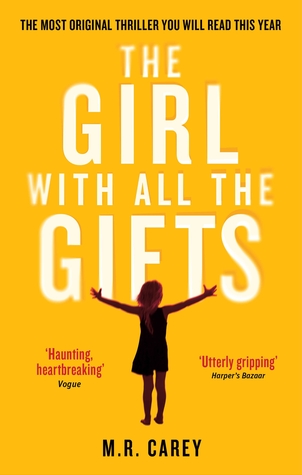
The Girl With All the Gifts by M.R. Carey

I saw this book being raved about on a few book blogs. The blurb was intriguing enough (what on earth is Melanie??) that I decided to give it a go. And as a testament to its popularity, it's extremely difficult to even get my hands on the book in the Singapore libraries (all copies loaned out, you need to reserve it, etc).

For those of you who expect me to read the book and be disappointed (I mean, it is very hyped), I'm sorry. I'm one of those reviewers that fell in love with the book and will end up praising it to high heaven.

The Girl With All The Gifts follows Melanie. All Melanie knows is that she lives on an army base with a bunch of other kids. They're also all special. What she doesn't know is that they're actually all test subjects. Even her beloved Miss Justineau is part of an experiment to test her cognitive and emotional capabilities.

And ah, I can't stand it. Let me say it right here: Melanie is a hungry (aka zombie). She and the other kids are different because they can think and feel. The only thing is that when they get close to human flesh, the hunger overtakes them. For Melanie, that is her biggest fear: that she will lose control and eat her beloved Miss Justineau.

When the Junkers (not sure what they are, but I think they are humans who are rebelling against what's left of the government) overrun the base, Melanie, Miss Justineau, the ruthless Dr. Caldwell and two soldiers (Sergeant Parks and Private Gallagher) are forced to leave and try to find help. Parks wants to kill Melanie, Dr. Caldwell wants to dissect her "number one test subject" and only Miss Justineau is trying to protect her. Melanie? She just wants to protect Miss Justineau.

This story was engrossing and tugged at my heartstrings. Melanie is really a special little girl, and I LOVE HER SO MUCH. She was my favourite character in the book. The other characters were well-written too - they all started off as one dimensional but then developed. I love character development of this sort!

If you like zombie books, and even if you don't, you should pick up this book.

Wednesday, August 27, 2014

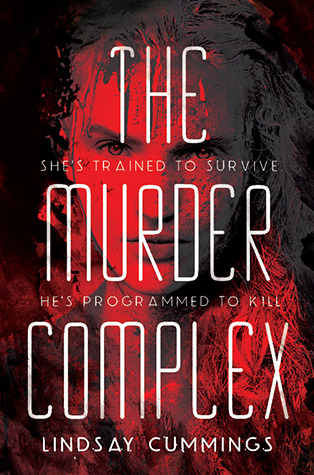
The Murder Complex by Lindsay Cummings

I heard about this book from Book Whales (click to read her review), and it intrigued me. Happily, the library had a copy ^^

The Murder Complex follows Zephyr James and Meadow Woodson, two very special individuals in a dystopian society run by an organisation (a government? Which is the correct term?) called the Initiative.. Zephyr is a Ward, which (as far as I can tell), means that he's an orphan and does the dirty work like clearing the corpses that build up. However, Zephyr has a secret - he kills people. He doesn't know why, but every now and then, he wakes up with a body lying next to him. Meadow is trying to help her family survive by taking a job with the Initiative. Thankfully, her father's training helped her to pass the test. But when Zephyr and Meadow meet, they discover (apart from the instant attraction on Zephyr's part) that something is going on behind the scenes. And it involves them.

Here's what I liked about the book:

Meadow's character. She's trained to survive (and that includes killing when necessary), and her character is exactly what you'd expect. She doesn't have a "hidden soft-side" or go teary-eyed and sentimental at the drop of a hat. In fact, she's quite hard-hearted when need be, and I thought it was very appropriate for someone with her background. Kudos to the author for not trying to soften her.

Zephyr and Talan's friendship. Talan is a friend of Zephyr, and I really liked seeing how these two people had such a strong bond. No, there wasn't any romance, just friendship. It was really really refreshing.

The mystery. There is a mystery in this book (though it's not a murder mystery), and I like how it unravelled. There were quite a few twists and turns, which made the book very addictive.

But, there were some things that I wasn't so crazy about. Like:

The instalove (Sorry Book Whales, I'm going to disagree with you here). I feel that, at least on Zephyr's side, the instalove was fairly strong. I mean, Zephyr has been dreaming of Meadow even before he met her, and he keeps talking about how perfect she is. Thankfully, Meadow didn't do the same, so I only had to endure this for Zephyr's half of the book.

The treatment of Meadow's mom. Without giving away spoilers, let's just say that I found the treatment of Meadow's mom to be too contradictory. Her character, and her relationship with Meadow seem to flip flop, and since it was part of the action-packed finale, was rather unconvincing.

Overall: I liked the book. I'll even read book 2 is I can get my hands on it (this feels like the start of a series). There might have been some things that I'm not crazy about, they weren't so major as to thoroughly dissuade me from continuing the series, or reading other books by this author.

If you're looking for a different opinion, try the review over at A Page of Heaven

Friday, June 13, 2014

For Darkness Shows The Stars by Diana Peterfreund

I can't remember who recommended this book to me, but it was recommended as a good retelling of Jane Austen's Persuasion. So whoever you are, thanks!

For Darkness Shows the Stars is about Elliot, a luddite who is trying to save her family estate while her worthless father and snobbish sister continually impede her efforts. One day, after having been reduced to renting out part of the estate, she discovers that one of the renters was her childhood friend/love interest Kai, now going by the name Malakai. Of course, since this is a retelling of Persuasion, he pretends not to be interested in her, and so on.

What is unique about this book would be its premise. The premise of this book is as far as can be from Persuasion. In this world, mankind has had tinkered with DNA manipulation too much, resulting in a catastrophic accident where most of mankind were Reduced (mentally reduced). The only ones to survive were the Luddites, who had shunned DNA manipulation.

Personally, I loved this. It helped turn the book from a mere-retelling into a story of its own. It made the difference between Elliot and Kai stark from the beginning, and brought in social issues (for example, should normal functioning children of the Reduced have the same rights as Luddites?). This premise had so much potential.

And yet, the premise turned out to be its achilles heel. The book never fully dealt with the issues raised by the premise. Is slavery, seen by the Luddites as a responsibility to take care of the reduced, right? Should society start experimenting with genetic manipulation again? What are the rights of Post-Reductionists? These were all issues that I was interested in, and which the book sadly neglected in favour of the angsty love of Elliot and Kai.

And Kai wasn't even that likable a character. While I had a strong respect for Elliot, who chose duty over her heart (I can relate to that), Kai just seemed petty for most of the book. To me, the flaws of Captain Wentworth (incidentally another name that Kai goes by) was magnified in Kai and his treatment of Elliot. He seemed to be completely incapable of understanding her situation despite growing up with her. In Persuasion, his anger was somewhat excusable because Anne did share some of the blame for breaking it off (she did let herself be persuaded not to marry him after all). But in the case of Elliot, she had no such choice. To leave her family would be to doom not only them, but all those under their care. Without her, her father would have mistreated the Reduced and Posts under their care and bankrupt the family.

While I think that the premise of this story makes it a very interesting re-telling of Jane Austen's Pride and Prejudice, I feel that the book failed the grab the opportunity to explore the issues raised by the premise. It's a pity, because I did enjoy reading the book and I think that it could have been a really great book. I did notice this is the first in a series, and I think I might check out the second book, to see if any of the themes raised here are developed further.

Wednesday, June 11, 2014

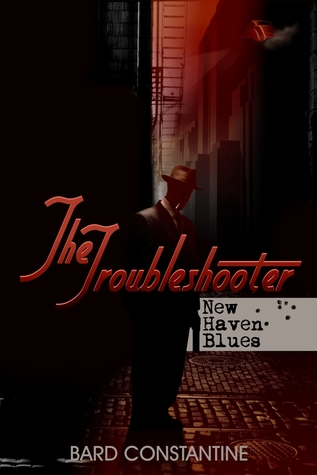
The Troubleshooter by Bard Constatine

I was approached by Bard Constatine to see if I would review one of his books. I chose The Troubleshooter because it sounded really interesting - private-eye in a futuristic dystopian city? Sign me up!

The Troubleshooter stars Mick Trubble, an amnesiac who makes a living solving problems. One day, he's hired by a rich person to find Tommy Tsunami, one of the most dangerous people in New Haven. If that job's not difficult enough, Mick finds out that this 'job' is at the heart of a plot that may change New Haven forever. And he is one of the key players.

What I thought was the most unique part of the novel would be its setting. It's basically a pulp-fiction story with your fast-talking private eye, but in a futuristic world where the underground is run by competing factions (or gangs. They're basically gangs with lots of powers). I thought the dichotomy between the futurist things (like synoids, which are androids but cooler) and Mick Trubble would be too much, but it works together wonderfully.

Mick Trubble is clearly the star of the book. I found the other characters interesting, but I didn't really pay them much attention - unless Mick's attention was focused on them. As the narrator, he steals the show, which may or may not be a good thing, considering that several characters, like Hunter could become major characters in future books.

Another 'star' of the book would be its language. The book uses many unique words, which necessitates a glossary even before you start reading the book (The introduction to the glossary was well-written too, I enjoyed reading the forward). For me, a once-through the glossary was enough, and I managed to pick up the meanings of the words from context. However, others may be confused by all the words, in which case the glossary will definitely come in handy.

I really enjoyed this book, and it looks like the first in a unique and enjoyable series. If you like noir, pulp fiction, private-eye novels, dystopian novels or all of the above, you should definitely pick up this book. Chances are, you won't regret it.

Disclaimer: I got a free copy of this book from the author in exchange for a free and honest review.

Friday, November 15, 2013

Entanglement by Dan Rix (Oops! I Read A Book Again Blog Tours)

You can find the tour schedule here


You know, despite the fact that I didn't like the main characters very much, Entanglement was an awesome book (I guess it's proof that liking a book and liking the characters are two different things). I think I finished it in about two hours, thanks to a sudden rush of spare time (I got to school too early) and the fact that the book was gripping (hey, I had the distraction of the internet, so this is a relevant fact :p)

Entanglement introduces the concept of halves. Halves are people who are born at the exact same time and are basically soulmates. But for Aaron, he's not too excited. And unlike what the blurb says, I don't think it's because he thinks the theory is crap. I think it's because he has a neurological problem that means that even if he does meet his half, he won't recognise her (halves have a special, almost telepathic conversation).

But then, he meets Amber, a girl who might be his half. The only thing is, there's another guy called Clive who's supposed to be Amber's half (even though they're not 18 yet - 18 is the age you meet your half). But there's this really strong chemistry between them, and Aaron's attraction (and then love) for Amber puts both of them in danger.

Personally, I loved this concept of halves. Add in a mysterious (possible evil) secret society and you have me hooked. I read this book mostly for the world-building, which is why my complain is that I need more on this brotherhood! If there was a way the history and structure could be introduced into the book, I would have been over the moon.

The characters? Well.... I quite liked Aaron (the book is from his POV after all), but Amber, well, she seemed extremely antagonistic. I wasn't even sure if she liked Aaron or was just using him to annoy Clive until the later half of the book. But I have to admit, the choices she made at the end really earned my respect. I think that while I won't be squealing over these characters any time soon, they do have my respect.

All in all, this is an excellent book. I'd highly recommend it if you love dystopian fiction.

Disclaimer: I got a free copy of this book as part of the Oops! I Read A Book Again blog tours in exchange for an honest review.

Wednesday, August 14, 2013

Anomaly by Krista McGee

Anomaly is Krista McGee's first foray into Sci-Fic/Dystopian fiction. Before that, she wrote books like First Date, Starring Me and Right Where I Belong (And I loved them all)! So while I was sad that her latest book isn't in that same world, I was also pretty excited to see how she would tackle this new genre.

Anomaly follows Thalli, the titular character who experiences emotion, making her an anomaly. In the world that Thalli lives in, humans have destroyed their own world, and so the Scientists have started re-creating mankind to be without emotions, born to fufill their role. Thalli is her pod's musician, and for some reason, she feels too much.

The book is told from Thalli's point of view, which I think severely limits things. I didn't really get a sense of how the world functioned - I knew a bit of the history, a bit of how it worked, but it never really came to life for me.

Likewise for the characters and their relationships. I think writing about a world where most characters don't feel is tough. So the challenge is to show Thalli as different. But, she has Bert (check name), her romantic interest, so she never feels that isolated. I think that at least for this book (this seems like a series), their relationship should have been put on hold.

Honestly, my favourite part was the ending, because it brought a tiny twist to the whole plot and made in more interesting. Up till then, it felt fairly standard. I could more or less guess what was going to happen.

Well, the bottom line is, it's decent. Not as good as her previous books, and not as good as some other books in this genre, but it's a nice read. I wish I could muster more enthusiasm, but it seems like Sci-Fi/Dystopian is not really her forte.

Disclaimer: I got a free copy of this book from the publishers via NetGalley in exchange for a free and honest review.

Friday, July 12, 2013

The Torturer's Daughter by Zoe Cannon

This book. Was. Incredible.

Like really incredible. Sure, I would have liked a little more worldbuilding, but it has a lot of things I like - realistic characters, interesting internal conflict and a rather unexpected twist.

In The Torturer's Daughter, Becca is well, the daughter of a prominent Torturer (her mom's job is to get confessions from Dissidents). One day, her best friend Heather calls her - apparently her parents and her were taken to 117, the place where her mom works. So she rushes down and well, she can't do much, but she manages to meet Heather.

Heather does get released (but not her parents), and Becca sticks by Heather despite all the rumours that surround Heather. And when she hears from her mom that Heather's parents were Dissidents and were executed that night, she tries to find proof of their guilt).

And of course, since this is a dystopian story, she does find proof. And the proof makes her question the status quo. Add a boy who has a dissident past, and well, it seems to be shaping up to be a normal dystopian story right?

Well, no. One of the parts of the book I loved was the characterisation of Becca's mom. Yes, she's a torturer, but she's also a mom who's doing her best. You can see that she loves her daughter and that she's following her principles. Those two traits make her admirable, and the only reason why she can be considered the bad-guy would be because she supports the Government.

And on the other hand, the love interest/dystopian-background guy isn't so admirable. For one thing, he lies. Repeatedly. And he seems to have an anger problem.

The subversion of these two characters is what makes the book so interesting for me. To be honest, that's why I really want more about this society - I can't make up my mind if to go against the current government is that wrong. I know it's generally accepted that if it's dystopia, the current ruling power has to be wrong, but looking at the characterisations in this book, I can't help but think - what if the government is flawed (it does do terrible things), but ultimately working for good? It's a definite possibility in this book.

I really hope there's a book two! I'd love to know more!

Thursday, June 20, 2013

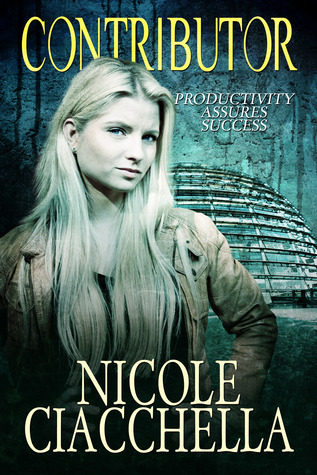
Contributor by Nicole Ciacchella

Ok woah, this book was intense. In a world where everyone is marked by how much they can contribute to the Job Creators/Society, Dara is an up-and-coming student, vying for the prestigious position of Apprentice to the Head of Engineering. But her perfect life starts to fall apart when the ruthlessness of the competition starts to eat at her, and her family undergoes a trial that challenges her beliefs.

Can I say that Dara really reminds me of me? Not the "has a boyfriend part", but in the beginning, when she believes that hard work will be the key to success, wow, that was something that I used to believe. I'm not the smartest person (certainly not the smartest person in my family), but like Dara, I used to think that as long as I worked hard, I would get the good grades, the scholarships, the secured future.

But that future is never secure. As Dara finds out, a system based solely on how much you contribute will neglect the importance of friends and family. And Contributor is a book that follows Dara as she finds out who are her friends, and how much her family actually means to her. It is, I think, very much an exploratory sort of book - it is only at the end of the book that Dara makes a decision based on what she has learnt.

And because of that, I really admire her. I won't give away any spoilers, but let's just say that while this book does promise a book two, the cliffhanger is not very terrible. I like the ending because of the possibilities, and Dara's decision (while not very surprisingly), is admirable.

In short, this is a book that I think deals with an issue very close to all our hearts. Capitalism is very much a dog-eat-dog world, and Meritocracy, while great, does tend to be a little too hard-hearted. This book is one that can make the reader ask "am I focusing on success at the expense of the more important things in life?"

Disclaimer: I got this book from the publisher via NetGalley in exchange for a free and honest review.