Monday, March 31, 2014

One Click by Richard L. Brandt

Amazon was always fairly expensive in Singapore (shipping and all that). But, when I moved to Japan, it became a life-saver when I was looking for English books. Or you know, just wanted to buy anything from Amazon Japan (Prime for students, celebrate!) Ironically, I didn't get this book from Amazon, I chanced upon it in a BookOff store.

One Click is basically a short history of Amazon.com, from it's early beginnings (actually, even before it started, since it does talk about the jobs Jeff Bezos had before he started Amazon), to their crash, and a short discussion on the impact of Amazon.com on the book industry. This is a revised version, so an afterward about the Kindle Fire was added.

What this book showed me that Amazon.com, which I've always taken for granted, is no ordinary company. The reason why it's so successful is because it has a founder who is driven and timed the launch of the website very well. One other thing that I learnt was that the decision to sell books was a largely practical one.

This is mostly a history of Amazon.com, and the short chapter asking "Is Amazon Killing the Bookstore"? is to me, not comprehensive enough. It's really more of an introduction to the debate than anything. But, this isn't the focus of the book, and I'm sure that there are other books that talk about this more in-depth (perhaps I'll look it up on Amazon.com).

This short (207 page) book is a quick introduction into Amazon.com. If you're interested in learning more about the company, this may be a good introduction book. There are about 10 pages of notes in the back, so you can find different sources for further reading.

Friday, March 28, 2014

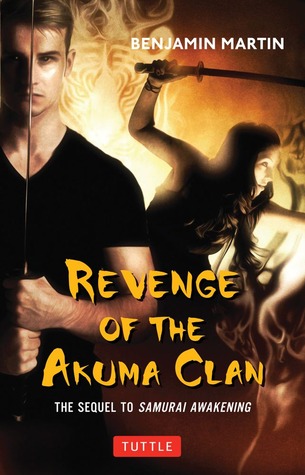
Revenge of the Akuma Clan by Benjamin Martin

When I finished Samurai Awakening, the first book in this series, my reaction was basically "I love it!". Now, for Revenge of the Akuma Clan, my reaction is "I LOVE IT AND I NEED THE SEQUEL NOW!"

But before I start, I need to thank Benjamin for the review copy that he sent. And it's autographed so this is one book I'm never getting rid off :D

Revenge of the Akuma Clan follows David as he continues on his path to be a Jitsugen Samurai, a samurai who protects Japan. But Chul Soon, the antagonist in Samurai Awakening is planning his revenge on David. David prepares for the next attack, but will he be strong enough? -resistingtheurgetospoilthebook-

AHEM. To continue, this book continues the strong characterisation in the first book and even introduces a few new characters (or rather, more of David's classmates find out his secret). Plus, existing characters like Takumi, Natsuki and Rie continue to develop and form new relationships. And of course, there is Kou and Reimi, the two kami inhabiting David and Takumi respectively. That's a large cast of characters. And yet those are just the kids. There are more adults, and I even learned something new about Yukiko, David's host mother.

The pacing of this book starts of normal at first (an ookami incident, a bullying incident), but towards the end of the book, it starts to pick up and rushes at you like a shinkansen. It's definitely the more exciting part, with one event leading to another.

What I liked about this book, apart from the plot and the characters, was how David's personal (Jitsugen Samurai) life and school life started to get more and more intertwined. It felt like the most natural route, since there is no way that so many supernatural events/fights can happen without anyone noticing.

The other thing that I liked was the school trip to Kyushu. It is the island where I'm living on after all. In addition, I've been to most of the places that David and his class goes to. I do wish there was more detail, but I didn't see any mistakes. And since a lot of books set in Japan tend to focus on Tokyo (or Osaka), it was refreshing to see Fukuoka and the rest of Kyushu appear.

If you liked Samurai Awakening, you have to get the sequel. If you're a fan of Japan/fiction set in Japan but haven't read it yet, what are you waiting for? Go and get these two books now!

Disclaimer: I got a free copy of this book from the author in exchange for a free and honest review.

Thursday, March 27, 2014

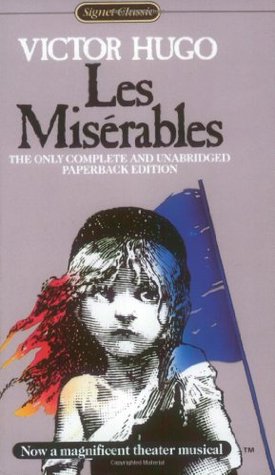
Les Miserables by Victor Hugo

So, I finally got down to reading Les Miserables. It's an absolute monster of a book, on par with War and Peace, although I finished War and Peace much faster.

Before I even watched the movie, all I knew of Les Miserables was that there was a priest who helped a convict that stole from him. That's in the first section of the book and made me wonder how many people read further. Well, it's a really thick book and it tends to ramble so I do understand if people don't finish it.

Les Miserables is basically the story of Jean Valjean (fleeing from the police, represented by Javert). All else is background. Well, along the way there's something about a revolution too. But for a book this thick, it has devoted so much effort to the character of Jean Valjean that all other characters seem flat in comparison.

My least favourite character has got to be Cossette, followed by Marius. Cossette, for someone who has gone through hardship and spent time in a convent, is surprisingly airheaded. As soon as she realises she's pretty, she completely changes. And her sole purpose for living is Marius. Nothing else. She can even gradually forget about Jean Valjean, the man who was like a father. Marius as a character had slightly more depth (he also had more of a storyline), but his insta-love and obsession with Cossette was tiring. Actually, it's probably because I'm not a fan of insta-love that made me not a fan of their relationship. It's got to be unhealthy, the way the two of them are. I mean, Marius only joins the revolt because he thinks his relationship with Cossette is doomed.

So, is it worth reading it? Yes, definitely yes. Victor Hugo does write well and for me, the story of Jean Valjean was so well-done that it made the book for me. And the book does have some pretty deep themes, like redemption, grace and love.

But what about the digressions, you ask. Well, it's not as bad as you think. The most obvious one would be about the sewers and I found that fairly interesting. And the chapters are divided in such a way that if you peek at the start of each chapter, you can figure out how many chapters you need to skip (if you want to skip the digressions). That would probably cut down on the time needed to finish this book too.

Bottom line: It's a bit hard to get through (all those digressions!) but it's a rewarding read.

Wednesday, March 26, 2014

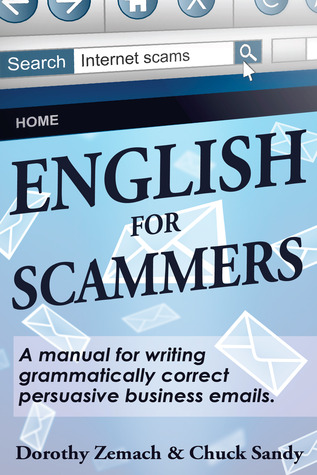
English for Scammers by Dorothy Zemach and Chuck Sandy

If you've ever taken a look in your spam inbox, you would have seen many many claims that promise to make you rich. And if you actually open one, well, you'll regret it because the grammar (and sometimes the font) will give you a headache. While I never ever want to give my personal details to these scammers, I am quite often tempted to reply with an email correcting their grammar and writing style.

Thankfully, English for Scammers does that, which means I can happily ignore all the spam mails, content to know that if they wanted to, they could write nicely. This book teaches you the basics of writing a business letter, from format to tone and even basic things like grammar and punctuation. Keep in mind though, for the grammar and punctuation part, it's not a comprehensive chapter, but is good enough as an introduction. Each chapter ends with a series of exercises, most of which require you to correct the English in a poorly-written scam email. Answers are included at the back of the book.

To me, this book was amusing and fairly educational. For one thing, I didn't know that esophageal cancer was so prevalent in the scammer world. Plus, I haven't had a writing class since secondary school, so it was a good refresher on how to write a professional email. Most of the book uses American English, but the book does give the British English equivalents, which I appreciated.

Difficulty level-wise, this book is probably suited for the beginner or for someone looking for a quite refresher on how to write a professional email. Using these terribly written emails was actually a good idea, because it gives you a very clear sense of what not to write, and by correcting them, you learn how to write a proper email.

Disclaimer: I got a free copy of this book from the publisher via NetGalley in exchange for a free and honest review.