Showing posts with label coursera. Show all posts

Saturday, November 28, 2015

Coursera: Fantasy and Science Fiction: The Human Mind, Our Modern World (Part 5)

And... it's time for another week. I was actually rather unsure if I would submit an essay, because I totally did not enjoy A Princess of Mars. Herland, too, had a rather strong overtone of "THIS IS A MESSAGE. ACCEPT ME", which I'm not too fond of. Even if I agree with the message. But, I found a topic, so I wrote an essay.

The Manly Man in Herland and Princess of Mars

Although Herland is a feminist utopian novel and Princess of Mars is a swashbuckling space western, both of them feature protagonists that can be classified as "manly men". In Herland, this character is Terry, and in a Princess of Mars, the character is John Carter. However, the two books portray the two characters differently.

In Herland, Terry is a character who is a lady-chaser, active and always looking for something "to oppose, to struggle with, to conquer", things Jeff calls "masculine nonsense". In other words, Terry wants "Something Doing", or in other words, an adventure, which explains why "his great aim was exploration". However, in Herland, Terry is the character that cannot adapt, and after attacking his wife, is expelled from the clearly utopian Herland

On the other hand, John Carter in A Princess of Mars is the hero of the story. He has", in his own words, "always outclassed my adversary in agility and generally in strength as well", is made a chieftain although he is a prisoner, and gets the girl. He survives by being the best fighter in a planet that reveres fighting. Although Dejah Thoris can be a strong female character, her principle role is to let John Carter rescue her. This is unlike the women in Herland, who are wise rulers and can think (and stand up) for themselves.

It's clear that the two different types of environments result in the same type of character being seen in two different ways. In a world where peace and maternal wisdom rule, the manly man is unnecessary and the reader is led to see that his actions are destructive for the betterment of society. On the other hand, in a world where fighting is revered and women characters exist to support the male, the manly man is the hero of the story, revered and respected by all.

Grade: 4

Thoughts: There seemed to be a few contradictory evaluations this week, but they're all food for thought. Now to finish reading Bradbury by tomorrow (I loved F451, but I haven't read much of this other works.

Saturday, November 21, 2015

Coursera: Fantasy and Science Fiction: The Human Mind, Our Modern World (Part 4)

We've finished more than half the course! This unit is unit 6, and it's about H.G. Wells. I chose to do my essay on The Island of Doctor Moreau. I also considered The Invisible Man, but couldn't find a suitable topic in time.

The Beast People: Human or Not?

One famous description of man is of him as "a little lower than the angels"[1] and made to "have dominion over the works of thy hands; thou hast put all things under his feet, All sheep and oxen, yea, and the beasts of the field; The fowl of the air, and the fish of the sea, and whatsoever passeth through the paths of the seas."[2] Man is a contradictory animal, with both soul and flesh. In this essay, I would like to examine the nature of the Beast People in The Island of Dr. Moreau, and their relationship to their creator.

First, the Beast People are described as "triumphs of vivisection". They are animal, with the "soul of beasts", but with the Law, they aim to overcome their earthly nature and attain humanhood. In this respect, they are similar to humans, who struggle between the two ends of angels and beasts. In fact, H.G. Wells suggests as much at the end of the book, as Prendick sees the similarities between humans and the Beast People, and "[can] not persuade [himself] that the men and women [he meets] were not also another Beast People"[3].

Next, I would like to discuss the beast people and their relationship to Dr. Moreau. It is a twisted relationship of the traditional relationship between the Christian and God. Dr. Moreau gives them the Law, but makes no other attempt to make them human. Indeed, Dr. Moreau dismisses their "hymns", marriages, houses and calls them a "travesty of humanity." He is a creator who feels no love for his creation [4], a twisted version of the Christian God.

In conclusion, the Beast People and their relationship with Dr. Moreau can be viewed as a twisted version of the Judeo-Christian view of the relationship between humans and God. In this way, the created reflects the attitudes and character of the creator.

Grade Received: 4
What I learnt: There isn't one lesson in particular, but this week's feedback is way better than the previous few weeks. In the previous weeks, I had about half the responses left blank, this week, there was only one blank! And nice detailed comments too XD

The next unit is on Burroughs and Gilman. I've only read A Princess of Mars, but I don't think I can write about it without going into a rent. Hopefully, Herland goes better.

Saturday, November 14, 2015

Coursera: Fantasy and Science Fiction: The Human Mind, Our Modern World (Part 3)

So I have somehow made it through yet another week! It's starting to look like I can complete the whole course, although I'm not sure how I'm even making the time to read the stuff...

Anyway, this week was a selection of stories from Hawthorne and Poe. I quite liked Poe, but I'm not sure if Hawthorne was for me. Still wrote on him though. Anyway, my essay:

The Mary Sue in Hawthorne

In fanfiction, the term Mary Sue pops up frequently. A Mary Sue is a female character who is unnaturally beautiful and talented, and everyone character in the story adores her. If she dies, it is in a heroic self-sacrifice that saves the entire universe, and everyone will mourn her. In this essay, I would like to consider if the female characters in Hawthorne's 'The Birthmark' and 'Rappaccini's Daughter' fit the stereotype of the Mary Sue.

In The Birthmark, Georgiana is considered perfect, except for one, superficial flaw. To me, this resembles the superficial flaw many Mary Sues often have (like clumsiness). In addition, Georgiana seems to be presented as the perfect, meek woman, which female readers might wish to aspire to. However, her ignoble death goes against the Mary Sue stereotype.

In Rappaccini's Daughter, Beatrice is blessed with beauty and the power to live among dangerous plants. She appears perfect, a trait of many Mary Sues. Yet for love, she's willing to divest herself of her powers, and eventually dies. Like Georgiana, her death is not a self-sacrifice, but is more of a total submission to the man that she has fallen in love with. In this way, her death goes against the Mary Sue stereotype.

The female characters in the above two stories are both presented as ideal women - meek and beautiful. In this aspect, they fit the Mary Sue ideal of the perfect female character. However, their ending prevents them from being classified as a Mary Sue, as their untimely and ignoble deaths negate the wish-fulfilment/self-insert function of the Mary Sue. Unless, of course, one wishes to be a tragic heroine. But that is not the norm in most fandoms.

Grade: 4

What I learnt: Someone commented I could have used more evidence in my essay, and I totally agree. Should have done that. But it seems like trying to be more focused was a good idea. Now, I'll have to find a new topic to write about - this week, we're reading stories by H.G. Wells. Still making my way through The Island of Dr. Moreau!

Saturday, November 7, 2015

Coursera: Fantasy and Science Fiction: The Human Mind, Our Modern World (Part 2)

So, I was in Saga last week, but still managed to get the essay out! The blogging... not so much. But for the last two weeks, we read Dracula by Bram Stoker and Frankenstein by Mary Shelley. Unlike the previous two books, this was actually my first time reading these classics.

Week 3: Dracula

My essay

The Transylvanian Castle as a Twisted Garden of Eden and What it Implies

"You may go anywhere you wish in the castle, except where the doors are locked, where of course you will not wish to go." Does this ring a bell? It did to me. I was reminded of Genesis 2:16, where God instructs Adam and Eve that "you are free to eat from any tree in the garden, but you must not eat from the tree of the knowledge of Good and Evil". In the book, the quote is followed by a reference to the count's "knowledge". And like Adam and Eve, when Jonathan gains knowledge, his idyllic life is no more, and he, Mina and their friends are thrown into a world of suffering.

While the comparison of the Count's castle to a twisted Garden of Eden seems obvious to me, how would the original readers have seen it?

I believe so.

Christianity was a large part of Victorian English life, with the Church of England as the dominant Church. Bram Stoker himself was a member of the Church of Ireland. In addition, non-conformist Churches and challenges to Christianity had arisen. I believe that most readers, even non-religious ones, would have been exposed to various Bible stories and sermons from young, and hence would have made the connection immediately.

If the castle is a twisted Garden of Eden, then it's possible to read Dracula through the lens of the Christian Literary Theory. The story can be seen as showing the Fallen World, ruled by Satan, the Prince of the Air (Remember his powers of flight?). Bravely battling him, with symbols of Christianity, are our heroes. While Mina is not strictly a Christ-figure, she comes close with her selflessness, in taking on Dracula's 'sin' and using it to help the others, and finally being redeemed. In the end, evil is defeated and good triumphs.

What I learnt: Apparently, I am introducing too many things in one essay. Got to remember to focus only on one thing, in depth. Also, I need to make my writing more academic.

Grade: 4

Week 4: Frankenstein

My essay

"Abhorred Monster": The use of framing in the narrative to influence the reader

Throughout the novel Frankenstein, the reader is led to see the being created by Victor Frankenstein as some sort of monster. But, if an objective look is taken, this "daemon" and "abhorred monster" becomes something of a pitiful creature - created good, but committing evil deeds due to its rejection from society. It is not, at its core, an evil being.

Why then, and how, is the reader manipulated into believing the worst of Frankenstein's creation?

In the beginning of the novel, the reader is introduced to Frankenstein as a "noble" and sympathetic character. His character is elevated, and used to devalue the character of the monster. Because Frankenstein is so good, this monster that he has created and despises must therefore be bad. In this way, Captain Walton's opening primes the reader to think the worst of the monster.

The second half of the narrative is dominated by Frankenstein, and the monster first speaks only in Chapter 10. If the monster's speech is read in isolation, he is a sympathetic character, but the interjections of "fiend" and "wretched devil" prevent the reader from developing too much sympathy for it. While it is given a few chapters, the overwhelming dominance of Frankenstein's view prevents the reader from developing real sympathy for his creation.

During Captain Walton's closing narrative, he comes close feeling sympathy through the "expressions of [...] misery" from the monster. However, like the reader, he has been too influenced by Frankenstein, and seeing things through his eyes, has his indignation "rekindled". Any genuine emotion the monster may have is ignored.

In conclusion, Captain Walton plays the role of the reader, and his reactions influence and prime the reader to think the worst of Frankenstein's creation. This, coupled with the dominance of Frankenstein's narrative, turns a misunderstood being into a monster that has entered the cultural consciousness.

My grade: 4

As always, I'm interested in knowing if I made any mistakes in my analysis, or if there's anything that I could improve on.

Saturday, October 24, 2015

Coursera: Fantasy and Science Fiction: The Human Mind, Our Modern World

Hey everyone! I'm currently taking this course called "Fantasy and Science Fiction: The Human Mind, Our Modern World", because I like to add stress to my life. Anyway, they have this mini-essay requirement, and I thought it might be interesting to share the essays, and you guys can like, give me your opinions. I need the Lit exchange! Because I'm obviously way rusty.

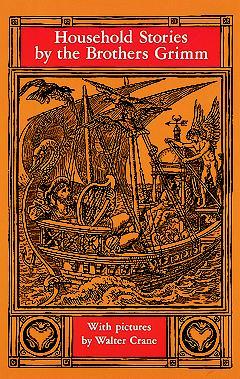
First week: Grimm's Fairy Tales
My essay:

Bad People Finish First: Rewarding Lying and other Bad Behaviours

To me, fairytales were stories that rewarded good and beauty while punishing evil and greed. While this holds true for many stories, such as The Goose Girl, Aschenputtel, etc there are a significant number of stories where behaviours, such as lying/deceit in "Clever Gretel" and "The Three Spinsters", abusing animals in "The Frog Prince" and "The Wonderful Musician" or a refusal to listen to bad advice, as in "Faithful John". In all these stories, the protagonists does things that most would agree are at best, not good. Yet there are all given Happy Endings, with no repercussions.

Two things these stories have in common are the gender and status of the protagonists. Both protagonists in Clever Gretel and The Three Spinsters are poor young women. Hence, it's possible that as a member of a disadvantaged group, deviousness was not only necessary, but lauded. In Faithful John, the prince has a sufficiently high status (and a loyal retainer) that he can afford not to listen to good advice, showing that the upper-classes have more room to make mistakes. Likewise, the musician in The Wonderful Musician has a valuable skill that he can use to raise his status, and choose who he wishes to friend.

The only exception is the princess in the Frog Prince, who is female, yet is never reformed. Because the story is short on details, I theorise that her behaviour is condoned because of her status, which supersedes the requirements of her gender to be a nice girl (like in "The White Snake", where the "proud" princess is changed by an apple into a loving one, or "The Gallant Tailor", where the princess, having married under deceit, cannot leave her husband).

In conclusion, the Grimm's Household stories are surprisingly practical - if the deck is stacked against you, cheat. But otherwise, remain the role you are born in.

(Score:6)

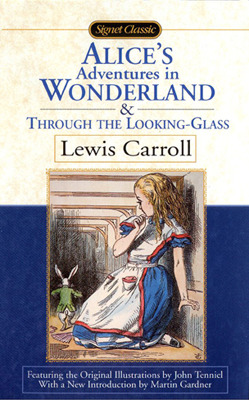
Second Week: Alice in Wonderland and Through the Looking Glass

My Essay (done in a rush because... school life took over):

What is "Natural"?

The word "natural" is used four times in Alice in Wonderland, and three times in Through the Looking Glass. In most of these cases, the word "natural" is used in contexts that could be broadly divided into two - positive (talking animals, dancing with Tweedledee and Tweedledum, and Alice herself are natural) and negative (floating, watches and waistcoat-pockets and confusing conversations). To me, this seems to indicate that Lewis Carroll had a very specific definition of "natural" in mind.

Like in fairytales, the extraordinary is not necessarily unnatural. The world may follow it's own rules, as strange as they may be. Natural is simply the world working as it should. It is only when the rules are broken that things become unnatural. People should walk, animals should not be constrained by the artificial forces of time, and conversations should not be confusing. Break the unspoken rules, and things feel off.

But is that world natural?

Alice is a very unusual girl, as seen by her reactions to different situations. She tries to talk to a mouse in French, talks to the cats, pretends she is two people, etc. So, is she reacting naturally to a natural world, or does her reaction to this unnatural-seeming world prove how strange she is?

Personally, I think Alice shows us a new, much less cynical, way of looking at the world. She is the one that took most things in stride (see how seldom the word was used), and adapted to her new environments quickly, not letting them overwhelm her (compared to me. I would have broken down and drowned in my tears by chapter 2). This adaptability of hers is what is natural.

(score: 4)

So, these are my essays. What do you think? I'm pretty sure I have some pretty big gaps, cause of the word count and because I haven't critically analysed anything in forever.

Next week: Dracula! Currently reading the book in bits and pieces, when I can find the time.

Friday, July 4, 2014

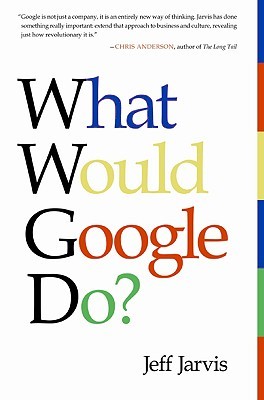
What Would Google Do? by Jeff Jarvis

As part of my Understanding Media by Understanding Google Course, I was assigned several books. Unfortunately, none of them are available in the school library here, but thankfully, Scribd had a two of them. What Would Google Do is one of them,

To summarise the book in one sentence, it looks at what Google does, and how that will impact various fields such as Media, Public Welfare, Utlities, etc. Some of the areas that he looked at seemed very unlikely to be affected by Google, but the basic question asked is: what would happen if there was no middleman controlling the flow of information?

Whether you like the first part of the book, where he talks about how Google is changing things such as publicness, society, economy and others, or whether you prefer the case study is really a personal preference. Personally, I liked the first half of the book, but that's because the arguments brought up there were new to me and thus more interesting. The second half of the book is really an application of what the first half says, so it felt a bit repetitive at times.

This book is so optimistic that it's hard to be skeptical of what he's saying. The author is definitely persuasive when it comes to making a case for his new world. But, I wonder how much of it is applicable to countries such as China. For some, like how the media will change, I found his forecasts to be interesting and believable, but I still remain doubtful about whether his forecasts of things like healthcare will come true.

All in all, this book is an interesting read. If you're curious about Google and its impact on society today (and how it might impact us in the future), this is a good book to read. I'll leave you with a quote that I really like from the book:

We no longer need companies, institutions, or government to organise us. We now have the tools to organise ourselves. We can find each other and coalesce around political causes or bad companies or talent or business or ideas. We can share and sort our knowledge and behavior. We can communicate and come together in an instant. We also have new ethics and attitudes that spring from this new organisation and change society in ways we cannot yet see, with openness, generosity, collaboration, efficiency. We are using the internet's connective tissue to leap over borders - whether they surround countries or companies or demographics. We are reorganising society.