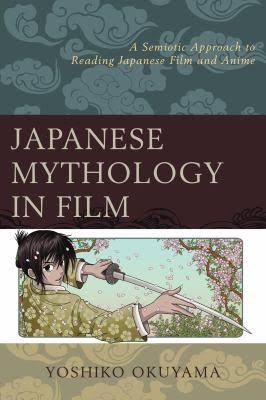
I had to borrow this book as soon as I saw it because I took a class on Miyazaki Hayao’s films. That’s a very tenuous connection but I’m clinging on to it all the same.
Japanese Mythology in Film is an introduction to the study of Japanese culture through movies (both live action and anime). The author argues that semiotics can be used to uncover signs of Japanese mythology which in turn can be used to develop cultural or visual literacy.
First, a few definitions:
Semiotics is “the study of a system of signs to determine how symbolic meanings are created and transmitted through use of words, concepts, images, and so forth.” In other words, studying the meaningful words and pictures in the movie (at least in my understanding).
Mythology in this book is defined as “the stories and allegories of deities and humans, the afterlife, and natural phenomena and supernatural forces as well as to other myths and legends of the mainstream and folk religions of Japan.” So basically religious Japanese culture.
After explaining what semiotics is in detail and why it’s a valid way of analysing film, as well as the presence of mythology in film, the book goes on to analyse the following topics:
- Taoism and Shintoism in Onmyoji and Onmyoji II
- Folklore motifs in Spirited Away and Princess Mononoke (Obviously this was my favourite chapter)
- Buddhist and Folklore motifs in Dorito and Departures
- Eclectic myths in Mushi-Shi and Cyber mythology of Ghost in the Shell 2: Innocence
I’m only familiar with Miyazaki’s movies and I’ve watched a few episodes of Mushi-shi, but the book does a great job of summarising the movies so that I can understand the analysis (and it made me want to watch everything mentioned).
If I start to go into detail about what I learnt, I’d just end up summarising the whole book. Perhaps it’s because of the breadth of the work, but I felt that this book taught me more about Japanese mythology and culture than the Miyazaki module.
Because this book is aimed at undergraduates, the tone is academic. However, it is definitely not inaccessible and I would recommend this to anyone interested in Japan, myths, and/or cinema.
Wednesday, February 28, 2018
Tuesday, February 27, 2018
The Perfect Nanny by Leila Slimani
I heard a lot of good things about this book (and apparently it’s based on a true story) so I decided to borrow it and see what it’s about.
The Perfect Nanny starts when Paul and Myriam hire Louise to be their children’s nanny. Myriam has been unhappy as a mother, so Louise allows her to go back to work, which she enjoys. However, Louise becomes obsessed with carving out a space for herself in this family and starts to take more and more drastic steps.
The tension in this book was really high, which made it such an addictive read. Louise seems to be perfect at first, but there are warning signs, such as her (literally) ferocious love for the children. Then bit by bit, she starts to unravel, which raises the tension even higher because we know how this is going to end.
The writing was great too. You could totally feel how obsessed Louise is, although I still think My Cousin Rebecca’s portrayal of obsession is still better. While I totally got that Louise was getting obsessed, I didn’t feel the obsession the way I felt it when Du Maurier wrote her book. Apart from Louise, Myriam’s guilt about going back to work was also well-written, and I could empathise with her.
That said, the novel doesn’t actually show the climax. We see the immediate aftermath and the build up to it, but no climax. It actually feels like the novel was abruptly cut off, because there are a few more loose threads than I was expecting.
All in all, this was a very tightly written novel. If you’re into domestic thrillers, this will probably be right up your alley.
The Perfect Nanny starts when Paul and Myriam hire Louise to be their children’s nanny. Myriam has been unhappy as a mother, so Louise allows her to go back to work, which she enjoys. However, Louise becomes obsessed with carving out a space for herself in this family and starts to take more and more drastic steps.
The tension in this book was really high, which made it such an addictive read. Louise seems to be perfect at first, but there are warning signs, such as her (literally) ferocious love for the children. Then bit by bit, she starts to unravel, which raises the tension even higher because we know how this is going to end.
The writing was great too. You could totally feel how obsessed Louise is, although I still think My Cousin Rebecca’s portrayal of obsession is still better. While I totally got that Louise was getting obsessed, I didn’t feel the obsession the way I felt it when Du Maurier wrote her book. Apart from Louise, Myriam’s guilt about going back to work was also well-written, and I could empathise with her.
That said, the novel doesn’t actually show the climax. We see the immediate aftermath and the build up to it, but no climax. It actually feels like the novel was abruptly cut off, because there are a few more loose threads than I was expecting.
All in all, this was a very tightly written novel. If you’re into domestic thrillers, this will probably be right up your alley.
Monday, February 26, 2018
I Never Knew That About England by Christopher Winn
This is one of the books that I got in England! I thought it’d be a nice trip souvenir, though maybe it’s more suitable for during the trip.
I Never Knew That About England is basically a compilation of interesting facts in England. The book is organised geographically, according to the “39 traditional English counties that have defined the map of England for many hundreds of years, since these are based on natural boundaries.” I’m a total geography noob so it doesn’t matter either way to me, but I suppose it’d be a plus/minus point to people who are passionate about counties.
The facts here range from one sentence to a couple of paragraphs long, and cover things such as:
- the home of marmite (Burton-on-Trent)
- the legend of the “wicked lady”, a heiress who was so bored so took to becoming a highway robber
- the world’s first railway bridge (Causey Arch)
And many more facts. Some were familiar to me, but many are brand new.
And because there is just so much to say, each area only gets a little space. If I were still in the planning stages of the trip, I would definitely have added a few facts from here into my itinerary. In retrospect, perhaps it’s a good thing I found this book in England. The itinerary was far too long as it was.
I Never Knew That About England is basically a compilation of interesting facts in England. The book is organised geographically, according to the “39 traditional English counties that have defined the map of England for many hundreds of years, since these are based on natural boundaries.” I’m a total geography noob so it doesn’t matter either way to me, but I suppose it’d be a plus/minus point to people who are passionate about counties.
The facts here range from one sentence to a couple of paragraphs long, and cover things such as:
- the home of marmite (Burton-on-Trent)
- the legend of the “wicked lady”, a heiress who was so bored so took to becoming a highway robber
- the world’s first railway bridge (Causey Arch)
And many more facts. Some were familiar to me, but many are brand new.
And because there is just so much to say, each area only gets a little space. If I were still in the planning stages of the trip, I would definitely have added a few facts from here into my itinerary. In retrospect, perhaps it’s a good thing I found this book in England. The itinerary was far too long as it was.
Labels:
non-fiction
,
travel
,
western
Thursday, February 22, 2018
Norse Mythology by Neil Gaiman
If you're a fan of the Myths and Legends podcast or just a fan of mythology in general, you need to read this. Norse Mythology is Neil Gaiman’s retelling of the Norse myths, such as how Thor got his hammer, the strange wedding of Freya, Loki’s children and much more. Most the stories end with a line about Ragnarok so that even though the stories are disparate, they have a sense of purpose. Everything leads to the end. Everything leads to Ragnarok.
The language here is Gaiman at his best. It rings with the timelessness of myth, with the added inclusion of wry humour. [Slight spoilers] I also liked how most of the book was in past tense, until the time of Ragnarok, where it changed to present tense which gave it a ring of prophecy.
The characters too were well-written. Thor is a great hero but he’s not the wisest. Loki is truly ambiguous, the trickster who’s allegiance is only for himself (leading to some pretty comic situations). Then there are tragic characters, like Hod, who was tricked into killing his brother and then died for it. Or Tyr, wise and self-sacrificial. There is a wide variety of gods and they are all brought to life in these stories.
If you’re a fan of mythology, you’ll want to read this take on the Norse myths. It’s wonderfully written and I actually want to listen to theaudiobookk. These tales sound like they should be told by a bard.
The language here is Gaiman at his best. It rings with the timelessness of myth, with the added inclusion of wry humour. [Slight spoilers] I also liked how most of the book was in past tense, until the time of Ragnarok, where it changed to present tense which gave it a ring of prophecy.
The characters too were well-written. Thor is a great hero but he’s not the wisest. Loki is truly ambiguous, the trickster who’s allegiance is only for himself (leading to some pretty comic situations). Then there are tragic characters, like Hod, who was tricked into killing his brother and then died for it. Or Tyr, wise and self-sacrificial. There is a wide variety of gods and they are all brought to life in these stories.
If you’re a fan of mythology, you’ll want to read this take on the Norse myths. It’s wonderfully written and I actually want to listen to theaudiobookk. These tales sound like they should be told by a bard.
Labels:
mythological
,
western
Subscribe to:
Posts
(
Atom
)


