Showing posts with label tea and books. Show all posts

Sunday, September 24, 2017

Alice in Wonderland Tea

It's a rare Sunday post from me! Well, I finally have something book-related that is not a review that I wanted to share. I suppose I could share this any day of the week but I have this "weekdays are for reviews" mentality. Anyway, I bought these today: 


Alice in Wonderland tea!! Even though I really shouldn't be buying more (because I already have way too much to drink), I just couldn't resist these!


I really love the details on the packaging, from the top of the box


To the little message on the lid.

I decided to open up one packet of Alice Grey Tea (which is basically Earl Grey Tea) and I really love the design on the packet too. Is it bad that I want to save everything?


I thought the tag at the end was cute as well.


The tea was delicious too. It was very fragrant (I could smell the oil once I opened the box), but it didn't taste too overpowering and I really enjoyed my mug of tea. Yes, I use a mug because a cup simply isn't enough. I can't wait to try the breakfast tea too(:

By the way, each box cost me about 200 yen, which I find really cheap. If you're in Japan, you can check out the nearest Kaldi - that's where I found these. 

Monday, December 16, 2013

David Copperfield by Charles Dickens

When I was younger, I read an abridged version of David Copperfield. I didn't know it was an abridged version, so while I was browsing through a reading list for the Tea and Books reading challenge, I was quite surprised to find it on the list. So of course, I had to read it.

And for a really long, and rather old book, it's very readable. While I quite like Victorian fiction, I tend to be able to read it only in print format. Somehow, they don't read well as an ebook. But with David Copperfield, I was able to read the Gutenberg version in a few days.

If you've never heard of it, David Copperfield is basically a fictional biography of David Copperfield, who may or may not be partly modeled after Charles Dickens. David is born to a childish mother, who remarries a harsh man. He's sent to a horrible school, and when his mother dies, sent to work in a factory. He then runs away to his eccentric aunt, who protects him and educates him. After that, well, the novel really just follows the course of his life, just past his (second) marriage.

Despite the fact that I remembered it as a child's book, it's surprisingly mature.. David Copperfield is basically trial after trial after trial. There is seduction, there are wrong marriage decisions, there is blackmail and fraud, there is spousal abuse,  there is an unhealthy obsession with another person (by a minor character), the amount of dark material is actually quite startling. Yet David remains optimistic and along with his friend Traddles, they remain beacons of light in a really dark world. And yes, the world they live in is really dark.

There's a lot of stuff that could be analysed about the book, but really, you can just google that and page after page of results will come out. This book has been assigned reading for a long time after all. The only thing I want to point out is that quite a few characters are rather flat (actually, I could probably make the case that each character has one sort of trait that is there for their interaction with David. So David is like the complete version of them). Something interesting to take note of would be the different names that David Copperfield is called - his real name is called relatively little times.

I loved this book! It was really easy to read and I enjoyed reading it.

Note: I read this book for the Tea and Books reading challenge.

Monday, September 23, 2013

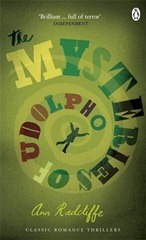
The Mysteries of Udolpho by Ann Radcliffe

To be honest, I picked up this book because Jane Austen mentioned it. And satirized it in her book Northhanger Abbey (You should read that book if you haven't read it yet!). It's a long long book and it was written a long long time ago, which means some people would think it boring straightaway.

But once you get used to the writing style, it's actually not that bad.

The book is about Emily, a poor heiress. She fell in love with this guy called Valencourt, but since her father died, her aunt dis-approved of him. And then she was carried away by her new uncle to a remote castle in Italy (to use Singlish 'and den she kenna carry by the uncle to some ulu place lor' - Maybe I should do a Singlish summary?). The rest of the book is about her trying to run away from her evil uncle, and when that happened, about her romance with Valancourt (that took up the last of the four volumes).

I'm not sure why the last volume existed. Sure, it cleared up a few mysteries, but it could have been done by some fantastical plot twist at the end (I mean, the plot twist was already fantastical enough).

For me, the trick to enjoying this book was to learn to live with long long sentences. (If you want an example of the long sentences, just look at my Teaser Tuesday). For someone used to slightly shorter sentences (and having read a few books that keep emphasizing a 'clean' writing style), this got a bit tiring to read at times. The other thing I had to get used to were all the sonnets. It seemed like as soon as Emily was moved by something, she composed a sonnet. For me, it broke up the flow of the text, and well, if it came during a particularly exciting section, it dragged the book a little.

Still, it's something that I enjoyed much more than I expected!

Note: This book was read for the Tea and Books reading challenge.

Monday, August 19, 2013

Fall of Giants by Ken Follett

I've been on a bit of a reading slump lately, but Fall of Giants was so absorbing I devoured it in two days (and read a few other books concurrently as well). And in the end, it gave me back my appetite for reading!

For some reason, Fall of Giants reminds me a little of Anna Karenina. It's not the prose, it's not the characters, it's the lack of plot. In which case, it also reminds me of those long 600 plus episode Taiwanese soap operas that ahem, older ladies (and me and some of my guy classmates) like to watch.

Basically, Fall of Giants follows the Williams family (Ethel and Billy), the English aristocrats Fitzherberts (Maud, her brother Fitz and his wife the Russian princess Bea), Walter von Ulrich (German), Gus Dewar (American) and the Russian brothers Grigori and Lev. If you look at the characters, you'll notice that most of the countries involved in World War One (and World War Two) are represented here. And that's really what the novel is about - how these different characters interact as war approaches, during war and finally, when the war ends.

I don't think this novel is a class struggle sort of novel. I mean sure, Fritz and Bea are terrible examples of aristocrats. But there's Maud and Walter and Gus (who's upper-class American) - those three are characters that I really liked. And yeah sure, there are the admirable working class, but what about Ethel and Billy's dad, who, to be frank, I did not admire at all. Or Lev, who's a cad (actually, he's like Fritz, but not noble). Bottom line, I don't think that a certain class is stereotyped (for example, all working class people are to be admired) based on the characters themselves.

There's also no obvious villain here. That's because there's no obvious hero and no obvious plot. I mean, Fritz and Lev are my two least favourite characters (and yes, I hoped that they came to a bad end), but they aren't evil. At least, they don't scheme to ruin the lives of others - they're just extraordinarily self-centred. But if I had to point out a 'villian', then I'm going to have to go with the whole concept of war. And the stupidity associated with the concept of "winner take all".

What I really liked were how all these characters were woven together. At first, I didn't see how certain characters could connect with others, but as the novel went on, everything came together. I doubt most of the characters knew how their lives intersected (for example, I doubt that the Russian brothers were aware of Fritz or Ethel or Billy, etc), but as a reader, the lines of connection were quite clear. And the multitude of nationalities served to provide a look at how different countries viewed things.

Lastly, the ending. The ending isn't happy. Sure, the war ended, but we are introduced to Hitler, see the begining of the tragedy that will be Communist Russia and well, if you know anything about modern history, you'll know that the next few years will be brutal and even the hope that the League of Nations brought will be snuffed out really soon.

All in all, I really reccomend this book! Also, special thanks to my friend Nic for buying the book to me and getting it all the way from Singapore to Japan ^^

Note: I read this book as part of the Tea and Books reading challenge.

Friday, June 7, 2013

The New Evidence That Demands A Verdict by Josh McDowell

When I first came to Japan, ok before I moved here, I faced this huge huge problem - which books should I bring? And apparently, 'all of them' was not an answer. Well, after a painstaking collection, I reduced the choices to under 40kg and well, the rest is history. One of those books that made the cut would be this one - The New Evidence That Demands A Verdict.

This book is hefty and intimidating. I bought it because I'm a strange girl and because I've always had an interest in apologetics. To me, this is one of the best books you can have as a reference guide.

Kind of like Frank Morison's "Who Moved The Stone?", The New Evidence That Demands A Verdict is aimed at well, showing how logical Christianity is. But with a lot more detail. This book is broken up into four parts: The Case For The Bible, The Case For Jesus, The Case For and Against Christianity and Truth or Consequences. These are all really broad topics, and they cover things from whether the Bible is historically reliable, allege contradictions in the Bible, whether Jesus existed, Documentary Hypothesis (it's a theory that says that The Pentateuch, the books that Moses wrote, was actually written by a bunch of people who lived long after Moses died), the knowability of truth (this was very useful for IB), defending miracles, the list goes on an on.

And for a book this thick, some of the chapters can be rather short. They're all broken down to one point per section, and some sections, like introductions and conclusions, are basically summaries and so are very short. Other sections last much much longer.

My favourite part is actually Part Four: Truth or Consequences. Perhaps because it's the easiest to understand (I find Form Criticism and the Documentary Hypothesis extremely difficult to understand), but it's a section that I used over and over again in IB.

I really recommend buying this book, reading through it at least once (this is my second time reading through it), and then using it as a reference.

___________
Unrelated note: This book was re-read for the A Cup of Tea Reading Challenge. This challenge is one where you have to read books that are longer than 650 pages. For the record, this book is 687 pages. And well, if you're wondering why I'm so slow on this challenge, don't worry, I have a plan.