Wednesday, August 6, 2014
Rocket Ship by C.O.B
Sick and tired of their lives, two best friends (Lincoln and Gary) decide to run away by building a rocket ship. However, if you read this book expecting a tale of runaways, you may be disappointed, because the rocket ship only launches at the end of the book, and even then, we don't know how it launched.
While this book initially focuses on Lincoln and Gary, it eventually expands to all the dissatisfied children in the class. It becomes a look at childhood, and whether certain types of childhood pain is unbearable, and what makes it worth staying on in your current life. This added dimension was certainly something that I was not expecting.
However, for all the good points of the novel, there are also parts of it I didn't like. One thing that annoyed me was the style of narration. I found the book slow to start (I only started liking it when the other kids came in), and the way of narration made it hard for me to connect with any of the characters. This is probably because the point of view is strictly third person ( "Lincoln and Gary", "they", not "Lincoln and I" or "we").
Speaking of the kids, my favourite characters were probably Gary (for the optimism) and Jacob (the misunderstood bully). On the other hand, I didn't like Lincoln, because he came across as a bully. Sort of like how the bullied become bullies once they get some power or advantage over others. There are also quite a few other kids, but I don't really remember them because there are too many, and the book is too short for them to make an impression (and it doesn't help that the book is in third person, so I never ever hear the individual voice of each kid).
Overall, this book is interesting. While the characters are all fairly young (I believe they're about 12), the style of this book leads me to believe that it's for an older audience. Lastly, this is a personal preference, but I would have preferred a more direct style of narration (first person please!) and less telling (for example, don't tell me they're 'aghast', show it to me). Those two things were what kept the book from completely drawing me in and captivating me.
Disclaimer: I got a free copy of this book as part of Enchanted Book Promotions Blog Tour in exchange for a free and honest review.
Labels:
blog tours
,
fiction
,
western
Tuesday, August 5, 2014
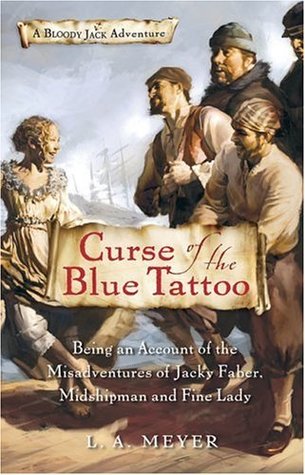
Teaser Tuesday - Curse of the Blue Tattoo by L.A. Meyer
Whoop! Tuesday means the worst day of exams are over, and only one more day to go! And then on Friday, I return to Singapore! I can't wait to see my friends and family again :D
This week's teaser tuesday is from Curse of the Blue Tattoo by L.A. Meyer. It's the second in the Bloody Jack series (you can read my review of the first book here), and I'm enjoying it immensely.
Here's the teaser:
What are your teasers this week?
This week's teaser tuesday is from Curse of the Blue Tattoo by L.A. Meyer. It's the second in the Bloody Jack series (you can read my review of the first book here), and I'm enjoying it immensely.
Here's the teaser:
"As I rush about doing my duty, I'm thinking that Mistress prolly sprung this as a surprise so that the ladies would just spend one day getting ready, instead of a whole week. And keep them on their toes and get them used to preparing on the spur of the moment - never can tell when the President's gonna drop by, don'cha know."Teaser Tuesday is hosted by MizB of ShouldBeReading. To particpate, just share two teasers from a book you're currently reading, along with the title and author.
What are your teasers this week?
Labels:
fiction
,
teaser tuesday
,
western
Monday, August 4, 2014
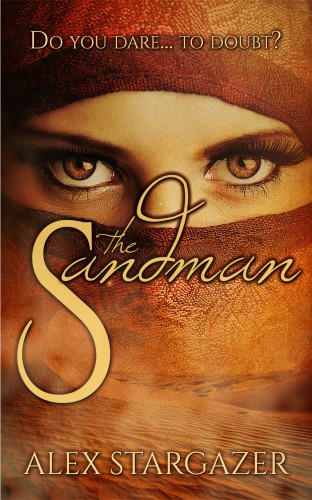
The Sandman by Alex Stargazer
This book sounded so good. I mean, an unconventional heroine, a mysterious entity (the Sandman), the two meeting. It had the trappings of a good bildungsroman. But, the book really disappointed me.
Now this book grew out of a an English GCSE paper. Nothing wrong with that, stories have come from stranger places, and I remember enjoying writing stories during my O Levels. But, this story is just too short.
First, is Leila an unconventional person ("everything a girl like her shouldn't be")? All we have as proof is that she doesn't want to marry an odious man in her village. Name me one girl who will gladly marry a man she doesn't like. This shows nothing about her. After all, did she take any concrete steps to get out of the marriage? No. She just followed the sound of a child's voice and got lost. All we have to know that Leila is unconventional is that the author has told us. Even though this story is short, the character building could have been so much better if Leila started her journey by defying her father rather than just getting lost. She does end by resolving to tell her father that "life was for people. Money was for cowards", but resolve is fine and dandy. Many people resolve to do things. Then they break them. We call these New Year Resolutions. Again, it shows nothing.
Second, is the Sandman the symbol of critical thought? All we have to go is by his own self-description and one statement about Adam and Even (that Adam was afraid of Eve because she knew things he didn't). I'm going to leave aside the theology criticism because the Bible (and I suppose the Q'uran as well) doesn't give us a clear motive. If you're interested, you can read this article.
To me, this isn't enough. I can call myself "the modern day Helen of Troy", but that doesn't mean I'm beautiful. Or, I can call myself "the biggest book blogger" and cite one tiny award I win, but that doesn't mean anything. To put it simply, the Sandman suffers from the same problem as Leila - they are not fully explored.
At the end of the book, the author analyses his own paper and tells you "what to take away from this." This, in my view, is a no-no. Books are meant to inspire questions, not have the authors tell you exactly what they mean. As a former Literature student, I'm pretty sure that my interpretation of any text would have been hampered if the author came out and told me "I wrote this book with this message." In my view, the author should have used the extra pages to build on the story, instead of expounding his message. Curious readers can do the interpretation and analysis for themselves, thank you very much.
To sum, the failing of this book is that it over-reaches itself. As a short story, it might work if the characters were given a bit more character, or the issue explored more fully. But, it tries to do both, and that's where the book fails - it doesn't get the chance to explore anything fully. Add that to an unnecessary analysis, and the book goes from a "short story with potential" to "a story that tries to be deep but comes across as pretentious (at least to me)."
Disclaimer: I received this book from the author through BookBlogging in exchange for a free and honest review.
Now this book grew out of a an English GCSE paper. Nothing wrong with that, stories have come from stranger places, and I remember enjoying writing stories during my O Levels. But, this story is just too short.
First, is Leila an unconventional person ("everything a girl like her shouldn't be")? All we have as proof is that she doesn't want to marry an odious man in her village. Name me one girl who will gladly marry a man she doesn't like. This shows nothing about her. After all, did she take any concrete steps to get out of the marriage? No. She just followed the sound of a child's voice and got lost. All we have to know that Leila is unconventional is that the author has told us. Even though this story is short, the character building could have been so much better if Leila started her journey by defying her father rather than just getting lost. She does end by resolving to tell her father that "life was for people. Money was for cowards", but resolve is fine and dandy. Many people resolve to do things. Then they break them. We call these New Year Resolutions. Again, it shows nothing.
Second, is the Sandman the symbol of critical thought? All we have to go is by his own self-description and one statement about Adam and Even (that Adam was afraid of Eve because she knew things he didn't). I'm going to leave aside the theology criticism because the Bible (and I suppose the Q'uran as well) doesn't give us a clear motive. If you're interested, you can read this article.
To me, this isn't enough. I can call myself "the modern day Helen of Troy", but that doesn't mean I'm beautiful. Or, I can call myself "the biggest book blogger" and cite one tiny award I win, but that doesn't mean anything. To put it simply, the Sandman suffers from the same problem as Leila - they are not fully explored.
At the end of the book, the author analyses his own paper and tells you "what to take away from this." This, in my view, is a no-no. Books are meant to inspire questions, not have the authors tell you exactly what they mean. As a former Literature student, I'm pretty sure that my interpretation of any text would have been hampered if the author came out and told me "I wrote this book with this message." In my view, the author should have used the extra pages to build on the story, instead of expounding his message. Curious readers can do the interpretation and analysis for themselves, thank you very much.
To sum, the failing of this book is that it over-reaches itself. As a short story, it might work if the characters were given a bit more character, or the issue explored more fully. But, it tries to do both, and that's where the book fails - it doesn't get the chance to explore anything fully. Add that to an unnecessary analysis, and the book goes from a "short story with potential" to "a story that tries to be deep but comes across as pretentious (at least to me)."
Disclaimer: I received this book from the author through BookBlogging in exchange for a free and honest review.
Labels:
BookBlogging
,
ebooks
,
fiction
,
western
Friday, August 1, 2014
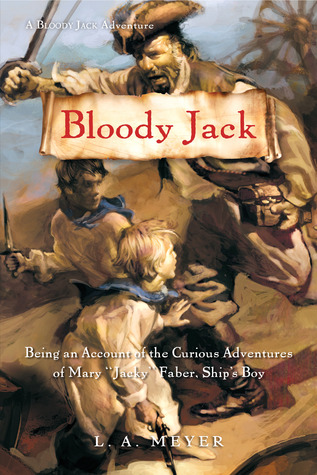
Bloody Jack by L.A. Meyer
I've been seeing this series around Rainbow Plaza for some time, and I've finally worked up the nerve to borrow it (I hesitate to approach series that seem awesome just in case they don't live up to expectations). Thankfully, this book is as good as I hoped!
Bloody Jack is the story of Mary "Jacky" Faber, an orphan girl who, after the death of the leader of the gang she was in, disguises herself as a boy and gets a position as a ship boy on the HMS Dolphin due to her ability to read. Of course, being the only girl in a ship full of men bring a whole set of problems, not least her growing attraction to one of her friends.
I love Jacky's voice in this book. I thought that the manner of talking would grow tiring after a while, but through a clever trick, the author manages to lessen the amount of slang, leaving enough to make the language interesting, but not so much that it gets tiring to read. I really enjoyed the first-person narration in this book, and I think it's a good example for those who want to tell their story in the voice of their protagonist.
To me, Jacky was a perfect protagonist. She's smart, she's sassy, and I particularly liked the way she told Jaimy, the ship boy she liked, that she was a girl. While there is one romance, her relationships with the rest of the boys are just friends, and I enjoyed reading about their friendship (of course, they think she's a boy, so that kind of negates the "girls can be friends with boys" thing in a way).
This story follows the first two years of Jacky's life on a ship. Yup, she goes two years without being discovered, although the way the story is told, you'll hardly notice the time going by until a character makes a reference to their ages or something like that. The plot involves pirates, ship drama, crazy inventions, and lots more. It's chock-full of things to make sure you'll never get bored. And, I didn't feel that it was too rushed, which is another point in its favour.
My only complaint about the book is that the passage of time isn't clearly marked out. I had the impression that Jacky was a 13 year old for most of the book, and was a little shocked at some of the things she did romance-wise (nothing explicit happens, but they almost go there). It was only later, when I realised she was 15, did the things she do start to sound a little more reasonable (although I do think that she's too young for some of that).
What an awesome first book. I have the second book with me right now, and I look forward to reading it!
Labels:
fiction
,
historical
,
western
Subscribe to:
Posts
(
Atom
)